

By S.L. Hansen
For the Register
Joyful voices filled Lincoln’s Blessed Sacrament Church Saturday, Oct. 8, at a Mass honoring St. Daniel Comboni.
St. Comboni was a missionary to Africa who made a significant impact on the region currently known as Sudan and South Sudan.
Justin Mori, the primary organizer of the feast day celebration, said South Sudanese refugees in the U.S. have celebrated the feast of St. Daniel Comboni for over a decade, mostly in Omaha and Des Moines, Iowa.
“This is the first time it’s being celebrated in Lincoln,” he said. “Such celebrations often bring South Sudanese together to relive their faith tradition as it’s celebrated back home.”
Mori arrived in Lincoln as a refugee in early 2000. He became a citizen five years later.
“I was born and grew up during war,” he revealed. “I did not experience peace until my newfound home Lincoln.”
Mary Onnorato, who sang in the choir, arrived in Des Moines six years ago. She said the Sudanese and South Sudanese in the U.S. work together to preserve their culture.
“It’s important to teach the ones born here how we celebrate in Africa,” she said.
They have organized a group called “Catholic Warriors” to help sustain and grow the faith among Sudan/South Sudan refugees in the United States. Onnorato said they hope to take this annual Mass to other communities in the future, such as Chicago or Detroit, so more refugees from Sudan/South Sudan can participate.
At Blessed Sacrament, a large portrait of St. Daniel Comboni was tucked among autumnal floral arrangements in front of the altar. The choir assembled, a keyboardist provided drum and piano accompaniment, and around 100 Sudanese and South Sudanese people greeted each other with wide smiles and clasped hands as the Mass began.
Most of the people in attendance drove to Lincoln from other communities. Around 50 people, including the choir, came from Des Moines.
The main celebrant was Father Ambrose Ladu John Daniel, who was ordained in the Archdiocese of Juba in South Sudan. He is currently parochial vicar and refugee director for the Archdiocese of Des Moines. His concelebrants included two Nigerian priests who are also ministering in Des Moines: Father Emmunel Offeing and Father Ignatius Mako, M.D.M.
In his homily, Father Ambrose said, “It’s an important day for us, Sudanese and South Sudanese. But more importantly, it is an important day for all of Africa.”
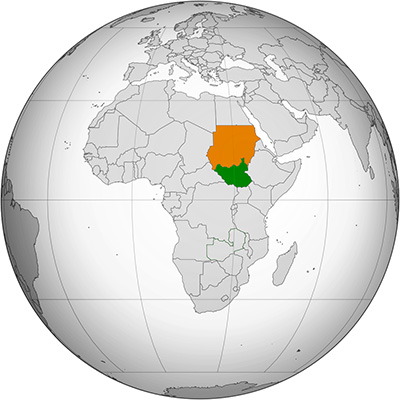 Located in eastern Africa, Sudan became a sovereign country in 1956. Since 2011, Sudan has been split into two nations – Sudan and South Sudan.
During St. Daniel Combani’s life on earth, the two countries were part of Abyssinia (an independent nation) plus southern Egypt and a handful of other smaller countries colonized by the United Kingdom, Italy and France. Understandably, there is a complex joint history, with many different ethnic groups, languages and religions found among the population.
“St. Comboni’s mottos ‘Africa or Death’ and ‘Africa by Africans’ built attachment between him and people of Africa and of Sudan in particular,” Mori said.
“The Church in Africa is a growing Church,” Father Ambrose noted during his homily. “When St. Combani came to Sudan and South Sudan, there was no priest, no sister, no visible Church. But today, if you go back to Sudan and South Sudan, you will be surprised.”
Among Christians in the area, the largest portion today are Catholic, with 2.7 million faithful mainly concentrated in South Sudan. This directly reflects St. Daniel Combani’s work and vision.
Despite the division into two nations, there is one joint Bishops Conference currently comprised of 14 bishops. There is a religious community of men, and there are two convents, including the Combani Missionary Sisters.
“Sisters and brothers, what we celebrate today is not just to thank St. Combani or to honor him, but we are here to promise that the work, the light he left in our country, will continue to shine,” Father Ambrose said. “We are here to renew our faith.”
After Mass, a social event lasted until midnight, featuring traditional food, speeches, games, and dancing to Sudanese music. It was all the comforts of home for refugees who fled war, famine, and homelessness.
“South Sudan has been in war for decades and still unstable to date, dashing all hopes of return to our ancestral land,” Mori reflected.
“Despite all the good life we experience in diaspora, the first generation of South Sudanese [immigrants] still yearn for peace back home and wish to see home when the guns quiet down.”
He asks all people of good will, “Please pray and work hard for peace and stability in South Sudan.”
The mission of St. Daniel Comboni
By S.L. Hansen
For the Register
Born in Italy in 1831, St. Daniel Comboni was intrigued by the descriptions of Central Africa by missionaries who had returned from the region.
After he was ordained, the saint left for Africa as a missionary priest in 1857. Five others accompanied him on the four-month journey to the city of Khartoum. Though shocked by the poverty, disease, unbearable climate of the region, rapidly followed by the deaths of several of his companions, St. Comboni’s devotion to the people of Africa remained undaunted. He adopted the motto, “O Nigrizia, o morte!” – Africa or death.
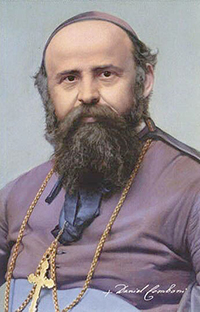
Over the next decades, he spent most of his time in Africa, returning to Italy only to raise funds and recruit more missionaries. In 1864, while praying at the Tomb of St. Peter in Rome, St. Comboni was given the inspiration to create his famous plan for the rebirth of Africa, “Save Africa Through Africa.” In other words, he would trust the Lord to use the hearts, minds and talents of African people to grow the Church.
By 1867, St. Combani had founded the Comboni Missionaries for African men. Five years later, the Comboni Missionary Sisters were established. In July 1877, the saint was named Vicar Apostolic of Central Africa, and ordained bishop a month later.
The next two years brought a drought and famine to central Africa. The local population was diminished by half, and St. Comboni’s missionary personnel was reduced to only a few. Unphased, he used his role as bishop to work against the slave trade while recruiting more missionaries among the African people. He opened schools and hospitals, some of which bear his name to this day.
Finally succumbing to sickness in 1881 – only 50 years old – St. Comboni encouraged the people gathered around him, “I am dying but my work will not die.” His statement proved to be prophetic, as the Church has continued to grow in Sudan and South Sudan.
