

By S.L. Hansen
for the Register
At the end of September, principal organist for Lincoln’s Cathedral of the Risen Christ Dave Schmidt received an award from his alma mater, Mount Marty University (MMU) in Yankton, S.D.
The university’s alumni association grants four awards each year to alumni. Schmidt, class of ’76, received the Distinguished Service to Church and Community in recognition of his 41 years of service to the Cathedral. 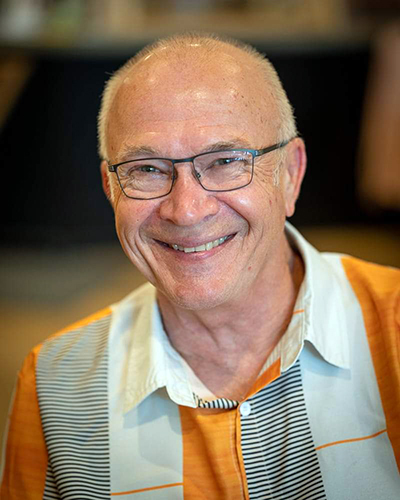
“I have played for 41 deacon/priest ordinations, approximately 1,200 funerals and weddings, over 5,000 weekend services, 31 religious final professions, three new building dedications and Lincoln Diocesan seminary graduations,” he summarized.
This is not the first award Schmidt has received. In 2011, he was honored by Pope Benedict XVI. Based on a recommendation by Bishop Fabian Bruskewitz, Schmidt received the Cross Pro Ecclesia et Pontifice medal, the highest award given to lay people for service to the Church by a pope.
Schmidt’s musical training began with piano lessons in the first grade. While doggedly playing scales and learning to sight-read music, an organ next to his teacher’s piano caught his eye. Eventually, his teacher allowed him to try it. By the eighth grade, Schmidt was playing the organ for church.
Though he did not grow up Catholic, Schmidt chose to attend Mount Marty University, which was about 45 miles away from his hometown. He initially enrolled in the institution’s renowned nursing program.
“I found out after taking all the science classes that nursing was not my thing,” Schmidt admitted.
He changed his major to music, which led to meeting Sister Jane Klimisch, OSB. She not only taught him how to play for Mass, she instructed him about the Mass itself and how music enhances worship.
“You’re raising hearts and minds to God,” explained Schmidt.
He received the sacrament of Confirmation in the Catholic Church on Ash Wednesday 1977.
After graduation, he became the parish music director for St. Mary Catholic Church in Aberdeen, S.D. He stayed until 1980, when a job offer at a national restaurant chain coaxed him to Sioux Falls. There, he was organist for one parish, helped start a parish CCD program at another, and directed a large choir for a city-wide Holy Saturday service.
The restaurant chain moved him to Lincoln, then Hastings, then back to Lincoln. With each new assignment, Schmidt found a place behind church organ consoles. His final move in 1982 gave him opportunity to play for St. Andrew Lutheran Church as well as the Cathedral of the Risen Christ. Eventually, he became the Cathedral’s principal organist and music director. He retired from the restaurant business in 2015 and now has time to serve other parishes in Lincoln as needed.
Though he has played every organ in every Catholic parish in Lincoln and quite a few others, Cathedral’s is his favorite.
“It has a very romantic and cohesive sound,” he said. “That organ is kind of an extension of my heart and soul and ears.”
Largely it’s because he knows what sound each of the stops will produce. An organ’s “stop” is a set of pipes that make a particular sound. The organ console contains as many knobs as stops, which the organist uses to control which pipes are producing sound and which are stopped.
“A flute [stop] on the Cathedral organ sounds completely different than the flute on the Newman Center’s organ or the new St. Michael Parish’s organ,” Schmidt explained. “Some pipes are really loud, some very soft and very kind.”
This is one of the key aspects that make playing an organ quite different from playing a piano. Good pianists can master the organ, but Schmidt said there aren’t as many interested in doing so these days.
“There are organists around, but they are all concert organists,” he lamented.” A lot of churches can’t afford [to hire one].”
His hope is that more pianists will want to learn, because the organ — particularly the pipe organ — is so ideally suited for Mass.
“I’ve thought about this many times,” he mused. “A pipe organ fills the air with sound. You can kind of relate that to the Holy Spirit. You can’t really see it but you know it’s there.”
The faithful who attend Mass at the Cathedral can always count on hearing Schmidt play the organ, except for Saturday vigils, where another organist is at the console. Additionally, there are three other organists who can substitute for him on the rare weekends he is out of town.
Schmidt also volunteers as accompanist for several small schools in the surrounding area and Lincoln Public Schools. He’s worked with the Lincoln Symphony Orchestra when they need an organist, and he volunteers at a local hospital and provides transportation for cancer patients.
Still, the great joy of his week is selecting music for Mass based on the readings and sitting at the Cathedral’s organ, instinctively working the stops and making the music that assists in worship.
“Pretty much whenever there is a service there, I am the organist,” Schmidt said.
