

Guest column by Natalie Bender
Member of the Cathedral of the Risen Christ Parish in Lincoln
Photojournalist intern, Southern Nebraska Register
If you look up #140 Rue du Bac, Paris, on Google Maps, the images of the busy street show so many people, everywhere. But there are not nearly as many people in Google’s images as I passed on a cold Thursday afternoon this spring.
Google Maps said my hotel was a 30-minute walk from my destination, but it felt like I made the trip in 30 seconds; practically running the entire way, I was so excited.
The city of more than 2 million people – larger than the population of Nebraska – was a bit daunting to me. The streets were so narrow, yet the cars were so fast, and they came from every direction, even on one-way streets. They fit into spaces I thought far too small – and then motorcycles squeezed by, too.
The enormous Bon Marche department store looms over one side of the Rue du Bac. Shops and restaurants dot the other side of the tiny street, with more people moving every which way.
The people were friendly, but they seemed unbothered by all the activity and all the noise. I passed several schools on my way, and I was impressed with how the children – going somewhere dressed as knights and princesses that day – knew how to play and run with abandon, yet stay out of the way of the people doing business on the narrow sidewalks.
On a wall on that busy street is a simple opening with a small sign, maybe 15 inches wide. It reads, “Chapelle Notre-Dame de la Médaille Miraculeuse” (The Chapel of Our Lady of the Miraculous Medal). That small, simple sign doesn’t come close to doing justice to the location within – but, I suppose, nothing really could.
As I crossed the threshold of that opening – not an actual door, just an arch in a wall – every sound of the city melted away. I stood in an open-air courtyard of the chapel, and I could see all that bustling activity just feet away, but not a single sound made it past the wall.
The grounds are the property of the convent of the Daughters of Charity of Saint Vincent de Paul, and at the other end of the courtyard is the chapel where the world received the Miraculous Medal.
The saint who told the world about the Miraculous Medal is St. Catherine Labouré.
I can’t remember a time when I didn’t know about St. Catherine Labouré. I always knew my middle name, Catherine, was chosen to honor my mother, my great-grandmother, and St. Catherine Labouré. But I do remember when I learned that the saint I loved so much was incorrupt, and people could still visit her body, as well as the chapel where she received miraculous visions.
At 8 years old, I eagerly told my parents I wanted to go to the Chapel of Our Lady of the Miraculous Medal in Paris to see my patron saint. They gently explained how far away Paris was, but they smiled and said they hoped I’d get to go one day.
A trip to Paris, while always on my bucket list, still didn’t feel likely just a year ago. In fact, it was still a “one day” hope just a few months prior to my visit there. However, at Thanksgiving, my aunt, who’d canceled an earlier trip to Europe due to the pandemic, announced she had rescheduled it. The friend she’d originally hoped would go along was no longer available, and when she asked, somewhat lightly, if anyone else wanted to go, I cheekily said I would. I think my family laughed a little at my long-shot offer, but my aunt called me later and explained how we could actually make it work. And so, less than four months later, there I was, about to enter the chapel I’d wanted to see for so long.
St. Catherine Labouré was born in France in 1806, just a few years before the construction of the very chapel I visited. She lost her mother at only the age of 9 and famously said to the Blessed Virgin Mary, while looking at an image of her, “you will be my mother now.”
She became a member of the Daughters of Charity led by St. Vincent de Paul – whose chapel is just around the corner, and whose heart is in the Chapel of the Miraculous Medal. St. Catherine had a vision of St. Vincent de Paul as a child, which led her to eventually join his order and care for the sick. She had other visions of the saint later in life, which she felt strengthened her for what was to come. She was also summoned one night, in the summer of 1830, to the chapel, where she heard the voice of the Blessed Virgin Mary telling her God would call her to a mission.
That fall – on Nov. 27, 1830 – she got that call from her mother Mary herself.
St. Catherine Labouré had a vision of the Virgin Mary, and Mary’s appearance is well known today because she asked Catherine to have a medal made with her image, so that people throughout the world – and throughout time – could see her as St. Catherine did.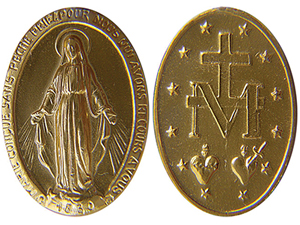
In the Miraculous Medal, Mary stands on a globe, with rays of light emanating from her hands. Mary instructed that these words be inscribed around her image: “O Mary, conceived without sin, pray for us who have recourse to thee.” That was especially striking, as the dogma of the Immaculate Conception – when Mary was conceived without sin – had not yet been officially proclaimed (that came in 1854).
The reverse side of the medal includes the letter M on a cross, surrounded by 12 stars, and the Sacred Heart of Jesus and the Immaculate Heart of Mary. Mary said all who wear the medal with this image would receive “great graces.”
St. Catherine said she asked Mary why some of the rays of light from her hands did not reach the earth. Mary reportedly told her those signify the graces for which people simply have not asked.
St. Catherine reported her vision – and Mary’s request to have the medal made – to her spiritual director. After a time of investigation, the request was presented to the local archbishop, and the medal was made. The medals were made and distributed so smoothly, it is said that in itself was miraculous. But God’s miracles associated with Catherine weren’t limited to that.
St. Catherine died in 1876, and her body was exhumed in 1933. She was found to be incorrupt – miraculously without the usual signs of natural decay. She was beatified by Pope Pius XI later that year, and canonized by Pope Pius XII in 1947.
According to Catholic tradition, incorruptible saints witness to the resurrection of the body. God chooses these holy people to inspire us to be with him in heaven one day. For me, literally seeing my patron saint face to face was an amazing promise fulfilled. While the Eucharistic Lord was also present in the chapel, of course, having the added experience of gazing into the face of the saint I’d so often read about and asked to intercede for me was a personal miracle. She was right there, and I couldn’t look away.
I thought of the noise and activity of the city, and marveled again that I couldn’t hear anything from outside. Kneeling in the chapel, I felt like the distractions of the world fell away and it was overwhelmingly peaceful. I talked at length to my friend, St. Catherine, sharing the good and the bad, and I tried to memorize as many details about her as I could. Most importantly, I saw her folded hands pointed toward Mary, and toward Jesus in the monstrance. I’ve always appreciated our saints’ intercession, but it was a powerful, visual example to me of the reality of prayer.
As a little girl, I pored over the stories of the saints – especially “my” St. Catherine, as I liked to call her. But it is easy to imagine saints as larger than life, and it can be hard to think of them as just regular humans. However, when I knelt in front of St. Catherine and looked into her face, I saw the beauty of her human features, preserved by her holiness. And we shared a moment of humor: I realized my “larger than life” saint was actually quite short!
In a very real and personal way, I got to experience a saint as the human person she was in life – a person, just like you and me. The saints are with God now, but they were like us. Now they are meant to sit by our side through the trials we face, and be shining but real guides for us as we journey to heaven, where hopefully, someday, we’ll be able to embrace them as friends.
St. Catherine’s feast day is celebrated Nov. 28, and is followed soon after by the feast of the Immaculate Conception – Mary conceived without sin – Dec. 8. Even with her feast day, St. Catherine points us toward Mary, who always points us toward Jesus, and is always ready to intercede for us. Like the rays emanating from her hands in the Miraculous Medal, she is just waiting for us to ask.
“O Mary, conceived without sin, pray for us who have recourse to thee.”
