

By Deacon Matthew Hecker, Ph.D.
Born and raised in Saunders County, as a child, Father Julius Tvrdy might not have thought too much about evangelization and serving as a missionary priest in a foreign land.
He was born in 1946 and grew up on a farm near Wahoo in a family of four brothers and four sisters.
“Those were much simpler times,” he said. “Our neighborhood got electricity the year I was born. This was a time of outdoor toilets, wood stoves and no TV or plastic.”
Father Trvdy attended his first three years of school in a rural, one-teacher, one-room school a quarter mile from home.
“In 1956, St. John Nepomucene School (in Weston) opened and my dad and two neighbors made the sacrifice to drive us 8 miles one way to receive a Catholic school education,” he said. “Then, I went to Wahoo Catholic for three years. In my senior year, Bishop Neumann Central High School opened. So, I was in the first graduating class from Bishop Neumann. That was in 1965.”
It was during the years of family life on a farm and attending Catholic schools that Tvrdy was first introduced to the possibility of a religious vocation.
“In the winter of my senior year while reflecting on the words of Psalm 116:12-13, ‘What can I give to the Lord for all the good He has done for me? The cup of salvation I will take up and call on the name of the Lord.’ I heard the specific call of Christ to consider entering the seminary,” he said.
That fall, eight men from the diocese entered the seminary and four of them were Bishop Neumann graduates.
“They sent me out to St. Thomas Seminary in Denver. I was one of 90 freshman that year,” said Trvdy. “Academics were always a challenge for me. But with thanks to God for the grace of faith in being called and with the patience of my professors, I continued.”
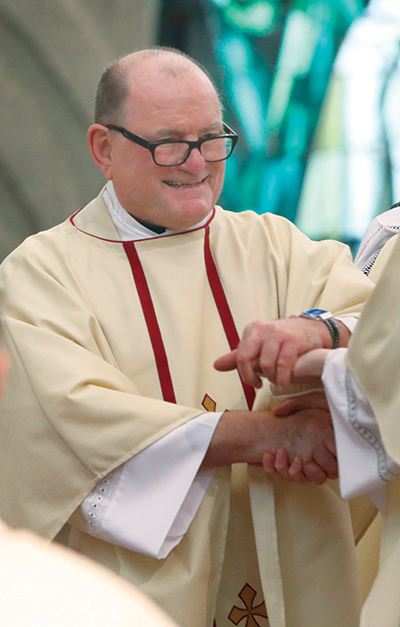
Father Tvrdy said all seminarians have to come to a point in their formation in which they can see themselves as ministering in the name of Christ.
“Working as a volunteer, in the teen and young adult detention centers near Denver, solidified this call for me,” he said. “In 1973, after eight years of formation at St. Thomas, I was ordained by Bishop Flavin.”
Father Tvrdy said the ‘70s were “interesting times for young priests.”
“This was the advent of a new emphasis on adult education,” he explained, “especially in terms of sacramental preparation. Prior to this time their often was little or no preparation for couples preparing for marriage or baptism. I remember meeting with couples who wanted to get married in two weeks. As a Church, we were going through big changes in the area of education and catechesis.”
Father Tvrdy spent his first eight years as an assistant pastor: three at St. Wenceslaus in Wahoo, three at Sacred Heart in Lincoln, and two years St. Michael in Hastings.
“I enjoyed the multicultural makeup of Sacred Heart Parish,” he said. “The school served many of the new Vietnamese and Hispanic immigrants as well as children of foreign students attending UNL’s East Campus. It was this community that sparked an interest in our diocesan mission.”
A few years later, while on retreat, Tvrdy remembered, he decided to discern the possibility of joining the diocesan missionaries working in Barquisimeto, Venezuela.
“The next summer, I spent three weeks with our team in Venezuela,” he said. “After which, I submitted my name to the bishop for consideration.”
In 1983, after two years as pastor of St. Anthony in Steinauer, Bishop Glennon Flavin sent Father Tvrdy to the missions.
“I first studied Spanish in Bolivia for six months before beginning work in our mission,” he said. “After language school, I joined the team of Father Rudy Oborny and Father John Keefe, who had already spent five years forming barrio El Carmen, a community of thousands of Catholic believers, into a parish family.”
When asked what it was like serving at a mission parish, Tvrdy said it was “all of the normal work of a parish priest but with fewer of the resources.”
“In responding to an economic crisis in the parish, and with some financial aid, we started a food co-op in our neighborhood,” he said. “It provided cheaper food and fresh produce within walking distance from their homes. It was a project supported by the volunteer help and money from that same community. They cared for it because it was a product of their own time and investment.”
Father Tvrdy said Father Bill Kalin’s dedication to the people led him to start a school that provided not only education but also two meals a day for the children.
“This barrio was the poorest of the poor,” Father Tvrdy said. “Families combed the city garbage dump collecting rags, paper, metal, which they sold to those who collected recycled materials. I was surprised to learn then, that this neighborhood was one of the safest – the people respected each other’s struggle to survive.
“I think as a missionary I received more than I gave,” he added. “The great faith, hospitality and kindness of the people of El Carmen left a lasting impression on me.”
Returning from Venezuela, Father Tvrdy was appointed as the first full-time director of Hispanic Ministry for the Diocese of Lincoln, working with The Daughters of the Holy Spirit (Hijas Del Espirítu Santo). They were a team of six sisters who came from San Luis Potosi, Mexico to help with recent immigrants.
“They gave our Hispanic community – living in the shadows of our society,” Father Tvrdy said, “a sense of belonging and appreciation. Many were teens and young adult men who missed that family touch that the Sisters provided. They were good teachers and provided a listening ear for many, especially the women.”
He said they used the SINE movement (now Light of the World or Luz del Mundo) as a tool for evangelization and adult faith formation.
“As a team, we worked first in Lincoln, which had a history of Hispanic Ministry. Then with help from the Lincoln community, we reached out to the Crete community. In turn, with the Crete community we reached out to Tecumseh, later to Nebraska City and finally to Hastings – always working with the leaders that had already been at work serving their community,” Tvrdy said.
“Our first years in the Hispanic Ministry were substantially different than today. We often spent time as translators.... The hospitals, schools, police departments and government offices didn’t at that time have bilingual personnel.”
In 2000, Tvrdy returned to Venezuela to work with Father Lyle Johnson.
“Our primary work that year was to prepare the parish to be turned over to the local diocese and bring to a close 25 years of missionary service by our diocese.”
Tvrdy later served for 10 years as the pastor of Sacred Heart Church/St. James Parish in Crete, St. Joseph, Harvard and ministry to the Hispanics in Hastings for five years, and finally, pastor of St. John, Minden for three years.
Trvdy has been retired for two years, but he stays active. Recognizing the need for Spanish speaking priests in Omaha he said, he lives as a retired priest in the rectory of Our Lady of Guadalupe, which is part of a cluster parish of four churches in the heart of South Omaha.
“It reminds me of the missions,” he said. “I celebrate daily Mass with a community, help with confessions, and visit the sick. I am happy to be a part of this community.”
While all Catholics are called to participate in the great commission, not many are called to learn a second language, travel far distances and immerse themselves in an entirely different culture to proclaim the gospel. Commanded by our Lord, to love God and our neighbor, Father Trvdy has spent a lifetime of humble witness showing how it is done.
