

Q. Do priests own their vestments, or do the vestments belong to the parish?
A. I have (rightly) been accused of being an over-explainer throughout my life. In my head, it is me providing context to what I am saying. In reality, it is me answering a bunch of questions nobody asked to finally get to the question that was asked but, by that point, so many other topics have been introduced that the thread of the original question disappears.
I am very aware that I do this. Unfortunately, awareness does not necessarily lead to a change in behavior, so I continue to do this and am about to do it again in answering this question.
If you want to just get to the answer, you have my full permission to skip to the end. I will not be offended.
The word vestments comes from the Latin word meaning clothes. This is an important point because it reflects the historical reality that what we today identify as vestments in the Latin Rite of the Catholic Church come from the simple everyday clothes that were common to Rome and the wider Mediterranean world. It was not until roughly the fourth century that liturgical dress for bishops, priests, and deacons began to become truly distinct from the dress of the laity attending the Mass. As time progressed, the liturgical dress required for the liturgy became more formalized until it became part of the liturgical law of the Church.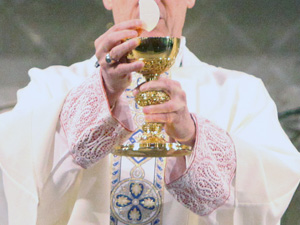
It has become common in the United States to use the word “vestment” to refer to the chasuble, that is, the outward garment worn by bishops and priests at Mass. However, properly speaking, vestments refer to all liturgical garb that is to be worn while celebrating a sacrament. This would include the alb (the long white garment worn by bishops, priests, and deacons as well as acolytes and in some places altar servers); the cincture (the rope-like belt worn around the waist); the amice (a white square cloth that is worn under the alb if the alb itself does not sufficiently cover the common cloths the cleric is wearing); as well as the cassock (the long black robe-like garment); the surplice (the white garment that is worn over the cassock) and the stole (the scarf-like garment that is worn across the neck and hangs down over the chest).
While it might seem like a lot of stuff to wear (which it is), each of these garments has a specific liturgical purpose and symbolism. The alb is meant to signify that the person wearing it has been reborn in baptism. The cincture is meant to represent chastity and, in the case of bishops, priests and transitional deacons, celibacy. The stole represents the mantle of Christ and that the cleric is acting under and with the authority of Christ when celebrating a sacrament. The chasuble represents the “putting on” of Christ by the bishop or priest, signifying that they must decrease and Christ must increase, and it is Christ who is acting through them.
In addition to the symbolism of the vestments themselves, the General Instruction of the Roman Missal also states that the vestments should contribute to the decoration of the sacred action itself (GIRM n. 335). This is the Church’s way of saying they should look dignified and should reflect the sacred action taking place. Christ is acting through the priest and therefore the garments of the priest should reflect the magnitude of what is happening. Vestments should not be opulent, but they should reflect the dignity of a sacred celebration, so as to signal to those present that something special is happening here.
Now, finally turning to the actual question asked, I believe it is common for Latin Rite priests in the United States to own their own alb and at least one or two chasubles, if not one for each liturgical color. Often times chasubles are given as gifts for a priest’s ordination or a special anniversary. Otherwise it is common for priests to buy new albs and chasubles as their older ones wear out.
I would hazard a guess that the majority of parishes in the U.S. would own at least some extra chasubles and albs for the use of visiting priests, or to provide for a priest who may not have his own. There is no hard and fast rule about it though, so it likely depends on the size of the parish.
This question was answered by Father Caleb La Rue, chancellor of the Diocese of Lincoln. Write to Ask the Register using our online form, or write to 3700 Sheridan Blvd., Suite 10, Lincoln NE 68506-6100. All questions are subject to editing. Editors decide which questions to publish. Personal questions cannot be answered. People with such questions are urged to take them to their nearest Catholic priest.
