

Cathedral parishioner a project lead for two routes
By S.L. Hansen
for the Register
Four routes across the U.S. will converge at the National Eucharistic Congress in Indianapolis July 17. Lincoln Diocese events will be June 14-21.
Beginning on the feast of the Pentecost May 19, the Eucharistic Lord will traverse the United States from north, south, east and west for the first time in history.
 This National Eucharistic Pilgrimage (NEP) will end at the National Eucharistic Congress in Indianapolis July 17. Four groups of pilgrims — one group for each route — will converge and process behind Jesus, who will be carried in a monstrance blessed by Pope Francis for Eucharistic adoration, along with tens of thousands of Catholics from across the nation.
The NEP was an idea put forth by Bishop Andrew Cozzens of the Diocese of Crookston, Minn., and the National Eucharist Revival Committee during the early stages of planning. The 60 days of pilgrimage over more than 6,500 miles are anticipated to gain more than 100,000 participants.
Vetted by the USCCB’s national liturgical advisory team, the event will include both solemn and minor processions. Canopies, candles, incense, and bells will be used for solemn processions, while ombrellinos – a more compact, umbrella-like covering – are a more practical covering for the lighter monstrance used for minor processions that cover considerably greater distances.
Another first for the United States will be processions by vehicle, when necessary. Vans will be used on parts of each route. Each van will be specially equipped as a Eucharistic adoration chapel and will include a monstrance, enabling pilgrims to take part in adoration while on the road. The West route will also include travel by boat.
Additional events, such as daily Mass and adoration, will allow for others who cannot walk with the pilgrims to participate. Overnight, the Holy Eucharist will be reposed in a parish or rectory tabernacle, to be consumed at Mass the following morning. A newly consecrated Host will be placed in the monstrance to continue the pilgrimage that day.
Cathedral of the Risen Christ parishioner Maria Benes is one of the organizers. She called the NEP “an unprecedented movement.”
Benes, who is co-founder of the Before Gethsemane Initiative, and her co-founder Chenele Shaw, applied to be route organizers when they heard about the pilgrimage. Benes has taken charge of the West and North routes, while Shaw is overseeing the East and South.
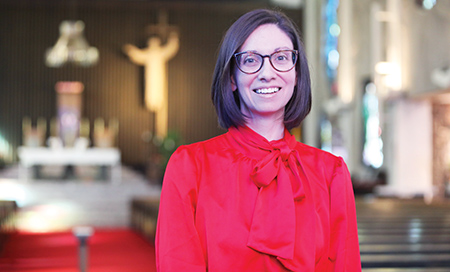
“Eucharistic devotion is my heart,” Benes said. “I love helping with the Eucharistic Revival.”
Each of the four NEP routes has a patron saint, chosen because of special historical significance to the geographical area of that route.
The West route, named for St. Junípero Serra and which includes the Diocese of Lincoln, will feature Eucharistic adoration at Mission Dolores in San Francisco. Mission Dolores was established by the saint during his missionary years. The procession will follow the Sacramento River, which was named for the Blessed Sacrament, and will include stops at marginalized places, such as Folsom Prison.
The North route has the patronage of the Blessed Mother. Several Marian Shrines will be visited, including the National Shrine of Our Lady of Champion in Wisconsin.
From the East, the Seton route — named for St. Elizabeth Ann Seton, founder of the first Catholic schools in the United States — will include major metropolitan areas, including the borough of Manhattan in New York City; Philadelphia; and Baltimore.
The South route is named for St. Juan Diego, to whom Our Lady of Guadalupe appeared in 1531 in Mexico. The South route will begin at the southernmost point in Texas. One stop will be at Corpus Christi, Texas, for Mass. Another stop will be at the Shrine of the Most Blessed Sacrament in Hanceville, Ala. Pilgrims will also visit St. Louis Cathedral in New Orleans, the oldest cathedral in continuous use in the United States. Another stop will be Louisville, Ky.
Benes said the general routes are finalized, but she and Shaw are working to map out exact walking trails or highways with wide shoulders on which the Holy Eucharist can be safely carried.
The pair are relying heavily on local parish contacts and local authorities as they plan. Parish contacts provide updates about closed roads, construction and other issues, while government officials help identify the safest roads. When there is no safe way to travel on foot, the pilgrimage will continue by vehicle.
Benes estimates that the average amount of walking will be about 10 miles per day. “The Serra Route going through Nebraska has the most driving because it is by far the longest route in terms of distance,” she said, “so their average walking distance is more like 5 to 8 miles a day… Adaptability is an important part of all this!”
Each route will be walked by what Benes calls the “Perpetual Pilgrims.” These young adults, aged 19-29, will accompany our Eucharistic Lord from start to finish. While en route, the Perpetual Pilgrims will be hosted and fed by local families, retreat centers, seminaries, monasteries, convents, diocesan staff – anyone who volunteers.
“We rely on the generosity of each local community that we visit, and we have been humbled by the response thus far,” Benes said.
Volunteers are also needed to provide the Pilgrims with water stations and snacks along long walking routes, especially on hot days. (Local faithful who join in are asked to provide their own food and water.)
People are encouraged to attend any event they choose on any of the routes. One can find all the details and learn how to register to attend events at www.eucharisticpilgrimage.org, with the understanding that more events are to be added as details are confirmed. All members of the public who join segments of the NEP are responsible for their own transportation, food and lodging. Also, Benes noted that some parts of the pilgrimage are not open to the public due to safety concerns, the distance required for the pilgrims, and necessary driving segments.
Those who cannot attend are encouraged to make their own prayerful pilgrimage as time allows. Hints are available at www.eucharisticpilgrimage.org/plan-your-own-pilgrimage.
“I can’t wait to see our Eucharistic Jesus unify our country as He spiritually and physically travels across the United States,” Benes said.
Despite the many divisive issues in the world, she believes this Eucharistic pilgrimage will bring people together, “because He is the source of all that is true, beautiful and good.”
