

By Dennis Kellogg
Director of Communications
Two Creighton University professors have spent several years researching the relationship between Catholic theology and sports.
From the joy of a buzzer-beating shot to win the game, to the agony of experiencing a last-second loss or season-ending injury, they shared their insights from a Catholic perspective, in both a popular college class and a book on the subject.
Dr. J.J. Carney and Dr. Max Engel teach a course at Creighton on sport and spirituality. Two years ago, they joined with a colleague in Alberta, Canada, Dr. Matt Hoven, to write and publish a book on the intersection of faith and sports. “On the 8th Day: A Catholic Theology of Sport” was written for both sports fans and academic students, such as those who take their class.
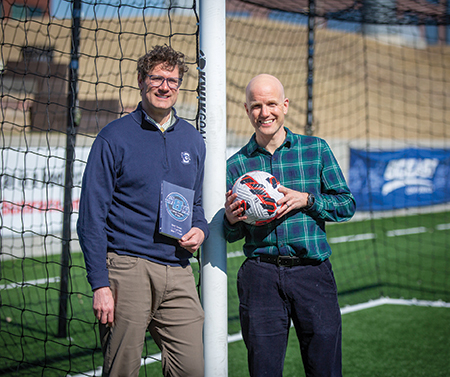
“I think, almost universally, (the students) don’t necessarily immediately connect sport and spirituality and religion,” Carney said. “So part of our goal with both the class and the book is to help students to start to see some of the connections between those two worlds, where the students can really make sense of that within their own experience.”
Engel said their research shows sports are important in our culture and offer a rich potential to evangelize.
“A lot of the suffering and loss in sports is an opportunity to encounter Jesus through the paschal mystery,” Engel said. “It’s getting students to look more deeply at their sports experience and seeing and recognizing what’s been there all along -- what they haven’t noticed -- whether it’s grace, paschal mystery, the communal relationships are deeply Trinitarian, the sacrificial nature that they’re called to give of themselves for the team and inviting them to see how that correlates with Jesus’ message in their everyday lives.”
The professors, who are both sports fans themselves, said they want students to begin to recognize areas in which sports and faith overlap. Examples could be a baseball player making the sign of the cross before stepping into the batter’s box, or an athlete giving glory to God in a postgame interview. Carney and Engel want the students to understand the difference between rituals such as prayer and pre-performance routines or even superstitions seen at times from athletes.
“We like to discuss ritual and prayer as more of a communion with God, more of building a relationship, and I think in the world of sport that can allow you to flourish, to be your best self,” Carney said. “That’s different than saying, ‘I’m going to pray this way and God will make sure that field goal goes through.’”
“(We) ask (students) to get into the motivation of themselves, their peers; kind of identify how they would operate, given their relationship with the living God, what’s appropriate for them – not so much judging others, but being able to articulate for themselves the practices they employ and what it means for them,” Engel added.
One of the discussions Carney and Engel engage in with students is the often-heard comparison of sports programs such as University of Nebraska Husker football or Creighton basketball to a kind of “religion.” Carney said the analogy doesn’t really work.
“I think at a deeper level, religion is more than just whatever is important to me,” Carney said. “It’s also about giving people a worldview and giving them a deeper set of values. It’s about connecting with a transcendent God who’s real to us and around the world. It’s about deeper traditions that have been handed down to us.”
Carney said sports might be closer to an idol than a religion. He said it’s a good thing, but like all idols, it becomes a problem when you try to elevate it to something it’s not meant to be. Engel said that can be especially detrimental when athletes are worshipped as gods, giving them a warped sense of entitlement and worth.
“That’s not just for prominent athletes. We see this in youth athletes and high school athletes,” Engel said. “When their center of meaning and value as a 14-year-old is contingent on their ability to put a leather ball through a hoop, or to throw an oblong football down the field, when those dreams don’t come true or something endangers that – an injury, or they don’t grow as expected – that’s really detrimental to their growth, to their formation.”
The Catholic Church has taken an interest in sports for many years. Pope John Paul II was an avid athlete who issued more than 100 discourses on sport. Carney said Pope Francis has broadened the focus on sports. One of the Vatican dicasteries has a particular focus on sport. This summer, Creighton University will host an invitation-only Sport at the Service of Humanity Conference, which is part of a Vatican initiative started in 2016. It is designed to bring together “faith leaders, sports and athletic pioneers, and academic experts to explore how to combine the passion of sport and values of faith to build a better world.” This marks the fifth time the event will be held in the United States.
Engel and Carney both said one of the most satisfying aspects of their research on sport and the Catholic faith comes from the reaction of the students who start to see the connection and then learn from it.
“Seeing other people go, ‘Oh, I see what you’re talking about. That makes sense to me. I didn’t realize what community has to do with God’s love for us. I didn’t realize what sacrifice for the team had to do with Jesus’ sacrifice for us. I didn’t realize what the life, death and resurrection of Jesus had to do with my season-ending injury when I was in high school.’ Seeing that growth has been very gratifying,” Engel said.
Likewise, Carney points to the students’ recognition of suffering in sport as one takeaway of importance for him.
“We worship a crucified Messiah. The message of the cross is that God doesn’t save us from suffering. God doesn’t save us from death, but redemption comes through that,” Carney said. “For me, the moving stories in class with students around injuries, around cuts, around just some of the pain they’ve dealt with in sport, but also helping them to see a spiritual path forward out of that. To see that just because you didn’t win the championship didn’t mean God wasn’t in that, and sometimes that God is actually in it more when you’ve suffered.”
Engel and Carney said they’ve had success in getting students to think more deeply about the link between the Catholic faith and sports. It’s a connection that may not be obvious at first, but upon further study and reflection, can result in deep insights about the students’ own life experiences.
“Sports are an easy entrée to then… bring into the conversation theology and their experience with sports.”
