

Holy Thursday homily
March 28, 2024
Cathedral of the Risen Christ, Lincoln
By Father Benjamin Holdren
St Gregory the Great Seminary
Bishop Conley & Msgr. Fucinaro, thanks for allowing me the joy of preaching this year, as we celebrate one of the holiest solemnities of the year, the Evening Mass of the Lord’s Supper, the fulfillment of Passover.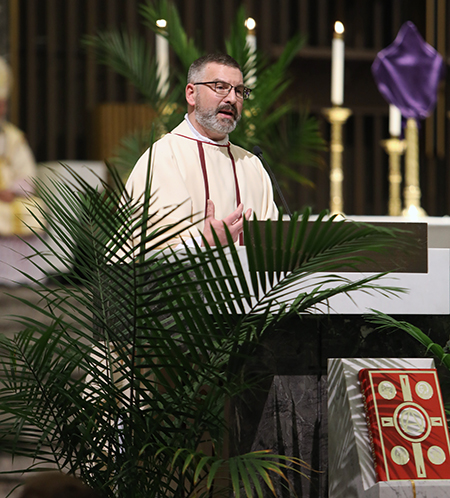
It is a Feast of love. And not just sentimental feeling, although we find that too, but more deeply, true love. We hear in the Gospel this evening, The Son of God loved His own in the world…and He loved them to the end
On this night, 2,000 years ago, Jesus knew that His Passion and Death had arrived. The hour had come to pass from this world to our heavenly Father
We reflect on Jesus, rising from the Last Supper, and tying a towel around his waist, the Son of God kneels down with a basin of water, and humbly, one by one, takes hold of the Apostles road-worn feet, and begins to wash.
As our Lord kneels before Peter, we witness his outburst, Lord, you will never wash my feet! Lord, you are not my slave! Do you not see how unworthy I am?? Do you not see my sins??
This evening, Jesus kneels before each one of us, taking our feet in His sacred hands, our feet, the symbol of the filth and repugnance of our sins. We join Peter in asking, “Lord, what are you doing?! My God, please stand up…do you not see who I am?”
But Jesus does see exactly who we are… and He loves.
St. Augustine teaches: Jesus’ whole life and mission can be seen through this symbolic act. The foot washing is a symbol of the kenosis, the self-emptying, of Christ’s Incarnation and Death. The foot washing is a symbol of the self-emptying humble love of our God.
St. Paul writes: Jesus, who, though he was in the form of God, did not regard equality with God something to be grasped. Rather, He emptied himself, taking the form of a slave. In this act of self-emptying, we begin to see clearly who Jesus is, and what He has come to do. Jesus lays aside the garments of His glory as God, and our God does for us the slave’s service of washing us clean.
His whole life and mission can be seen through this lens: In the Incarnation, God empties Himself of glory, coming in human likeness.
The Birth of Jesus: Our God-man born into the filth of a stable among the stench of animals, in unexplainable Mercy, entering into humanity’s suffering & selfishness;
The Baptism of Jesus: God, the perfection of all beauty, goodness, and truth plunging into the dirty water of the Jordan River, into our greatest sins and brokenness, to purify, to restore, to heal;
The Agony in the Garden: Jesus taking onto Himself the full weight of our sins, begging fallen humanity to watch and pray with Him. And when He finds fallen humanity too broken to respond, He loves anyway.
We encounter the most profound of love stories and the Son of God loved His own in the world… and He loved them to the end. To death…even to death on a cross.
And we hear Jesus say, Unless I wash you, you will have no inheritance with me. Peter, you will never be OK if Jesus doesn’t wash you. What causes us to push away from Jesus in those moments when our sinfulness weighs us down? Each of us needs Jesus to wash us and He has come precisely to enter into those places: our shame, our darkness, our brokenness. When we’re honest, we realize a hundred times a day we need our feet washed.
This is the startling beauty of the Gospel. Jesus sees us. He takes our feet in His hands, and mercifully, lovingly, He purifies and frees us. Jesus says to each of us, Allow me to make you clean all over, for if I wash you, you will be clean.
Jesus teaches us: If I, the master and teacher, If I who am God, have washed your feet, you ought to wash one another’s feet. I have given you a model to follow. As I have done for you, you should also do. In this symbolic act, we also are given the meaning of our lives, we are called to empty ourselves for others as well. As we receive, we are to give. We don’t want to be like ungrateful servants, having been forgiven a great debt, failing to forgive others their much smaller ones. 'As I have done for you, you should do for others.'
Who are the people in our lives we need to forgive? Who are the ones we need to love? Whose feet do we need to hold and wash? As we think of them, we realize how difficult it is to empty ourselves, for humble love like this, we need supernatural transformation and strength…. Which is precisely what happens each time we receive our Lord in the Eucharist.
Pope Benedict: “We learn what celebrating the Eucharist properly means: it is an encounter with the Lord, who strips himself of his divine glory for our sake, allows himself to be humiliated to the point of death on the Cross and thus gives himself to each one of us.”
In the Eucharist, we are made one with our Servant God, receiving the humble purifying love of His Divine Mercy... We are strengthened by Him. United to His Sacred Heart, our love is able to become truly humble, self-emptying, able to bring His Divine Mercy to those He entrusts to us, especially the poor… the poor like us.
As we prepare ourselves to receive Jesus Christ, our Lamb of God, in the Eucharist, to be loved and to become love, we turn to our Savior in prayer: From Psalm 65: To you all flesh will come with its burden of sin. Too heavy for us, our offenses, but you wipe them away.
Jesus, we give you praise that you are Self-Emptying Humble Love. Thank you for seeing us…and entering so deeply into our suffering, brokenness, and sinfulness. Thank you for never failing to wash us each time we come to you. This night, fill our hearts with profound gratitude as we are united to you in your Eucharist, strengthen us in this Feast of Divine Love,
Jesus, may we become what we receive.
