

Emmaus Institute welcomes vice president of academics
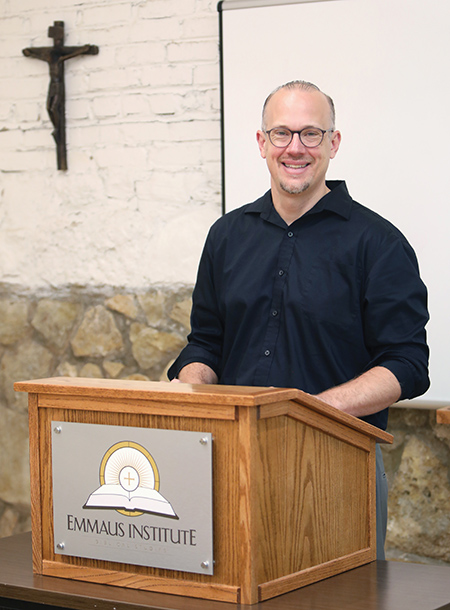
Dr. John Kincaid has been named Vice President of Academics for the Emmaus Institute for Biblical Studies in the Catholic Diocese of Lincoln. Dr. Kincaid has an impressive résumé of work as a Catholic theologian and has teamed with Dr. Brant Pitre, Fr. John Riccardo, and others on national projects.
Dennis Kellogg, director of communications for the Diocese of Lincoln, talked with Dr. Kincaid recently about how his passion for Scripture developed, his role with the Emmaus Institute, and his upcoming keynote address at the Emmaus Institute’s Bellarmine Banquet Sept. 22. What follows is an edited transcript of the interview.
Dennis Kellogg, Southern Nebraska Register: Early in your life, you had a passion for baseball. How did that shift to a passion for Scripture?
Dr. John Kincaid, Emmaus Institute: Growing up in Pittsburgh, I was raised in an evangelical Protestant home, and our faith was important to us, especially in my early years. But as I got older, another love of my life emerged, and that was baseball. In my teenage years, baseball became more important than God, and that was to my own detriment.
As time went on, and I played both in high school and in college, things began to shift in my life, and in college I had a profound reversion to my childhood evangelical faith. It was then that Jesus of Nazareth became the most important person in my life, and as a result, I wanted to know Jesus more, in particular, through the pages of Sacred Scripture. I decided to stop playing baseball and transfer to a school outside of my hometown of Pittsburgh called Geneva College. …After my time as an undergraduate, I went on to study at Covenant Theological Seminary in St. Louis, the denominational seminary of the Presbyterian Church in America.
While at Covenant, I began to ask some questions about the history of theology, about biblical interpretation before the Reformation, and about the nature of the Church. After my time at Covenant, I pursued a second master’s degree at Duke University, and it was during my time studying at Duke that my wife and I were received into the Catholic Church.
It was in becoming Catholic that my love for Scripture deepened in a whole new way. Reading the Bible out of the heart of the Church enabled me to integrate the various pieces of biblical interpretation in a manner that I had been seeking.
SNR: In looking at some of where you put your focus in your writings and in your career, it seems like one place has been looking at the Catholic faith through the writings of Saint Paul. Why that emphasis in particular and what is unique or different about viewing our faith through Saint Paul?
Dr. Kincaid: My love for Paul has been present since my reversion to the Christian faith. Through spending many years studying his letters, my love for him has only grown, for Paul’s theology is foundational to the Catholic faith.
For instance, the idea that the Church is the body of Christ. This comes from Paul, especially from Romans and 1 Corinthians, but as well from Ephesians and Colossians. There are other topics such as grace, faith, and being adopted sons and daughters of God that are central in Paul’s letters and have shaped Catholic identity and theology for nearly 2,000 years. In fact, I would suggest that it is nearly impossible to imagine our Catholic faith without Paul’s influence. Therefore, we should view Paul as a friend, somebody we turn to in order to help us fall more in love with Jesus, for Paul was a Christ-consumed man, and is an ally in our task of imitating Christ.
SNR: Scripture study for the average Catholic in the pew can seem overwhelming at times, if someone’s just looking to get started. What would your advice be to someone who really wanted to dive into Scripture and learn more about it?
Dr. Kincaid: There are multiple starting points. It can be as simple as beginning to read the Scriptures. You could begin with the Gospels, for instance, seeking to encounter Jesus of Nazareth.
Yet it is important to learn how to read Scripture well, which is complicated by the fact that it is a remarkably diverse and complex book that is not always easy to understand, particularly if you don’t understand the context of a specific passage. Fortunately, the Church offers us great resources to help us to read the Bible well. A good preliminary resource is the Catechism of the Catholic Church, especially its section on Scripture. It lays out various principles for interpretation that help guide us along the path of becoming good and attentive readers of Scripture.
... Additionally, at the risk of a shameless plug, the Emmaus Institute right here in Lincoln exists to help Catholics learn to read the Bible well. ... To be able to hear God’s voice in Scripture requires a certain training and formation, a kind of apprenticeship, so that we hear His voice through the pages of Sacred Scripture rather than our own voice. We come to the Bible to hear what God is saying through human authors.
SNR: You’re joining a talented staff at the Emmaus Institute. What do you think you will bring to that staff, and what’s the potential for the Emmaus Institute?
Dr. Kincaid: Well, I hope to be able to bring to the Emmaus Institute a number of things. First, my love and passion for the Apostle Paul. For instance, teaching classes on Paul and offering those classes to the wider community is something I’m very excited to be able to do at Emmaus.
I’m also eager to work with our fantastic faculty to continue to develop our curriculum in a manner that is able to serve the Church more fully, both in Lincoln and beyond. To be sure, Emmaus exists to serve the Diocese of Lincoln. But we also want to make our resources more accessible to the wider Church, and I am eager to help Emmaus accomplish this goal in the coming years.
SNR: You are going to be the keynote speaker for the Emmaus Institute Bellarmine Banquet coming up Sept. 22 in Lincoln. Can you share with us a bit about your talk?
Dr. Kincaid: The subject of my talk will be the Emmaus Institute’s purpose and vision and why I think the mission of Emmaus is critically important.
The talk will also look toward the future, that is, what needs to happen in the coming years for an ongoing renewal of the Church by developing a deeper knowledge and love of the Scriptures. As Pope Benedict said, this will require the work of an entire generation. Toward that end, the overarching goal of my talk will be to chart a vision for pursuing that work, not only in our current generation, but for the generations stretching out in front of us. In other words, the talk will be about the past, the present, and the future of the Emmaus Institute and the foundational place of the Scriptures as the written Word of God in the life of the Church.
If interested in the Emmaus Institute’s Bellarmine Banquet Sept. 22 at the Wilderness Ridge Country Club in Lincoln, find more information and purchase tickets at emmausinstitute.net.
