

Cathedral woman named Director of Pilgrimages with the National Eucharistic Congress
Dr. Maria Benes, Ph.D., is a member of the Cathedral of the Risen Christ Parish in Lincoln, and a co-founder of the Before Gethsemane Initiative. She was a key organizer of the 2024 National Eucharistic Pilgrimage, and responsible for the Marian and the St. Junípero Serra routes. Deeply devoted to the Eucharist, Benes describes Eucharistic devotion as central to her faith.
Corbin Hubbell, social media coordinator for the Catholic Diocese of Lincoln, sat down with Benes to discuss her commitment to fostering unity and deepening Eucharistic faith within the Catholic community across the United States. What follows is an edited transcript of that interview.
Corbin Hubbell, Southern Nebraska Register: I want to talk a little bit about how you got involved with this National Eucharistic Pilgrimage. How were you selected to help organize not one, but two of these national routes?
Maria Benes: Through our work with the Before Gethsemane Initiative, (my colleague) Chanel Shaw and I have made a lot of connections, and great friends, at the national level. And one of our friends, who was the founder of FemCatholic, Sam Pavlok, told Chanel they were looking for these project leads. Chanel applied and said, “Maria, they need another one. You want to work together on a second job?” And obviously I love working with her, and I applied.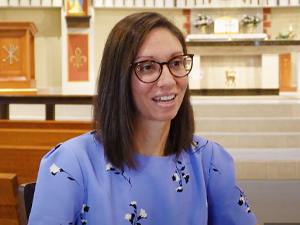
…The Eucharist has been such a huge part of my faith story. St. Clare of Assisi was my Confirmation saint, and I know many people are familiar with her story of the soldiers holding up the monstrance and protecting the convent, knowing that our Lord and the Blessed Sacrament was going to keep them all safe. And so it just seemed like a great fit.
I know they were also looking for individuals with experience talking to different groups of people. And both Chanel and I, through our work with the Before Gethsemane Initiative, and my work with (teaching political science at a university), being a Focus missionary; we both had quite a lot of experience talking to different groups of people.
SNR: I’m sure you had challenges, or difficulties, or bumps in the road. Can you tell us a little bit about how you might have overcome some of those challenges?
Benes: I learned very early on that Jesus was the architect behind this, or it would have never happened. Tim Glemkowski, the CEO of the National Eucharistic Congress, often (said) this almost didn’t happen, the National Eucharistic Pilgrimage. They tried asking several groups to do this, and it was thought impossible. And to be honest, I think even our pilgrimage team would say it would have been impossible without Jesus behind it.
One of my favorite stories to tell is when I got to San Francisco at the beginning, in May. I arrived a few days before we’re about to cross the Golden Gate Bridge with Jesus, and I go to the Chancery and the team there starts by saying, “we have a huge problem” – not something you want to hear right before you’re about to start this major thing.... We’re so thankful for all the authorities and their help around the country, but in this case, at the last minute, there was a change from the authorities that we had to be off the bridge by 3 p.m. instead of 6 p.m. And then on top of it… we had 975 people register, and then over 4,000 showed up. We had to somehow get 4,000 people off the Golden Gate Bridge from this Eucharistic procession in an hour!
And thanks be to God, we don’t know how we did it, but we got the front of the line off in time. (There were) still people trickling behind, but the authorities were happy, and it all worked out beautifully. (To this day, I still hear) stories of how that procession impacted people around the country and the world, actually.
Then, obviously, there were challenges throughout the two months. Our perpetual pilgrims were rock stars. Those young adults are seriously heroic. Could not have done it without each and every one of them.
SNR: I’m curious how this pilgrimage and how this Congress has impacted your devotion to our Lord in the Eucharist.
Benes: I was a cradle Catholic, and so obviously, grew up believing in the Eucharist, but there’s something to be said for doing something on this scale, and really letting our Eucharistic Lord lead. I’ve done a lot of amazing things in my career, which I’m thankful for, but this is the first time that it’s been something that it is completely centered on the Blessed Sacrament and Him leading the way. In fact, in many of the pictures and videos, the priests carrying the monstrance, you can’t even see the priest’s face. It is Jesus, the center and the focus. So that itself has been just so beautiful to really let Him lead and be receptive to the Holy Spirit.
The final thing I would say is, when I was teaching at the University of Nebraska-Lincoln, one semester, I taught a class that was for honors program students… and there were several US professors teaching different sections. It was a life skills class, in a way, and one of the weeks, the theme was religion, and personal beliefs and values. One of the questions I asked my students was, “Are there values or people you would die for?”
I think I had about 90 students that semester, and I would say only about half of them actually had someone or a value they would die for. A lot of them were like, ‘you know, I really believe this, or really love this person, but not enough to die for them.’ And it was a really interesting thing for me to reflect on.
I have thought about that a lot lately, when I go up to receive the Eucharist at Mass, that I would die for Jesus in the Blessed Sacrament. Our world is so hungry for someone to die for. Jesus died for us, and now we can give our lives to Him by carrying our crosses daily. So that’s just something I’ve thought about a lot through this whole process of being involved with the Eucharistic pilgrimage.
SNR: Looking forward, I know that the next Eucharistic Congress is in 2033, nine years from now. So looking at the long-term vision until then, what now? What’s the plan?
Benes: That’s the important question, right? And I will say some fun news. It’s likely there will be a Eucharistic Congress before then, because the reception has just been overwhelmingly positive. Not sure when yet, but it’s likely we won’t have to wait nine years, fortunately. But as they talked about at the end of the Congress, we are now called to go. The message does not just stay with us. The idea is that those 60,000 people throughout those five days that came in and out of Lucas Oil Stadium are now commissioned to go forth and share this message with others.
The National Eucharistic revival has started a campaign, “Walk with One,” and that’s for everybody! I know not everybody was able to attend the Congress. If you weren’t, many of the keynotes and even some of the breakout sessions are all online. I especially recommend watching the Masses and the Eucharistic adorations. Gosh, praying with 60,000 people in a stadium, whether it’s in your house or if you were there, it was just one of the most impactful moments for me.
But we’re all called to go and walk with that one person that Jesus is calling us to in a very natural way. … Look who’s already in your circle and continue to form relationships with them, and over time, invite them into a relationship with Jesus, and God does amazing things when we do that.
+ + +
After this interview, Maria Benes was promoted to be Director of Pilgrimages with the National Eucharistic Congress.
“I will coordinate next summer’s Eucharistic pilgrimage from Indianapolis to Los Angeles and then the hope is to have one Eucharistic pilgrimage every year,” she said. “I have big shoes to fill, following Will Peterson, but I am excited to keep the mission going!”
Watch the full interview on YouTube @CatholicDioceseofLincoln.
