

Southern Nebraska Register
A choir concert will be held Sunday, Nov. 17, at 7:30 p.m. in the Cathedral of the Risen Christ in Lincoln.
The event, the second in the “Give Glory to God” concert series, will benefit the restoration and maintenance of the Cathedral organ.
The impressive organ, comprised of more than 2,800 pipes, ranging from under a foot tall to stories high, resides behind the screen of the sanctuary in the Cathedral. While the Cathedral hosts the diocese’s largest liturgies, the organ is hidden from view, so most people never even see the pipes that produce much of the church’s beautiful music.
Diocesan archivist Sister Loretta Gosen, C.PP.S., wrote about the organ in “History of the Catholic Church in the Diocese of Lincoln, Nebraska (Volume I).” She said it was a Casavant Freres model made in Quebec, Canada. Myron Roberts, professor of organ at the University of Nebraska-Lincoln, was the consultant in the building of the 51-rank pipe organ.
“When all the parts of the massive organ were completed in Quebec, the precious cargo was carefully loaded into a huge moving van bound for Lincoln. Everything went well for more than 1,500 miles of the long trip,” Sr. Loretta wrote.
“Then, when the driver was only a few miles from the cathedral, he was stopped by a patrolman who charged him with driving a truck with excessive weight.”
She said Dorothy Maher, the postmistress in Greenwood, recalled that the incident occurred in front of the post office.
“Since the driver had been instructed not to leave the valuable cargo unattended,” she wrote, “Dorothy called a trucking company in Lincoln to request a truck to help transport the material for the last few miles of the trip.”
The pipe organ was successfully delivered and installed, and has now been in the Cathedral since before the first Mass and dedication in 1965.
Pipe organs have been included in Catholic liturgy for hundreds of years. When blessing a new organ in Germany in 2006, Pope Benedict XVI said, “In the Constitution on Sacred Liturgy of the Second Vatican Council (Sacrosanctum Concilium), it is emphasized that the “combination of sacred music and words … forms a necessary or integral part of the solemn liturgy” (No. 112).
“This means that music and song are more than an embellishment of worship; they are themselves part of the liturgical action. Solemn sacred music… is not therefore a kind of addition that frames the liturgy and makes it more pleasing, but an important means of active participation in worship,” he said.
“The manifold possibilities of the organ in some way remind us of the immensity and the magnificence of God.”
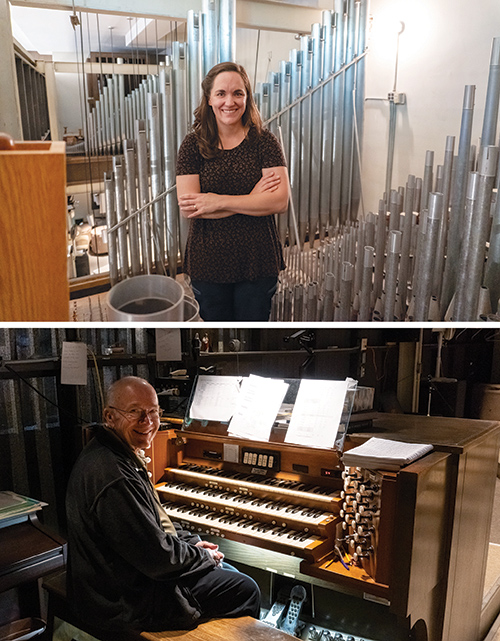
Dave Schmidt, Cathedral’s music director and main organist, said pipe organs “are living things.”
“Although made of metal and wood, the sound is produced by the same air that we breathe. It fills the air around us, much like the Holy Spirit—we can’t see it, but it surrounds us.”
It takes quite a bit of time and skill to play an organ proficiently. Schmidt said playing the Cathedral organ “feels like an extension of my own mind and heart.”
“Of the over 2,800 individual pipes, I know the sound of each one, which ones are out of tune, and which don’t work as they should,” he said.
Just as humans sometimes need joints replaced or pacemakers implanted to keep the body working, he explained, organs need repairs and replacements. After close to 60 years in the Cathedral, the pipe organ is in need of repairs.
Without an official estimate, the cost for repairs is expected to be $20,000 or more. The organ itself, however, is valued at several million dollars, which means the repairs are well worth the cost to avoid a full replacement down the road. The organ will last the lifetime of the parish if it’s maintained appropriately.
While the Nov. 17 concert is free and open to the public, donations will be collected at the concert to go toward maintenance of the organ.
Amy Flamminio, Cathedral’s choir director, is looking forward to the Nov. 17 concert. She said the repertoire will include Mozart’s “Coronation Mass,” John Ireland’s “Te Deum in F,” Xavier Dotras’ “Salve Regina Pacis,” and the premier of John Kosch’s “Bread of Angels.”
The singers will be joined by the Plymouth Brass and other orchestra instrumentalists, as well as the organ. Flamminio said she loves to direct pieces in which the voices and organ interweave.
Tenors and basses are still needed for the concert choir; sopranos and altos can join a waiting list. Those interested may visit bit.ly/giveglorychoir24 for rehearsal details and to register.
Participants will rehearse Saturday, Nov. 16, from 9 a.m. to 4:30 p.m. and Sunday, Nov. 17, at 1 p.m. until the concert. Singers will be on their own for lunch on Saturday, but a catered dinner will be provided for the choir before the Sunday concert. Music and recordings will be available ahead of time so that participants may learn their parts as much as possible before the Nov. 16 rehearsal. Questions can be directed to Amy Flamminio at This email address is being protected from spambots. You need JavaScript enabled to view it..
