

Dr. Arthur Grinstead is a family physician with an emphasis on women’s health who practices at Holy Family Medical Associates in Lincoln. He also serves as the president of the Lincoln Guild of the Catholic Medical Association.
Dennis Kellogg, Director of Communications for the Catholic Diocese of Lincoln, recently interviewed Dr. Grinstead. The interview comes as citizens are involved in early voting for Nebraska’s upcoming election. The ballot includes Initiative 439, a pro-abortion measure that, if passed, would enshrine abortion through all nine months of pregnancy, force taxpayers to fund abortion, threaten common-sense health and safety regulations and remove parental rights. All three Nebraska bishops have urged citizens to vote AGAINST Initiative 439. They have also encouraged citizens to vote FOR Initiative 434, which would keep in place the state’s current law restricting abortion in the second and third trimesters. In the interview, Dr. Grinstead responded to common myths surrounding abortion.
Myth:
We do not really know when life begins.
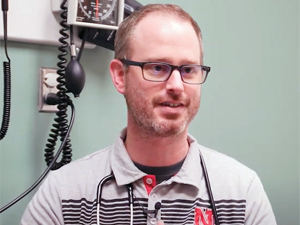 Dr. Grinstead: Like so many of these arguments, it’s just rooted in the mis-wording of true facts. Any physician who’s been to medical school went through embryology, and so they know, and we have known for quite some time now, when life begins and it begins at conception. Any of my colleagues who I’ve had this debate with, they can’t say, “Oh no, it doesn’t.” Because we know it does.
I was fortunate enough to train at the Pope Paul Institute. It’s just amazing to see how many things can be done to help support these lives from their earliest age. So it’s just all about trying to dispel those myths and educate patients as well, because many of them have spent their whole lives being told these same things from other doctors. So I try and educate my patients and help guide them down the path of truth.
Myth:
A baby isn’t viable unless it requires absolutely no medical attention after birth.
Dr. Grinstead: We use these words and they twist them. What does that mean? Viability? My 1-year-old daughter isn’t technically viable. If I leave her on her own with nothing, she is not going to survive. And you can make the same argument for somebody who got in a car accident and has to be intubated for a short time. They’re not viable.
When you start using language like that, it becomes such a slippery slope. Yes, (for an unborn child), depending on their stage, some might survive longer outside the womb than not, but all of them, whether they are 40 weeks or 20, are going to require some intervention after delivery by the parents, by a provider.
It’s amazing how far technology and medicine have come to the point now where we had a 21-week (baby) recently that survived, and it’s just truly amazing. I feel and pray that as we continue to advance further and further, that that age will continue to grow smaller and smaller and further negate any sort of argument about viability.
Myth:
“Healthcare provider” means a doctor.
Dr. Grinstead: Again, another use of language cleverly worded to try to misinform and get patients thinking down another path.
I am fortunate enough to be registered with the Abortion Pill Reversal network, and so I’ve worked with some of these women who come straight from Planned Parenthood, and I always ask them about their experience there, and they never let them see the ultrasound or hear the heartbeat. They’re very pushy, like, “All right, do it. Just take it. You need this. It’s for you and your freedom and everything.”
When I asked, “how long did you actually speak with a medical provider?” “Well, not very long at all.” “And did they give you informed consent? Did they talk about the risks of this treatment path that you’re going down, and the risks that are associated long term with an abortion, not just physical health and risks, but the severe long term mental health risk?” “No. They didn’t mention any of that.”
These healthcare providers are not doing what healthcare providers are supposed to do, providing informed consent, where you actually tell the patient all the risks, all the benefits, alternatives, and what each path may entail, not just in the short term, but in the long term.
Myth:
Having reasonable health and safety measures in place for abortions will limit the treatment that the woman would receive for a miscarriage.
Dr. Grinstead: They are just two completely polar opposite things. In a miscarriage, which happens, sadly, there’s been a loss of life already and so we help the woman to get through this.
It’s quite different to an abortion, where you have a viable, healthy pregnancy with nothing going wrong, and now you’re—for all intents and purposes—declaring yourself God and you’re going to end that. And so it figures that there are many more complications in that realm than there are with a miscarriage that usually passes naturally. We use some medications at times to help and decrease the risk of complications if the miscarriage doesn’t happen naturally on its own, but in no way does any law regarding abortion affect management of miscarriages.
Myth:
There’s a relationship between the right to an abortion and the treatment of a woman who is experiencing an ectopic pregnancy.
Dr. Grinstead: No, and as far as I know, I still have not seen any sort of legislation that would impact how ectopic pregnancies are managed.
It is worth noting that an ectopic pregnancy where you still have a heartbeat and a healthy baby are exceptionally rare. I’ve never seen one, and the OBGYN I trained with had been practicing 40 years, and he had never seen one. A situation where we have an ectopic with a living, healthy baby is very, very rare. There have been attempts at trying to implant that baby in the uterus. Sadly, none of them have ever succeeded. But if that is the case, then we know that can’t continue to term as it would take the life of the mother, and there’s not anything that would put a doctor at fault, or a patient at fault, if that were the case.
Myth:
Abortions are needed to save a woman’s life.
Dr. Grinstead: That term gets thrown around all the time. Again, I’ve never had that case. The doc I trained with, in 40 years never had that case. They do happen, but they’re exceedingly rare.
I was at the Catholic Medical Association conference recently, and a maternal fetal medicine specialist gave a talk about this exact thing and just how rare it is. And in those cases, the technology and advancements in medicine every day are coming further and further, and she and her team have often been able to... figure out a way to keep both alive.
So often in medicine, especially obstetrics, we will see something on an ultrasound, or something is going on, and we feel that we have to do something. I even had a case of that recently where the first trimester ultrasound was very concerning... and we continued to pray about it, follow the pregnancy, optimize progesterone and do other things. Had the mother been in a more secular environment, it’s the standard of care at that point to talk to the woman about an abortion. But we didn’t do that, and that baby delivered, and I still take care of them. They are perfectly healthy and fine.
We do everything to protect both patients, because that’s the thing—remembering that there’s two patients.
Myth:
Chemical abortions are safe for women.
Dr. Grinstead: Let’s go back to the health care providers and informed consent. When they tell them all these are safe, these are fine; they don’t provide informed consent. They don’t tell them about the risks associated with the chemical abortion itself: physically, the immediate aftermath, the long-term aftermath, physical health, mental health. It’s just something that kind of gets swept under the rug as they just try and pressure and coerce the patient into getting rid of the pregnancy and using all of these lines and things to help try to make them feel better, but they don’t.
All the research shows these long-term mental health effects, but also the serious physical effects on women who have had chemical abortions in their cycles afterwards, their fertility long-term is impaired, many things that just don’t get explained to them at all when they’re going through that.
Myth:
Abortions are safer than childbirth.
Dr. Grinstead: That is just truly astonishing to me, because it would figure that anything that you’re doing, where you take something that the body is trying to do naturally and as God intended, and you try and take that, subvert it, and move it in a different direction, that it ends up with significantly more complications, and it does. What we see 99% of the time with a routine pregnancy and childbirth, even if it’s a cesarean section, the risks of an abortion outweigh it by a mile in physical health, mental health, everything like we’ve discussed. So that argument holds no water.
Myth:
Abortion is health care for women.
Dr. Grinstead: I would challenge a medical provider. I would say, “OK. Tell me one other thing you do in your practice of medicine, where you take something that’s going perfectly fine, healthy and well, and you try and twist it and subvert it and cause another outcome.”
And they can’t, because we really don’t do anything else in medicine where we take a human physiologic process that’s going perfectly fine… like, if your blood pressure is wonderful, why in the world would I do something to make it not that way? And it would figure that if I did that, that you would probably have some bad outcomes because of it.
When they say it’s healthcare, it’s the literal antithesis of healthcare—you’re ending a human life. As we know from embryology, it is a distinct human life with its own DNA, heart, lungs, nervous system, everything. You’re literally ending a life. The first line and rule in our Hippocratic Oath is “first, do no harm.”
To watch the entire interview with Dr. Arthur Grinstead, including his comments on Initiative 439, go to the Catholic Diocese of Lincoln channel on YouTube.
