

Southern Nebraska Register
The UNL Opera program will present four performances of “Dialogues of the Carmelites,” a 1957 opera based on the true story of the Carmelite nuns of Compiègne, martyred during the French “Reign of Terror.”
The performances will be held Sunday, Oct. 27 at 2 p.m.; Tuesday, Oct. 29 at 7:30 p.m.; Friday, Nov. 1 at 7:30 p.m. and Sunday, Nov. 3 at 2 p.m. The performances will take place in the Howell Theatre in the Temple Building, 12th and R streets on the campus of the University of Nebraska-Lincoln (UNL).
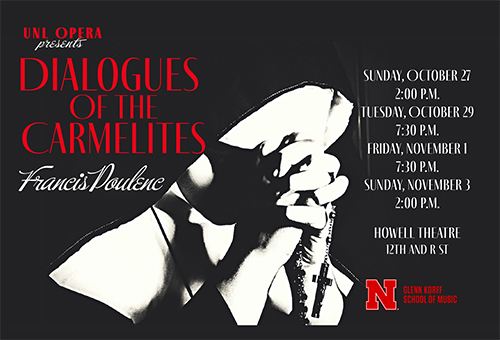 The opera premieres in 1957, by the French composer Francis Poulenc. UNL Opera’s production will be performed in English, with piano, in the more intimate space of Howell Theater, which should serve to magnify the impact of this opera even more.
The story itself is based on actual historical events. During the French Revolution in the 1790s, the Catholic Church came under increasing attack, at first by social stigmatization, then through legal strictures and confiscation of property, culminating in the Reign of Terror, when tens of thousands of persons of all stripes were arrested and guillotined in public executions.
Among those killed was a group of Carmelite nuns from Compiègne, about 50 miles northeast of Paris. The sisters were forcibly disbanded in 1792, arrested together in June of 1794, and beheaded the next month, after a one-day trial, having made an offering of martyrdom for the survival of the Church and the nation. Ten days after their deaths, the Reign of Terror came to an end.
German author Gertrud von le Fort published a novella drawing upon the events in 1931, “The Song at the Scaffold.” The work served as a warning and social commentary, with Nazism already on the horizon. Later, the French author and playwright Georges Bernanos adapted the novella, putting more emphasis on the drama of individual characters. This, “Dialogues des Carmélites,” was used by Poulenc as the basis for his libretto, or text for the opera.
“Though von le Fort, Bernanos, and Poulenc were all Roman Catholic, as with all great works of art, the particular is a doorway to the universal and what is timebound touches upon the timeless,” said Michael Cotton, musical director of the production.
“The characters in the opera make choices of lasting personal consequence against the backdrop of wider social conflict. Important questions are raised, which are relevant even today: why does an apparently civilized, highly cultured society succumb to irrational and bloodthirsty hysteria? How would we respond in that situation? With courage to go against the mob, or with easy acquiescence?”
Even though nearly all of the principal characters are ultimately put to death, Cotton said, “Dialogues” is “not really a tragic opera.”
“Indeed, seen with the eyes of faith, either in the grace of God or the innate nobility of the human spirit, it is suffused with hope. Courage wins out over fear, sacrifice defeats tyranny, love is shown to be stronger than death. A light shines in the darkness, and the darkness does not comprehend it,” he said.
Ticket information is available at https://nebraskarep.org/unlopera.
