

Q. Humans can become saints but not angels. Angels are angels. How did St. Michael, the Archangel, become recognized as a saint?
A. Recently I had a conversation with two priest friends about equivocation. Equivocation is an interesting term because in modern parlance, it is generally defined as using ambiguous wording to obfuscate the truth.
In philosophy, equivocation means calling two things by the same name. The common example that is used is “love”: I might say I love God and I love pizza but – unless I have a very strange view of pizza – “love” does not mean the same thing in both statements, even though we use the same word. Therefore, equivocation in the philosophical (and, I suppose, the popular) sense of the word can lead to confusion.
This week’s question is a perfect example of that confusion. The issue is the title of ‘saint,” which has two different but related meanings. Strictly speaking, a saint is anyone who is in Heaven. When someone is canonized a saint, it is the Church officially and infallibly stating that this person is in Heaven. Someone can be a saint without being canonized. In fact, the vast majority of saints (people in Heaven) are not canonized, but we can say with confidence they are in Heaven because of the sanctity with which they lived their lives.
Up until sometime in the sixth century, the popular acclaim of the people of God was what determined if someone was venerated as a saint or not. Martyrs were held up as examples of Christian perfection, and following their deaths, they were venerated – first in their local communities, and eventually throughout the wider Christian world as their stories spread. There was no formal declaration, people just recognized sanctity when they saw it and began venerating these holy men and women as saints. Gradually, this spread to even those who were not martyred, but left no doubt as to the sanctity of their lives and thus confidence that they were in heaven.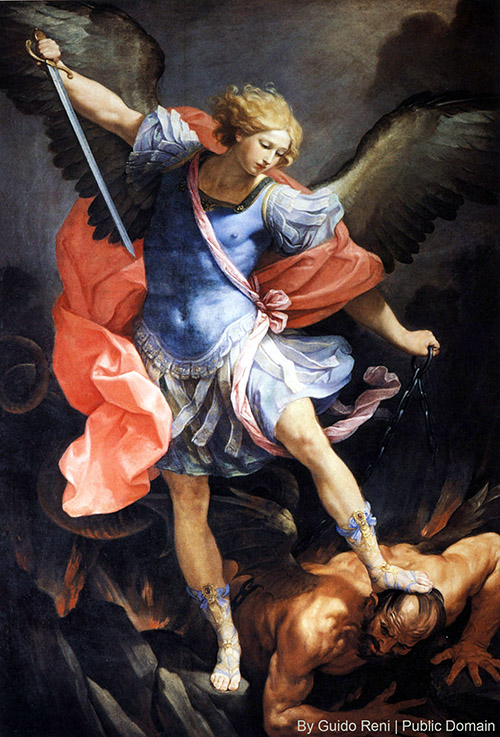
St. Michael, though not human, was surely in heaven and was a powerful figure of intercession and protection amongst the early Christians. Churches were dedicated to him – most famously the Michaelion, which is believed to have been constructed by Emperor Constantine – further cementing the veneration of St. Michael in the hearts of Christians, especially in the Eastern Roman Empire. At no point was there any formal declaration of him as a saint, because there did not need to be.
Formal canonizations began sometime in the sixth century and were handled by local bishops in their own dioceses for their own subjects. The first papal canonization that there is record of was St. Udalricus in 973 (Catholic Encyclopedia). It was Pope Greogry IX in 1234 who made papal canonizations the only official way for saints to be formally declared as such by the Church.
Despite this formalization, the Church never went back and canonized saints who were in essence “canonized” by popular acclaim. St. Joseph, St. Peter, Ss. Felicity and Perpetua; none of these saints was ever formally canonized, but they are all rightly venerated as saints today and referred to as such. It is no different for St. Michael who, though not a human person and never canonized, is nonetheless rightly referred to as Saint Michael, for there is no doubt of his sanctity.
This question was answered by Father Caleb La Rue, chancellor of the Diocese of Lincoln. Write to Ask the Register using our online form, or write to 3700 Sheridan Blvd., Suite 10, Lincoln NE 68506-6100. All questions are subject to editing. Editors decide which questions to publish. Personal questions cannot be answered. People with such questions are urged to take them to their nearest Catholic priest.
