

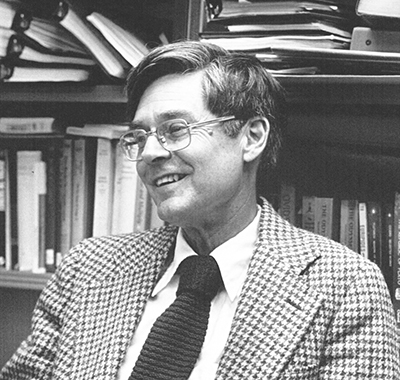
Dr. John Senior (1923-1999) was a professor of classics at the University of Kansas. I first met him in the fall of 1973, my first semester in college, when I enrolled in the Integrated Humanities Program (IHP), a two-year, four semester humanities course for freshmen and sophomores at KU. Dr. Senior was one of three teachers who team-taught the IHP. The other two were Dr. Dennis Quinn and Dr. Franklyn Nelick. They were all phenomenal teachers, and their teaching styles and gifts complemented each other harmoniously in marvelous ways.
 But it was John Senior who had the greatest impact on me. So much so, that half-way through my junior year when I discerned that I should become a Roman Catholic, I asked Dr. Senior to be my godfather. I found out later that he had sponsored dozens of students upon their entry into the Catholic Church. He was a father, a wise counselor, a friend, and a mentor to several generations of college students in the waning decades of the 20th century.
John Senior was a gentle and soft-spoken man, with contemplative temperament. While he was not a dynamic speaker, the tone of his voice and the way he pronounced words was captivating. In class he would often recite long passages from the books we were reading, and the inflection of his voice and the cadence of his speech would keep us on the edge of our seats, straining to hear every word. He would then pause after finishing the quote, indicating that he himself was quite taken by the text. Then he would begin to explain the passage with a deep and profound understanding of the writer. I could listen to him read all day long. His voice had a lyrical quality about it. Fortunately, there are recordings of his voice and whenever I listen to those recordings, those memories come rushing back to me.
One of my fellow students put it like this: “John Senior, like Socrates, had the uncanny ability to get young people to think, to wonder, and to change course in midstream. How he did this owed a great deal to his own sense of wonder and appreciation of God’s presence in our lives.”
Although John Senior was an accomplished teacher, I would say that he showed us things more than he taught us things. His pedagogical method was more experiential than didactic, what St. John Henry Newman described as the difference between real assent and merely notional assent.
He used to compare his role as a teacher to that of a janitor, someone who simply opens doors for students so that they could walk through themselves. He would draw us into the true, the good and the beautiful, and then let us go, to tread the path on our own. When we stumbled and lost our way, as young people are wont to do, he was always there with a kind word of encouragement and a gentle nod to help us on our way again.
He saw how the particular and the concrete was a doorway to the universal and timeless. He had the vision of an eagle who looks down on earth and sees how everything is connected, the big picture if you will. But at the same time, he was very “down to earth” and he was not at all an ivory-towered academic. He loved what he called the “really real.” What the poet Gerard Manley Hopkins called “the dearest freshness deep down” truth of things. He would show us how to find the true, the good and the beautiful in the books we read, the poems we memorized, the friendships we forged and the experience of life that we shared. John Senior had the ability to speak to the heart as well as to the mind. He showed us how to see the world with a sacramental imagination, through a lens that allowed us to see beyond the ordinary to the eternal.
In God’s divine providence, Dr. John Senior came into my life at just the right time. That was over 50 years ago, and his words, his example, his smile, his voice and his friendship continue to inspire me today, just as profoundly as it did over five decades ago.
+++
From the Register: In November, the Church encourages us to remember and pray for the souls who have gone before us. As part of that effort, the Register presents a special project called “Echoes of Faith: Remembering Our Catholic Inspiration.”
We asked 30 priests, religious and laity to share the story of someone they knew personally who has died, but had an impact on their Catholic faith that has endured over time.
Each day in November, we will highlight one such story at lincolndiocese.org/echoesoffaith and on our social media channels. We will also feature a story each week in the Register, with a preview of daily stories to come in the week ahead. We invite you to read these stories daily this month, as we join together to honor those whose faith still echoes in our lives.
Please follow this "30 stories in 30 days" project at lincolndiocese.org/echoesoffaith.
