

By Fr. Kenneth Borowiak
for the Register
Beauty. Beauty was the reason Ashland was chosen to be a community in the southeast part of Saunders County in the last half of the 19th century.
While on a fishing trip on Salt Creek, a man with the surname Argyle was drawn to the natural beauty of the area. In addition to the picturesque and striking scenery the area provided, advantages for the creation of a town – 25 miles northeast of Lincoln – existed.
Being close to the Platte River and to the confluence of the Salt and Wahoo creeks would provide transportation and a source for waterpower.
The community was named Ashland by Mr. Argyle and formally organized in 1870, just shortly after the establishment of Nebraska as a state in 1867.
It was this natural beauty and the growing Catholic population there that drew locals to seek a location for a church. It was the centennial of the establishment of that parish – St. Mary in Ashland – that was celebrated Nov. 3.
“Our Mass is so beautiful,” said pastor Father Robert Matya. “We have such a wonderful religion. Our art, prayers, ceremonies all are beautiful. It is natural that the pioneers of Ashland would want to build a church in this area.”
The centennial celebration of St. Mary Parish has been a multifaceted event throughout 2024. The activities celebrating St. Mary Parish included participation in Ashland’s annual Stir-Up Days in July. Comparable to many rural Nebraska towns’ annual celebrations, the event included community, food, music, a carnival, and the much-anticipated grand parade.
For the parade, the parish created a float, which was adorned with an 8-foot tall 100th birthday cake. They also served a meal to Stir-Up visitors. On Sept. 15, St. Mary Parish celebrated with a block party that included food from a new steakhouse in town, yard games, and a live band.
The culminating event was this last weekend, with the centennial Mass celebrated by Bishop James Conley, with Father Matya concelebrating. After the 10:30 a.m. Mass, the parish’s annual “Harvest Fest” ensued. Harvest Fest included a special homemade meal with locally sourced pork loin. An extensive shop of baked goods attracted purchasers looking to support St. Mary and satisfy their sweet tooth.
History and development
There was interest in building a Catholic church shortly after the establishment of Ashland in 1870. The first Catholics in the area – 12 faithful families – had to travel quite a few miles to Mass, usually to Greenwood. Some Catholics would spend all day in Greenwood just to attend Sunday Mass, as the train only ran through twice a day – once in the morning and once at night. Later, St. Joseph in Greenwood would become a mission parish to Ashland.
On October 17, 1900, Mrs. Edward Larkin informed Bishop Thomas Bonacum, the first bishop of the Catholic Diocese of Lincoln, that she was giving him the deed to a lot of land in Ashland. She had hoped that a house on the property could be used for a Catholic church, but it ended up not being feasible to make the necessary renovations to the house.
Still, Mass and the other sacraments began to be celebrated in Ashland after the turn-of-the-century, mostly in peoples’ homes. Father Philip Matuska, O.F.M., regularly reported to the bishop the progress of the practice of the Catholic faith in Ashland.
Father Matuska began soliciting funds for a church. Since the Catholics of the area did not have significant financial means, Father Matuska asked the Catholic Extension Society for a grant in helping build a church. The Catholic Extension Society agreed to a gift of $1,000, with the stipulation that the parish was to be named for St. Mary. Bishop Charles O’Reilly, the Bishop of Lincoln at the time, also gave $200 to the building fund.
These monies were used to buy a Baptist church that had originally been constructed in 1893. It was renovated, a steeple added, and it was dedicated as a Catholic church by Bishop Francis Beckman Oct. 29, 1924.
As the parish grew over the next decades, it was realized that a larger and newer church was needed. After fundraising and a gift of $5,000, also from the Catholic Extension Society, ground was broken on March 18, 1956, for the current St. Mary Church.
That church was dedicated by Msgr. Thomas Kealy Feb. 27, 1957. Later, a grotto and educational center were added.
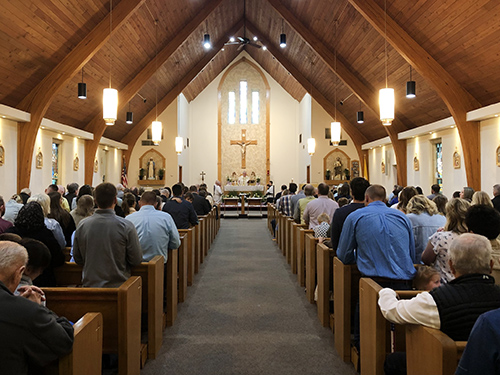
The city of Ashland has been experiencing a renaissance in the last 20 to 30 years. Every building and storefront in the city’s historic downtown is occupied with a business. There has been significant growth in the parish during the same time, due largely to the development of five large lake areas in the region – Sandy Point, Northlake, Big Sandy, Thomas Lakes, and Lake Allure.
“There have been initial conversations about a new church to accommodate anticipated and continued Catholic growth in this area,” Father Matya said. “The church owns about 20 acres at the Whitetail Development towards the southeast corner of town that could be used for such a project,” he added.
A parish-wide survey conducted last summer sought personal input in evaluating the current and future status of St. Mary Parish. Consistently highlighted within the results was the value seen in the small, tight-knit community at St. Mary.
“It’s an exciting time of growth in the life of our parish,” remarked Mollie Sundermeier, who serves as the parish engagement coordinator. “I think it’s important to keep in mind that a core value of our parishioners is a small-town, familial atmosphere. As St. Mary’s continues to expand, that will certainly be a part of the conversation in the decision-making process.”
