

Q. Why is Immaculate Conception a Holy Day of Obligation this year even though it got moved to Monday, Dec. 9? Isn’t that a change?
A. I am commonly asked by people I encounter who read the “Ask the Register” answers I write if the questions are real. Yes, they are real. People email in or write in questions, and these are the questions I draw from.
This week is an exception. No one wrote in this question, but I think it is important to address the change to the practice in the U.S. regarding the obligation to attend Mass when a Holy Day is transferred to a Saturday or a Monday.
The obligation to attend Mass on certain Holy Days (including Sundays) is a merely ecclesiastical law. The obligation to keep Holy the Sabbath is a Divine Law, but the obligation to attend Mass comes from the Church, not Jesus. Because of this, the Church is able to dispense from the obligation to attend Mass on these days and establish which days are Holy Days of Obligation.
Holy Days of Obligation are established by the Holy See: “Sunday, on which by apostolic tradition the paschal mystery is celebrated, must be observed in the universal Church as the primordial holy day of obligation. The following days must also be observed: the Nativity of our Lord Jesus Christ, the Epiphany, the Ascension, the Body and Blood of Christ, Holy Mary the Mother of God, her Immaculate Conception, her Assumption, Saint Joseph, Saint Peter and Saint Paul the Apostles, and All Saints” (CIC c. 1246 §1). The Code goes on to establish that the conference of bishops can suppress some of the holy days of obligation or transfer them to a Sunday, which is why in the U.S. not all of the Holy Days listed here are Holy Days of Obligation (CIC 1246 §2).
In 1993 the then-National Conference of Catholic Bishops (now the United States Council of Catholic Bishops or USCCB), with the approval of the Holy See, established that in the United States “whenever January 1, the solemnity of Mary, Mother of God, or August 15, the solemnity of the Assumption, or November 1, the solemnity of All Saints, falls on a Saturday or on a Monday, the precept to attend Mass is abrogated.”
Noticeably absent from this list is the Immaculate Conception. Despite this, in past years when Immaculate Conception was transferred to a Saturday or a Monday, the obligation to attend Mass was treated as having been abrogated. In response to an enquiry from an American bishop, the Holy See clarified that this should not be done, not just for Immaculate Conception, but for any Holy Day of Obligation that is transferred to a Saturday or a Monday.
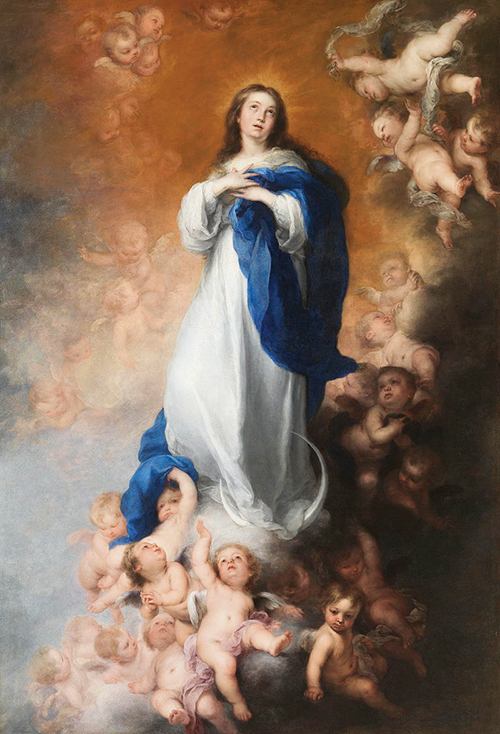
Basically, no matter when the day falls, every Catholic is bound by the obligation to attend Mass on a Holy Day of Obligation, so there will be times (like this year with Immaculate Conception) in which Catholics will need to go to Mass twice, either on the same day or on back-to-back days. Here is the break down:
At any Mass on Sunday, Dec. 8, whether within or outside the usual schedule, the Mass setting and readings for the Second Sunday of Advent are used. The obligation for Sunday is fulfilled by any Mass Saturday evening through Sunday night. The obligation for the Holy Day is fulfilled by any Mass Sunday evening through Monday night.
In other words, a Catholic could attend Mass Sunday morning and have all the prayers and readings for the 2nd Sunday of Advent and fulfill their Sunday obligation, then go to Mass that evening (which would have all the prayers and readings for, again the 2nd Sunday of Advent) and fulfill their obligation for the Immaculate Conception. Or of course you can go to Mass either the evening of Saturday, Dec. 7 or Sunday, Dec. 8 and then Mass on Monday Dec. 9 and fulfill both obligations that way.
No matter what the combination though, every Catholic will have to go to Mass twice.
A natural reaction to this change is one of frustration. “Doesn’t the Church understand how inconvenient this is?” Yes, She does, and that’s the whole point. The point of making it obligatory to attend Mass on certain days is because celebrating these days by gathering as a community and worshiping God and being fed by His Body, Blood, Soul, and Divinity is the best thing we could do on any given day, Sunday or otherwise.
Like a parent with a child, the Church is telling us we have to do this because this is what is best for us and, like a child, we might sulk or complain, or even throw a temper tantrum, but that does not mean the Church is wrong, any more than a toddler throwing a fit makes his or her parent wrong. We need to trust the Church when She says this is what is best for us, that Mass is more important than whatever else we could be doing, because, well, it is.
This question was answered by Father Caleb La Rue, chancellor of the Diocese of Lincoln. Write to Ask the Register using our online form, or write to 3700 Sheridan Blvd., Suite 10, Lincoln NE 68506-6100. All questions are subject to editing. Editors decide which questions to publish. Personal questions cannot be answered. People with such questions are urged to take them to their nearest Catholic priest.
