

Q. I was reading the Book of Judith, and it seems like Judith is praised for lying. Isn’t lying a sin?
A. The Catechism of the Catholic Church teaches that, “Lying is the most direct offense against the truth. To lie is to speak or act against the truth in order to lead someone into error. By injuring man’s relation to truth and to his neighbor, a lie offends against the fundamental relation of man and of his word to the Lord” (2483). The Psalms tell us that the Lord “[destroys] those who speak lies” (5:5). These raise an important question whenever we consider these teachings alongside scenes in the Bible, such as in Judith, that present that moral issue of lying to achieve a better end.
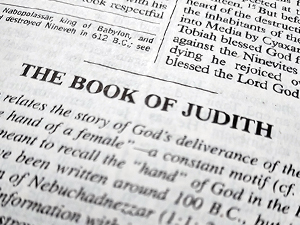
In the book of Judith, we encounter the evil king Nebuchadnezzar and his chief, Holofernes, who set out to destroy Bethulia, the hometown of Judith. Depicted with great bravery and heroism, Judith set in motion a plan to save her people by deceiving Holofernes and, using that deception, brought him to an end, thus saving her people and city. This is not dissimilar to the moral issues posed by the cases of the Hebrew midwives (Exod 1:15-22), and Rahab’s deception (Josh 2:1-24). This brings us to the layered question: Was Judith’s lying permissible? If characters in the Bible lie, does that mean the end can justify the means?
First, we should be clear that just because something is de facto in the Bible does not mean it is morally permissible. If this were the case, we would have a multitude of moral issues to wrestle with: Judith’s deception, Adam and Eve’s rejection of God, David’s adultery, Judas’ betrayal, and many more. Clearly not all of the Bible’s characters and their actions are presented as moral examples to be followed. For helpful guidance in navigating interpretive challenges of this nature, let us consult two of the greatest saints and biblical theologians in Christian history, St. Augustine and St. Thomas Aquinas.
St. Augustine writes, “No lie is just. Accordingly, when examples of lying are proposed to us from the sacred Scriptures, either they are not lies but are thought so for not being understood, or, if they are lies, they are not to be imitated because they cannot be just.”
Augustine goes on to treat the examples of the Hebrew midwives and Rahab, noting: “As for its being written that God dealt well with the Hebrew midwives and with Rahab the harlot of Jericho, he did not deal well with them because they lied, but because they were merciful to the men of God. And so, it was not their deception that was rewarded, but their benevolence; the benignity of their intention, not the iniquity of their invention” (Against Lying, 15.31-32).
Similarly, St. Thomas Aquinas notes that no one in the Scriptures is praised on account of his or her lie, but rather on account of his or her virtuous disposition. Thus, Aquinas says of Judith that, “It is thus that Judith is praised, not for lying to Holofernes, but for her desire to save the people, to which end she exposed herself to danger” (Summa Theologica II-II, q. 110, a. 3, obj. 3).
Ultimately, we can conclude with certainty that lying in any capacity remains a sin. It is a direct offense against Truth, which is fully expressed in the Person of Jesus Christ (cf. John 14:6). It can be said, then, that to some degree Judith indeed committed an offense in lying to accomplish her heroic plans. It is not her lie, however, but her devotion and heroism that receive divine approval. The Bible does not shy from depicting the full spectrum of human behavior, good or bad. What the Bible does reveal is the purity of intention and desire that Judith (and others) had, despite their illicit means of achieving them. In the end, while their good did not justify their sinful means, the resultant good outweighed the offenses that were committed in the process.
All of this leaves us with two convictions: the end should never justify the means, and we should remain pure in our acts and intentions; and we should cling to the hope that even when we do fall short, the Lord is merciful, and that “love covers a multitude of sins” (1 Pet 4:8).
This question was answered by Joshua Burks, associate teacher at the Emmaus Institute for Biblical Studies. For more information, visit www.emmausinstitute.net.
Write to Ask the Register using our online form, or write to 3700 Sheridan Blvd., Suite 10, Lincoln NE 68506-6100. All questions are subject to editing. Editors decide which questions to publish. Personal questions cannot be answered. People with such questions are urged to take them to their nearest Catholic priest.
