

Q. Is a devout Catholic allowed to attend a Lutheran worship service with a friend? Or, is that considered a sin?
A. Ecumenism is a tricky thing. On the one hand, we as Catholics should be striving to bring unity amongst Christians and heal the divisions amongst denominations. On the other hand, we are never going to change what we believe because, well, the Catholic Church has the fullness of Truth, so why would we? Therefore, ecumenism often becomes about finding those places where we can agree with non-Catholic Christians and working together in common cause, or gathering together in a spirit of common prayer.
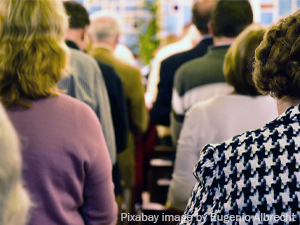
So, when it comes to gathering together in common prayer, all things being equal, a Catholic is able to gather with non-Catholics, either in an ecumenical service of some kind or even by attending a Lutheran or other non-Catholic worship service. As always there are a few caveats (more on those later), but attending a non-Catholic worship service is not in and of itself a sin. Christians share in the Baptism of Christ and though there are significant and important areas of disagreement between Catholics and non-Catholics, gathering together to worship in common can be a sign of the Christian unity we are called to strive for.
Now back to those caveats I mentioned. First and foremost, attending a non-Catholic worship service does not fulfill a Catholic’s obligation to attend Sunday Mass. Non-Catholic worship services and the Catholic Mass are not the same thing, and while a Catholic may want to support a Protestant friend by attending his or her ecclesiastical community on a Sunday, the Catholic cannot ignore his or her own spiritual wellbeing, and needs to still attend Mass.
Catholics also need to be aware that, while attending a non-Catholic worship service is not sinful, receiving bread and wine at a Protestant service is. Just as non-Catholics cannot receive Communion at Mass, Catholics cannot receive what Protestants understand to be communion at a worship service, and for the same reason.
The Body and Blood of Christ are called Communion because receiving our Lord under the appearance of bread and wine draws us deeper into Communion with Him and is a visible sign of our communion with the Church. Non-Catholics are not in communion with the Church and therefore cannot receive Communion. Catholics are not in communion with Protestant ecclesiastical communities and therefore are not to give the impression that they are, or that what Protestants understand communion to be is the same thing as Communion by receiving bread and/or wine during a Protestant worship service.
So what can a Catholic do at a Protestant worship service? “In liturgical celebrations taking place in other Churches and ecclesial Communities, Catholics are encouraged to take part in the psalms, responses, hymns and common actions of the Church in which they are guests” (Ecumenical Directory n.118). If a Catholic is attending a Protestant worship service, he or she does not need to sit with arms folded and a disapproving look on one’s face. There is nothing wrong with participating in those parts of the service that celebrate God’s Word or give praise to Him.
As I said earlier, ecumenism is a tricky thing. If we pretend all Christian denominations are basically the same thing, we reduce our faith to what can be agreed upon rather than the Revelation of God to humanity for the salvation of the world. If all we do is focus on why Protestants are wrong, we lose the spirit of charity that is to motivate us and lose sight of the good that can be achieved when Christians unite in common cause and prayer. Unity cannot be at the expense of Truth, and Truth cannot bring unity without Charity. Let us ask our Heavenly Father that we might all of us be instruments of His Truth and His Love in the world.
This question was answered by Father Caleb La Rue, chancellor of the Diocese of Lincoln. Write to Ask the Register using our online form, or write to 3700 Sheridan Blvd., Suite 10, Lincoln NE 68506-6100. All questions are subject to editing. Editors decide which questions to publish. Personal questions cannot be answered. People with such questions are urged to take them to their nearest Catholic priest.
