

Guest column by Sondra Jonson
“A voice is heard in Ramah…. Rachel weeping for her children; she refuses to be consoled because they are no more.”
(Jer. 31:15)
When my son Joseph told me he and his wife were expecting their second child, our whole family rejoiced. We had just buried his father a month earlier, and this new life was like a healing gift from Heaven. Their 6-month-old son Jude would soon have a sibling, someone to share life, adventure and family with.
What we could not foresee was the dark night two weeks later, when Joseph and I would sit praying the rosary in a silent hospital, as tears slid down his face. Little Jude lay sleeping in my arms while his mama Maridel underwent surgery for an ectopic pregnancy.
When the OB surgeon came to tell us the procedure had gone smoothly and Maridel was in recovery, I plucked up the nerve to ask her what would become of the baby’s remains.
Taken aback by the question, she gently, but politely, said, “It goes to the lab, and they don’t return it.”
Throughout that long night and the following days, our chief concern was helping Maridel recover from the surgery and restoring her tender, broken heart. But the thought of their child’s physical remains going to medical waste continued to weigh on my mind.
I mentioned this to my friend Mary, a retired labor and delivery nurse. She said, “Your kids have a right to have their baby’s remains!” She then contacted her daughter, who has professional connections to the lab that received the tissue. Within a day, we had the phone number of the lab director and my son called and arranged to have their child’s remains returned to them.
The story doesn’t end there—although each chapter of this tale is layered with both heartbreak and graces. The baby’s body was returned in a cardboard box to the obstetrician’s office. The parents of this tiny preborn human put the remains in an urn, and gave the child a name, “Gianna Rose,” which they engraved on the urn with her date and their prayer, and they set it on their home altar. Some weeks later, my son told me that after much prayer and discernment, they had decided to bury the urn in a cemetery.
And so, two months after the miscarriage, on a still and overcast Sunday afternoon, our family gathered at the local cemetery with our parish priest as he prayed for little Gianna. Joseph knelt and placed Gianna’s urn deep into the hole dug next to his dad, whom we had so recently buried.
The rest of the afternoon unfolded as most of our family get-togethers do, especially busy with Jude, now 8 months old and claiming our attention and vigilance. We always relish each other’s company; there’s always both laughter and serious exchange, always the shared pleasure of good food and comforts of home, and for me, the sweet sound of my adult children’s voices.
But on this afternoon there was an edge in the air, a silent tension—little things didn’t go just quite right. Joseph told me later that, on that night, he had cried and cried and cried.
“I never thought I would have to bury my daughter,” he said. “But,” he continued solemnly, “it was OK, Mom… because that night, Maridel and I got to finally grieve together.”
As much as my heart ached that night in the hospital, to know we would not see our little one this side of Heaven, burying her was almost more piercingly painful. And yet, we each had a sense that it was, in all its heartbreaking mystery, the right thing to do—the best thing for her, for her parents, for each of us, and for our God Who created her.
The Catechism of the Catholic Church teaches, “The burial of the dead is a corporal work of mercy; it honors the children of God who are temples of the Holy Spirit.” (CCC 2300) It took courage for my children to fight for the right to their child’s remains. It was a privilege not offered to them by their medical team. But, as difficult as it was at every stage, I know they both feel a deep sense of good that they did this for their child, a child so tiny as to appear insignificant, even disposable, to others.
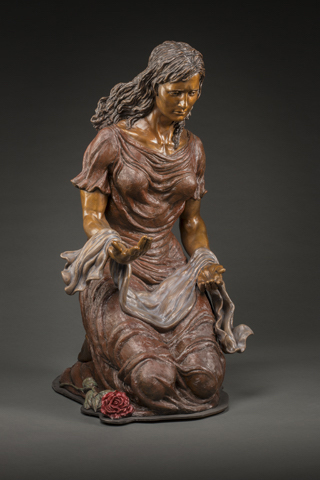
Twenty-five years ago, I sculpted “Rachel Weeping for Her Children,” echoing the prophet Jeremiah’s plaintive cry and plunging me into the pro-life movement. From the day we first installed “Rachel” at the Fatima Shrine at St. Germanus Parish in Arapahoe, to each subsequent placement of bronze and resin castings, I have listened again and again to parents’ stories echoing the prophet’s words, “A voice is heard in Ramah, Rachel is weeping for her children. And she shall not be comforted, because they are no more.”
I continue to ponder why, after all these centuries and millennia, Rachel still weeps.
She weeps with every mother who suffers for a child, with every father and family member. She weeps with the children in their small hurts and in their great trials. She weeps with our Blessed Mother Mary, and with every anguish of the human heart.
She weeps so that God might answer us as He did Israel’s mother: “Cease your mourning, dry your tears, your sorrow will have its reward… There is hope for your future, your sons will return to your land.” (Jer. 31:16-17)
Editor’s Note:
A memorial Mass will be celebrated Dec. 28 for those who have lost a child through miscarriage, stillbirth, infant death or abortion. All are invited. The Mass will take place in the John XXIII Diocesan Center in Lincoln. The reading of names will begin at 6:30 p.m., followed by the Mass at 7.
