

Southern Nebraska Register
Bishop James Conley celebrated Mass Dec. 29 in the Cathedral of the Risen Christ in Lincoln to open the Jubilee Year of Hope in the Catholic Diocese of Lincoln.
Pope Francis announced the jubilee year last May in a papal bull entitled “Spes non confundit” (“Hope does not disappoint,” from Romans 5:5). The Holy Father instructed all dioceses to celebrate Mass Dec. 29 to begin the year, a sacred time of grace and mercy. He also asked all dioceses to place a jubilee cross in the sanctuary of their cathedrals, visible throughout the year to all people, “pilgrims of hope.”
At the Dec. 29 Mass, Bishop Conley blessed the jubilee cross for the Catholic Diocese of Lincoln. Father Troy Schweiger, pastor of St. Patrick Parish in Lincoln, led the construction of the jubilee cross, aided by Deacon Stephen Kuchar, who constructed the base, designer Mary Ellen Kudron and David Reiser, who painted the elements on the crest in the center of the cross.
The cross is 9 feet tall on a 15-inch base. The cross arms are 4 ½ feet wide. The wood is 7 ½ inches wide by 1 ½ inches deep. The wood was stained in a dark walnut color to harmonize with the interior of the cathedral.
Editor's note: see photos from the Mass.
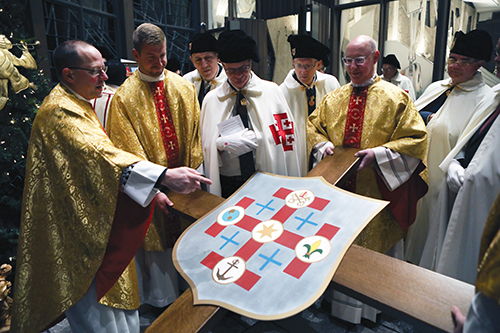
The crest in the center uses colors from the diocesan coat of arms. An image of the world represents the universality of the Church and the Jubilee Year that the entire world is celebrating, and a star represents the Diocese of Lincoln – the same star is on the diocesan coat of arms in reference to Our Lady. A corn cob represents the agricultural makeup of our diocese.
An anchor is included as an ancient symbol of hope – the jubilee theme – and steadfastness. Keys representing the diocese’s unity with Rome and the See of Peter, who called for and proclaimed the Jubilee Year of Hope.
The shape of the cross is a traditional “Pilgrim Cross” design since it is to be a focal point for pilgrims to the Cathedral. The shield also includes the Jerusalem Pilgrim’s Cross Medallion that was established by Pope Leo XIII in 1900 to honor the pilgrims who visited the Holy Land. The color of red on the Holy Land (or Crusaders’) cross signifies their Christian faith. The four smaller crosses stand for the Evangelists Matthew, Mark, Luke and John.
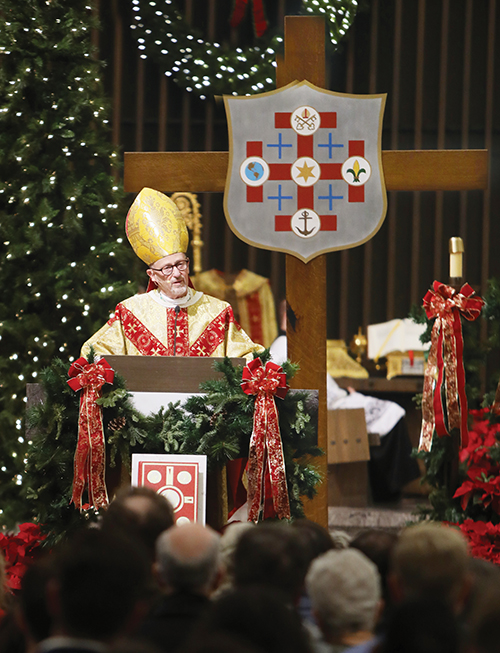
“It is through the cross that our hope comes,” Bishop Conley said in his homily (see video here). “It is through the victory of Jesus on the cross – that he suffered, died and rose from the dead. That’s our hope. And the cross is the sign of victory.”
He pointed out how often Catholics make the sign of the cross, and encouraged all to remember as they cross themselves, that it is a sign of hope.
“We are declaring that the cross is our hope,” he said. “And that in the cross we see the greatest act of love the world has ever known.
“Jesus showed us the way,” he continued. “So every time we sacrifice to love one another, every time we sacrifice to show kindness, every time we reach out to those who are suffering, we imitate that love from the cross.”
In the papal bull initiating the jubilee, Pope Francis wrote, “For everyone, may the Jubilee be a moment of genuine, personal encounter with the Lord Jesus, the ‘door’ (cf. Jn 10:7.9) of our salvation, whom the Church is charged to proclaim always, everywhere and to all as ‘our hope’” (1 Tim 1:1).
Each jubilee year brings the opportunity for the faithful to gain a jubilee indulgence. An indulgence means “a remission before God of the temporal punishment due to sins whose guilt has already been forgiven, which the faithful Christian who is duly disposed gains under certain prescribed conditions through the action of the Church ....” (CCC 1471).
The normal conditions to receive an indulgence are: sacramental confession 20 days before or after the indulgenced activity (one confession can count for many indulgences); reception of Holy Communion; and prayers for the intentions of the Holy Father (such as ‘Our Father, Hail Mary, and Glory Be’). To obtain a plenary indulgence, a person is to have no attachment to sin, even to venial sins.
Bishop Conley established eight locations in the Diocese of Lincoln to serve as pilgrimage sites for the jubilee year. They are These sites are the Cathedral of the Risen Christ, the Pink Sisters’ Chapel in Lincoln, St. Elizabeth Ann Seton Parish in North Platte, St. Benedict in Nebraska City, St. Mary in Orleans, St. Anthony in Steinauer, Assumption in Dwight and the Our Lady of Fatima Shrine in Arapahoe.
