

By Reagan Scott
for the Register
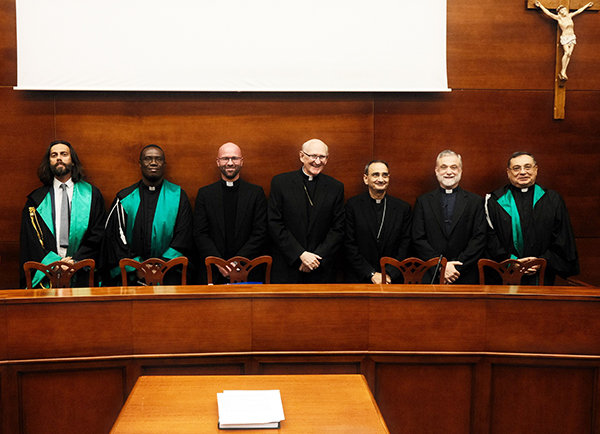
In November, Father Jim Morin completed a doctoral program in canon law at the Pontifical Lateran University in Rome.
For the native of Lincoln and St. Teresa Parish, the accomplishment marked the culmination of four years of graduate study, and nine total years spent in the Eternal City.
As a seminarian, Father Morin spent four years in Rome studying theology, and returned for a final year of study after his ordination in May 2016 to finish a license degree in patristics. He didn’t expect to return, or to pursue a degree in canon law, but after three years back in the United States, Bishop James Conley received a letter from the Holy See, inviting Father Morin to attend the Pontifical Ecclesiastical Academy (also referred to as the Accademia), to train as a diplomat for the Church.
“I started the degree as I was in the Accademia, discerning whether to spend my life serving the Holy See,” Father Morin said. “And then, after three years there, the bishop decided to call me home. At that point, I had already started working on the doctorate… so I spent a fourth year in Rome doing that and finished it in November.”
Father Morin’s program at the Accademia first had him complete his license in canon law, which took three years. His studies included the principles of law, history of canon law and how it’s developed, as well as its relationship to theology and divine law. There was also a lot of studying the laws of the Church, which are primarily contained in the “Code of Canon Law,” and the trials/processes of canon law, which delves into how conflicts are resolved within the Church.
“The goal of the license is to give you familiarity with all of the laws that you might have to, as a canon lawyer, either apply or interpret or explain,” Father Morin said. “Once you’ve done the license, the doctorate is primarily taking one specific question, or topic, or problem and writing a really long paper about it, while taking just a handful of classes.”
Father Morin said the purpose of the doctoral thesis is to address some question that hasn’t been addressed before. His was titled, “The Canonical Privacy of Clerics: An Examination of the Nature and Limits of Clerical Privacy in the American Context.”
The nature of his thesis dealt with questions like, “What is legal privacy, and does it have a place within canon law? And if so, what are its limits, especially for clerics?”
“The term privacy and the legal concept of privacy are not native to canon law; it’s an English term that developed in a common law context, and there’s not a direct equivalent in Latin or Italian,” Father Morin explained. “So the goal was to ask the question of, ‘Does canonical privacy exist?’ And specifically, ‘What bearing does it have on the lives of priests?’”
The second time Father Morin resided in Rome started in the midst of COVID-19 lockdowns. The city was devoid of tourists and restaurants were closed. Father Morin lived in a house with priests from all over the world, and said he enjoyed experiencing the universal Church and learning how priests live their lives in different places. He also said he got to experience how the Holy See works in a way he hadn’t before.
Now that he has returned from Rome, Father Morin has been named vice chancellor of the Diocese of Lincoln. He is in residence at St. Gregory the Great Seminary in Seward. Father Morin said there are two main roles for canon lawyers in most dioceses: one is serving on the marriage tribunal, dealing with petitions for declarations of nullity, and the second is helping the bishop govern the diocese according to the laws of the Church.
Father Morin said that while many bishops don’t have degrees in canon law, because canon law gives norms for how bishops should govern their dioceses, a bishop should have at least one canon lawyer who would help him do his job. In the Lincoln Diocese, this role falls to Father Caleb La Rue, the chancellor and vicar for canonical affairs for the diocese.
As the only legislator for his diocese, a bishop can enact norms that impact the workings of the diocese, but these norms must not conflict with the universal laws of the Church. This is where canon lawyers come in.
Father Morin explained: “If, for example, the bishop decided he wants to pass some norms about what’s required of the priests in the Diocese of Lincoln when they hear confessions, like where it should happen, or if the priest should be vested in a certain way, I look at those laws before they get passed to make sure they make sense, that they don’t contradict anything in the universal Church, and are written in a way that’s legally coherent.”
Before his graduation, Father Morin was able to help Father La Rue review texts or decrees from the bishop, and his role now remains similar.
“Sometimes it’s better to have two sets of eyes on something rather than one,” he said. “If Father La Rue has too much work to do or has a question that he wants to get a second opinion on, basically I just help him when he has questions.”
Father Morin said that while his time studying the law felt more abstract, he enjoys being able to apply what he learned now in his work, as it allows him to think about the law organically, with all of its parts. Now, he gets to use canon law to come up with the best solution to problems, one that respects all of the people involved, and respects the goal of the Church in its mission to proclaim the Gospel.
“The law is not meant to be something that’s oppressive; it’s a way to provide order to the diocese,” Father Morin said. “So I’m looking forward to helping make that happen and helping Father La Rue or the bishop in whatever sorts of ways they need it.”
Correction: This article originally listed Father Morin as the first priest of the Lincoln Diocese to become a Doctor of Canon Law. This was inaccurate and has been removed. The Register regrets the error.
