

Q. Are priests permitted to use homemade bread for Communion, or must they use hosts?
A. Among the many things God has entrusted to His Church is the responsibility of putting into practice what He has revealed to us. This is certainly true on the moral level of conducting ourselves in accord with God’s Truth, but it is not exclusive to it. The Church has also been entrusted with, for lack of a better term, making practical judgements as to how to live out Revelation.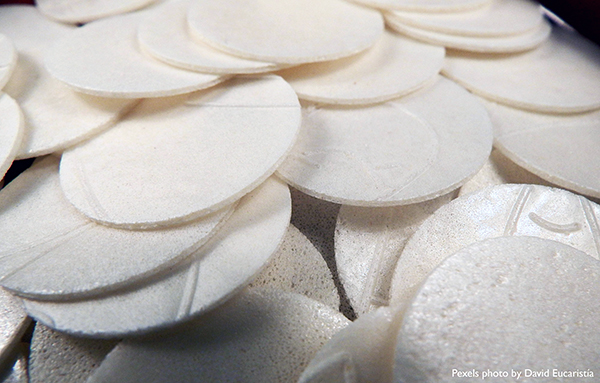
For example, Jesus commands us to go forth and baptize all nations, a very clear imperative from our Lord. The practical questions as to how that works, He leaves to the Apostles and their successors to figure out. Which is why things like the Didache, composed sometime in the first century, which lays out the practical requirements of baptism, were written. Catholics need to know the who, what, where, and how so that they can live out our Lord’s commands, and the Church, under the guidance of the Holy Spirit, establishes them. Put another way, Revelation tells us what to do, and the Church tells us how to do it.
That bread is to be used at Mass is of Divine Institution. The rules for what kind of bread is left to the Church. The Code of Canon Law for the Latin Church establishes the criteria: it must be real bread, it must be recently made so there is no danger of spoiling, it must be made from wheat, and in the Latin Church it must be unleavened.
The requirement that it be true bread made from wheat raises the question of low-gluten hosts. These hosts are, as the name says, low-gluten not no gluten. Removing gluten entirely means it is no longer true bread, which means it cannot be used to validly confect the Eucharist.
Recently made is a less clearly defined requirement. As various documents from the Holy See over the years have stated the climate of the place and the condition of storage impact how long before bread begins to spoil. Consecrated hosts should be consumed within a month’s time. Unconsecrated hosts can be stored for longer periods of time, using refrigeration and vacuum sealing and the like.
The bread must come from wheat and not have any additives. You cannot substitute other forms of bread from other grains or have anything other than bread in the bread. In the Latin Church, the bread must also be unleavened. This is rooted in tradition (small ‘t’) and is based on the fact that the bread Christ used was unleavened, as is required in the Passover Meal. In Scripture, yeast is symbolically associated with sin and corruption, and so excluding it from the bread that will become the Body of Christ helps highlight the Bread of Life as the ultimate source of freedom from sin and death.
There are not clearly established rules as far as who can produce the bread used for the hosts. In the middle ages, it was required in some places that cloistered religious produce the bread used for Mass for the sake of it not being contaminated by the “impurity” of the world.
There are still religious communities that produce hosts, but being produced by religious is not a requirement, as there are also many business that produce hosts. These businesses certify that the hosts they produce are made according to the requirements of the Church.
In summary, there is nothing that would absolutely forbid a priest from using homemade bread for the hosts at Mass, so long as he could be absolutely sure it was produced according the laws of the Church.
This question was answered by Father Caleb La Rue, chancellor of the Diocese of Lincoln. Write to Ask the Register using our online form, or write to 3700 Sheridan Blvd., Suite 10, Lincoln NE 68506-6100. All questions are subject to editing. Editors decide which questions to publish. Personal questions cannot be answered. People with such questions are urged to take them to their nearest Catholic priest.
