

Q. One of my New Year’s resolutions is to read the Bible on a consistent basis. Can you offer some tips to get me started and to keep me going?
A. This is a particularly appropriate question to consider in light of Pope Francis’ 2019 Apostolic Letter Aperuit illis, which declared that the third Sunday in Ordinary Time is to be devoted to “the celebration, study and dissemination of the Word of God.” The Holy Father goes on to say: “A day devoted to the Bible should not be seen as a yearly event but rather as a year-long event, for we urgently need to grow in our knowledge and love of the Scriptures and of the risen Lord, who continues to speak his word and to break bread in the community of believers. For this reason, we need to develop a closer relationship with Sacred Scripture; otherwise, our hearts will remain cold and our eyes shut, struck as we are by so many forms of blindness.”
Let me offer a few suggestions then in response to your excellent inquiry, beginning with some general principles and ending with several specific ideas.
First, be clear on your objective. The Bible is the written revelation of God, the voice of God in writing––inspired words through which God wants to talk to us. Your first objective and primary motivation in reading the Bible then should not be “to get something out of it,” but to listen as God speaks. On those occasions when you might not grasp what God is saying in a particular passage, your desire and attempt to listen are still expressions of love and devotion to the Lord, much as they are in patiently attending to a spouse or child, focusing on what the other is saying, even if it is unclear at the moment.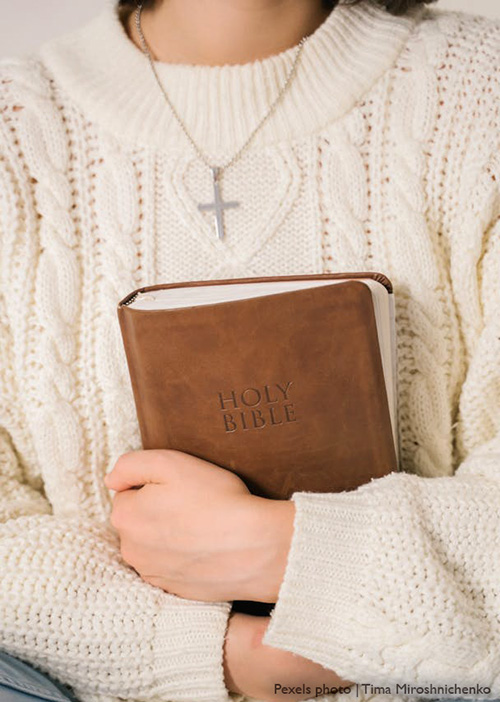
Second, read prayerfully. “We speak to Him when we pray; we hear Him when we read the divine saying” (St. Ambrose). Approach your Bible reading as one side of a two-way conversation. The voice that speaks in these sacred words is best heard by those whose hearts are open and attuned through prayer.
Third, stay focused on Christ. In the famous story of Jesus’ walking on the road to Emmaus with two of his disciples (Luke 24:13-49), our Lord confirmed that the entire Bible exists to bring us into a living encounter with himself. Always ask of every passage, “How do these words shed light on the One who is the Word?”
Fourth, avail yourself of helpful and reliable resources. It’s cute when a 3-year-old can button her coat or tie his shoes “all by myself,” but that’s not the goal in learning to read and understand the Bible. God has gifted the Church with many wonderful tools and resources (commentaries, radio programs, Emmaus Institute courses!) that can help us become better readers of the Bible. Regardless of how far along we are in our spiritual journey or how well studied we might be, we need each other on this path to glory. God has gifted his Church to assist us on the way.
Fifth, set realistic goals. Do not aim to master the Bible (no one ever does!), but to know and love the God who speaks there. In this way, Bible reading and study done properly ever remains a humbling and worship-inspiring exercise.
In terms of specific goals, while it is possible for an average reader to read through the entire Bible in a year, and many Christians succeed in that effort, I generally encourage people to settle into a single book of Scripture (say, Genesis or Matthew) for an extended time (a month or more)—reading, praying, rereading, meditating, even memorizing selected passages. Then move on to another book and repeat the process.
Alternatively, you might jumpstart your Bible reading resolution by focusing on the daily Mass readings, giving special attention to how the passages often highlight a common theme. And since the Scripture selections are usually short, it’s worth expending a little extra effort looking them up in your Bible and reading the fuller context (say, the entire chapter or the entire psalm from which the lectionary reading comes).
Over time, many people find themselves falling in love with certain biblical books. I am personally drawn to a handful of books in each Testament, and I tend to spend more time in those than in others. There is nothing wrong with this, especially since the lectionary cycles of the Church ensure that we hear more than just our favorite parts. It is good and necessary, of course, to listen to all that God has to say; but I have discovered that sometimes God opens his heart and speaks more intimately to mine as I snuggle into one of my chosen books and live there awhile.
Sixth, persevere. It’s always too soon to quit when it comes to reading the Bible and becoming familiar with the Divine Voice that speaks from its pages. Make Bible reading a daily habit, as daily as eating or sleeping. Start where you are, keep on going, and never stop learning and listening. Even small steps are better than no steps at all. Progress in any undertaking encourages further progress.
God bless your resolve and fill you daily with a deepening hunger for his Word.
This question was answered by Dr. Vern Steiner, president of the Emmaus Institute for Biblical Studies. For more information, visit www.emmausinstitute.net.
Write to Ask the Register using our online form, or write to 3700 Sheridan Blvd., Suite 10, Lincoln NE 68506-6100. All questions are subject to editing. Editors decide which questions to publish. Personal questions cannot be answered. People with such questions are urged to take them to their nearest Catholic priest.
