

By Father Kenneth Borowiak
for the Register
Bishop James Conley will celebrate a Solemn Pontifical Mass of Thanksgiving Feb. 2 to mark the 70th anniversary of vows of Mother Teresa of Jesus, the former prioress of the Carmelite Sisters at the Carmel of Jesus, Mary and Joseph near Agnew.
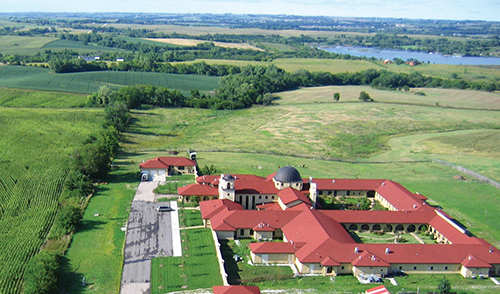
As one drives down a gravel road west of Agnew, right off Highway 79, one of the most scenic areas in the state of Nebraska is visible – the beginning of the southern end of the “Bohemian Alps.”
The Bohemian Alps is a region in southeastern Nebraska, largely in Saunders and Butler County, noted for its gently rolling hills and rural setting. Its name comes from Czech immigrants who migrated to the United States from Eastern Europe at the end of the 19th century and the beginning of the 20th century. The area reminded them of their homeland; Czech culture is still very noticeable in this area.
Atop a hill about 3 miles west of Agnew is a large yellow brick religious structure. This significant architectural landmark–the Carmel of Jesus, Mary and Joseph–has an extended, commanding view of four counties: Lancaster, Seward, Butler and Saunders.
A “carmel” is the name given to a religious monastery where cloistered Carmelite nuns live separately from the outside world.
Constructed in 2001, the Carmel of Jesus, Mary and Joseph is the home of 20 cloistered Carmelite Sisters. They are consecrated women religious, whose lives are dedicated mostly to personal prayer and to the prayer for others and the world at large.
Passing through the carmel’s impressive, large bronze doors allow visitors to step into a time from the past, preserved from the hectic demands of today’s world. One immediately smells the lingering aroma of incense entering the Romanesque chapel adorned with elaborate mosaics. Behind the Communion rail and to the right of the sanctuary is the cloister – where the Sisters gather daily for Mass and private and communal prayer.
Set off from the rest of the building by a cast iron grill, the beautiful chapel is the setting for the reverent celebration of the Traditional Latin Mass. The Sisters’ voices in unison chant the hymns in responses to the Mass in heavenly melodies.
Bishop James Conley will celebrate a Solemn Pontifical Mass of Thanksgiving Feb. 2 to mark the 70th anniversary of vows of Mother Teresa of Jesus, the former prioress of the Carmelite Sisters at the Carmel of Jesus, Mary and Joseph.
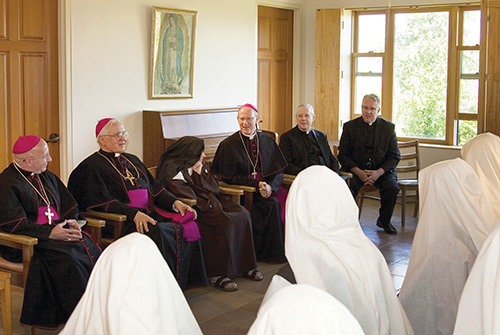
“Mother Teresa has a gentle strength,” said Father Christopher Barak, who serves as chaplain to the Carmelites. “She is always very kind, respectful and humble. We all feel the warmth of her heart in her quick wit, happy smile and quiet laughter.
“Her long life of continual prayer and daily penances allows her to peacefully accept all that happens to her for God’s glory,” he continued. “Mother Teresa deeply loves and is deeply loved by Her Bridegroom Jesus Christ. This makes her exude with great joy.”
A native of Chile, Mother Teresa of Jesus came to the United States for college and graduated in 1953.
Her older sister, who became interested about religious life by reading, passed on to her books about the Carmelites’ foundress, St. Teresa of Ávila (1515- 1582) and St. Thérèse of Lisieux (1873-1897), a Carmelite who Pope St. Pius X called St. Thérèse of Lisieux “the greatest saint of modern times.”
Intrigued by the notion of a cloistered life, Mother Teresa of Jesus went to a Catholic college: Marymount in Tarrytown, N.Y. It was there that she was introduced to consecrated women religious and a Carmelite priest chaplain. She discovered the beauty and depth of the sacraments of the Catholic Church, Eucharistic adoration and retreats.
Following her introduction to Carmelite spirituality, she encountered the Carmel of Cristo Rey in San Francisco. That Carmelite community came from Mexico. Their first language was Spanish, which was to Mother Teresa of Jesus’ advantage, since she was from Chile.
The Carmelite Sisters are a cloistered religious order, which means that the sisters live entirely behind the walls and confines of the Carmel. At the Carmel of Cristo Rey, Mother Teresa of Jesus said, she found a world that lies in mystery — a mystery of divine faith, ardent love, unfailing hope and a desire to serve the Church and others through prayer.
The Sisters begin their day at 4:30 a.m. Their daily horarium (“order of life”) centers on the celebration of the Holy Mass, two hours of mental prayer, the praying of the Divine Office in choir, work – which includes housework, food preparation, needlework, caring for the animals and gardens when in season, and other handiwork. One of the noted works that the Carmelite Sisters do is the creation and sewing and embroidering of vestments for Mass.
Another work of significance is praying for the needs of the local Church, others outside the Carmel, and the world at large. Many people seek out the intercession of the Carmelite sisters. The public may submit prayer requests by writing to the nuns at the Carmel of Jesus, Mary and Joseph (9300 W. Agnew Rd., Valparaiso, NE 68065-8724).
“We help people in the world with our prayers,” Mother Teresa of Jesus said. “Many people write to us asking for prayers.”
While many of the prayers reveal the difficulties of family life and the problems facing the world, the Sisters do not let the difficulties of the requests get them down.
“We give them to God,” Mother Teresa of Jesus said.
Mother Teresa of Jesus said the members of the community support one another by maintaining a life of prayer and solitude. The Sisters keep silence during most of the day.
“Even though one might see challenges in living in a close-knit community within a cloister, we strive to see our Lord in our mother prioress and the other sisters,” Mother Teresa of Jesus said.
In addition to supporting each other in community, she believes that the sisters contribute to society and in a larger way.
“By prayer and sacrifice we make an offering of our self to the Lord,” Mother Teresa of Jesus said.
The Sisters see the will of God in and through the current prioress. After being prioress for 35 years, Mother Teresa of Jesus is a mentor to everyone else.
Even though silence is a mainstay of community life, the sisters celebrate occasions like birthdays and religious holidays with great joy and fraternal celebration – especially during recreation – by singing and enjoying festive meals.
In November, Bishop Conley invited Professor William Shomos, director of opera at the University of Nebraska-Lincoln, to perform a portion of the opera, “The Dialogues of the Carmelites,” recently staged by his department. The opera is a fictionalized version of the true story of the martyrdom of 16 cloistered Carmelite nuns from a monastery near Paris during the closing days of the Reign of Terror July 17, 1794. The 16 Carmelite nuns were guillotined in the main square of Paris, one by one, for refusing to renounce their vocation. The nuns are now venerated as beatified martyrs of the Catholic Church. Ten days after their execution, the Reign of Terror ended.
Professor Shomos agreed, and he, his music director and six student actors visited the Carmel of Jesus, Mary and Joseph. The students performed four duets from the opera for the Carmelite nuns. The Sisters in turn sang a beautiful multi-harmonic hymn by Palestrina, “much to the delight of the students,” Bishop Conley said.
An exchange of questions and answers followed between the nuns – behind their grille – and the students in the “speak room” for visitors, many of whom were similar in age. The bishop called the discussion “a moment of grace and joy.”
For Feb. 2, Father Barak said, the nuns are excited for the celebration. They are “preparing spiritual bouquets, special Mass music, decorations, songs and entertainment and a delicious meal for Mother Teresa.”
Founded in 1150, Carmelites existed much earlier, founded by their holy father, St. Elijah the prophet, and his followers who lived throughout the centuries on Mt. Carmel, and were then baptized Christians through the preaching of the Apostles. Europeans joined them around the time of the Crusades.
As the world becomes increasingly secular, Mother Teresa of Jesus believes that a cloistered religious community has a central role to play in the Church.
“The Mass that we celebrate has changed very little in hundreds of years,” she pointed out, “and the silence that is an essential part of that Mass reminds us of the transcendence of God in the importance of prayer for the entire world.”
In reflecting upon 70 years of religious life, Mother Teresa of Jesus said that for her, Jesus is “the baby Jesus and my spouse. The true treasure of cloistered life is “offering everything to God and helping others to do so.”
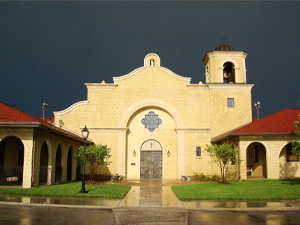
The Carmel Chapel is open to visitors from 6 a.m. to 6 p.m. every day. Mass is celebrated in the extraordinary form and is held at 7 a.m. on weekdays, and at 8 a.m. on Saturday and Sunday (although the schedule is occasionally changed for holy days and veilings of nuns). All are welcome.
People who wish to help the Carmelites may offer to God their prayers, fasting, penances and works of charity to gain graces for the nuns.
Editor's Note: Feb. 2 is World Day of Consecrated Life in the United States. Read more at the usccb site.
--
Longtime chaplain recalls first meeting
By Cathy Blankenau Bender
Editor-in-Chief
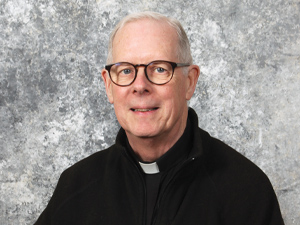
Msgr. Timothy Thorburn, currently pastor of Sacred Heart Parish in Lincoln, was the first to speak with the Carmelite Sisters who founded the Carmel of Jesus, Mary and Joseph in the Lincoln Diocese.
“I first spoke with Mother Teresa when she called the Chancery asking to speak with Bishop Bruskewitz about starting a new foundation of Carmelite nuns in our diocese,” Msgr. Thorburn recalled. “Hers was a tiny, soft little voice. I soon learned that behind that little voice was a strong will, not motivated by stubbornness, but by the love of God and the desire to do his holy will.”
It wasn’t long after that call that a small group of nuns visited the diocese, and Msgr. Thorburn met the one who had that little voice on the phone. Bishop Bruskewitz asked Msgr. Thorburn to take the nuns to various sites near Lincoln, to look for suitable property for a cloistered Carmelite monastery.
“And that is when I had the blessing to come to know Mother Teresa, and see that her only desire was to discover what our Lord wanted of her and her little community,” Msgr. Thorburn said.
“Although small and almost easy to miss in the group of visiting nuns,” he said, “Mother Teresa had – and still has – a smile that expresses joy, trust and confidence. And it truly was joy, trust, and confidence that became the foundation upon which our Carmel of Jesus, Mary and Joseph was established.”
The nuns first lived in a farmhouse a few miles from where the monastery was being built. A number of priests took turns celebrating Mass for the founding group, including Msgr. Liam Barr, who was pastor at Ss. Mary and Joseph Parish in nearby Valparaiso at the time, and Bishop (then Msgr.) Robert Vasa, who was vicar general at the time, and Msgr. Thorburn, who was then chancellor. When the Carmel of Jesus, Mary and Joseph was completed in 2001, he was appointed its first chaplain.
In the years Mother Teresa of Jesus was prioress at the Carmel, he said, the best description of her leadership style is that “she ruled with love.”
“The love of Jesus is the signature of our Carmel and its foundations,” he explained. “I noticed that it was with love that Mother always dealt with the Sisters, and I also noticed that it was with love that they always related to her. She was far more ‘mother’ than ‘superior.’”
Now, he said, she remains an example of love in the community.
Mother Teresa’s unofficial title today is “Madrecita,” or “little mother.” Thorburn said the title fits her “in every sense of the word.”
“First of all, Mother is small of stature,” he said. “Secondly, she is ‘little’ as St. Thérèse of the Child Jesus used the term.”
In the spirituality of the Carmelite Sister St. Thérèse of Lisieux, which the saint called the “little way,” she discovered that Jesus is attracted by those whom the world considers unimportant or useless: “Truly I say to you, unless you turn and become like children, you will never enter the kingdom of heaven,” Jesus said (Matthew 18:13).
“Our Mother Teresa seems to have taken those words as her marching orders,” Msgr. Thorburn said.
