

By Father Kenneth Borowiak
for the Register
From a farm just outside Pawnee City, to the architectural splendor of Vienna, Austria, Msgr. Richard Gyhra never imagined that he would be in a leadership role for the international Catholic Church.
Msgr. Gyhra began his priesthood in 1999 as an assistant pastor in Lincoln and teacher at Pius X High School. In 2007, then-Father Gyhra was notified by Bishop Fabian Bruskewitz that he would be serving in the Catholic Church’s diplomatic corps. After three years of formation, Father Gyhra was assigned as secretary of the Apostolic Nunciature in the Dominican Republic. He served there from 2010 to 2013, when he was made a Chaplain of His Holiness (monsignor).
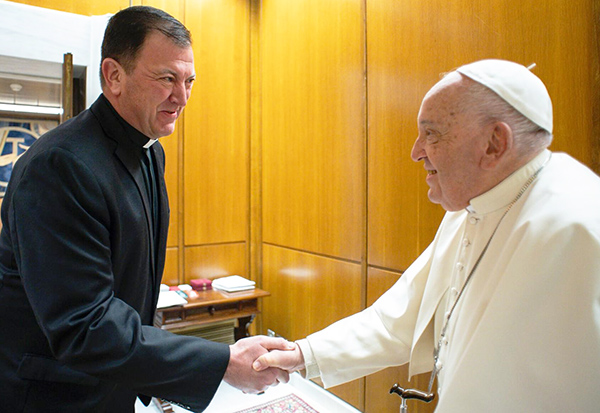
Msgr. Gyhra was then appointed secretary to the Permanent Mission of the Holy See to the United Nations in Geneva, Switzerland. In 2017, he was assigned to the Vatican’s Secretariat of State office in Rome, and five years later he was named counselor of the apostolic nunciature in Tanzania. Last year, he was made a Prelate of Honor and assigned by Pope Francis to be the permanent representative of the Holy See to the International Organizations in Vienna. In this position, Msgr. Gyhra is the pope’s ambassador for the Holy See to the United Nations office and specialized agencies, some of which are referred to below.
The Register recently had the opportunity to speak with Msgr. Gyhra by email, about the new role. Following is a part of that discussion.
SNR: How were you notified of your new posting?
I had come home to Nebraska to celebrate my silver jubilee of ordination to the priesthood, which was May 22, 2024. I received a call from Cardinal Pietro Parolin, the Secretary of State of the Holy See, who asked if I would accept an appointment as the Holy See’s Ambassador to the International Organizations in Vienna. I began my current position in September.
SNR: What is the mission of the Holy See?
The mission of the Holy See is to assist the Roman Pontiff in carrying out His divine mandate as a successor of St. Peter, the Vicar of Christ on Earth. That mission is the salvation of souls, which we believe comes through Christ and the Church He established. On the diplomatic level, one of the main goals is to protect the freedom of religion in countries throughout the world, so that the message of Christ may reach all and they may have the ability to adhere freely to the Gospel of Christ.
SNR: In November, you met with Pope Francis. What did that involve?
Each year, nuncios and heads of missions are encouraged to schedule a meeting with the Holy Father to share information and update the pontiff about their work. In my case, we discussed a number of global issues, such as the conflicts in the world that are the daily concern of the organizations I have to follow.
SNR: Did he make suggestions?
The Holy Father has a great appreciation for multilateral diplomacy – that is, discussions involving multiple countries as they work toward agreement in various issues. He views the international forum as the proper arena to discuss and to negotiate issues that have an impact on all nations and all people globally.
SNR: How do you respond to people who say the Church should not be involved in the areas and issues that are addressed by the United Nations?
The Holy See is recognized as a sovereign nation according to international law, and thus has the ability to act as any other state in international relations, both on the bilateral and the multilateral levels.
Within the international arena, there is a growing awareness of the importance of religion and interreligious dialogue in the issues being addressed. In the past, the role of religion was not given much attention, but it is becoming more prevalent in discussions now, providing an excellent opportunity for the Holy See to be engaged and guiding the discussions on this point.
SNR: Is the Holy See at the United Nations by accident or does the Church have a prophetic voice at the international table of discourse?
The Holy See was engaged in the creation of the United Nations in 1945. At that time, it was decided that the Holy See would remain politically neutral, and thus the Holy See has always retained the status of “observer” at the United Nations, rather than a full member. The observer status allows full engagement in all the meetings, but without the right to vote.
SNR: What are the key issues of concern to the Church that are in front of the United Nations today?
I think the most urgent priority of the Holy See with the United Nations is seeking ways to de-escalate and eventually to eliminate wars and conflicts. While most would think of the Ukraine and Middle East, there are actually more than 45 areas of armed conflict in the world today.
Other issues of great importance are the numerous threats to fundamental human rights, including the protection of human life, the respect for freedom of conscience, religion and belief, which is widely abused as seen with the attacks against Christians the world over, among others.
SNR: What is the OSCE and what does the Catholic Church contribute to the discussions about security in Europe?
The Organization for Security and Co-operation in Europe (OSCE) is a regional organization that was started Aug. 1, 1975. The original purpose of the OSCE was to provide an organization where issues during the Cold War could be debated and discussed with the hope of avoiding escalation and nuclear war. While it was fairly successful in that area, the present situation with the war in the Ukraine, which is one of the main issues in our daily discussion, has proven to be more challenging.
Though the Holy See does not have any military or commercial power, its potential influence lies in the fact that it provides a moral voice, striving for peace through de-escalation and ceasefires to stop bloodshed and to work at diplomatic solutions to the conflict.
SNR: What does the Catholic Church bring to the discussions of the International Atomic Energy Agency (IAEA)?
The focus of the IAEA is on the reduction of nuclear weapons and the peaceful, safe, and sustainable use of nuclear energy for non-military ends, for example, in medicine, agriculture, alternative power, and so forth. The Holy See tries to provide a moral compass in these challenging discussions which are usually dominated by military and geo-political interests rather than the common good of humanity.
SNR: What practical ways can the Church encourage nations to limit or stop nuclear weapons testing?
The Holy See is a founding member of the Convention on the Nuclear Test-Ban Treaty Organization (CTBTO), which is working toward the elimination of nuclear testing for military purposes. The countries possessing nuclear weapons are the only ones who have not ratified the convention. Getting them “on board” is a slow and difficult road, but one that is worth the effort.
SNR: What is the United Nations Industrial Development Organization (UNIDO)?
The UNIDO was created in 1966 to promote and accelerate the industrialization of developing countries, which were emerging from decolonization in record numbers. The organization probably had its height of success in the 70s and 80s.
SNR: How do you hold the interests in people of every country while acknowledging nations which are at war with each other?
Unfortunately, as Pope Francis often says, we are experiencing a “third world war” being fought piecemeal. In such a situation, the Holy See engages with all countries, especially those in conflict, to stop fighting, to seek peace, to respect human life.
SNR: How do you think your small-town upbringing prepared you for dealing with/working with people from very different cultures/opinions/experiences/perspectives?
Coming from rural Nebraska, being raised on a farm, I think one usually has a good work ethic, a sense of simplicity of life, being respectful, honest and unassuming. These are a few qualities that can be useful in the work I am doing.
SNR: What does your average workday look like?
The day begins with prayers and then Mass at 7:30 in our chapel. After a quick breakfast, I am in the office until the meetings begin at the OSCE or the UN, which usually go from 10 a.m. to 1 p.m. After lunch, I will either return to the organizations for afternoon meetings or work in the office, preparing reports. Many evenings, there are receptions to attend or other social events.
SNR: What are your thoughts of Vienna? Is there anything that reminds you of Nebraska?
Vienna, and Austria in general, is a place with a rich history and culture. Vienna is known for many things, especially for being “the city of music,” since some of the greatest composers came from Austria. There are also wonderful Advent and Christmas markets. The Austrians like their meat and potatoes, as do most central-Europeans, many of whom migrated to Nebraska generations ago, so the food is somewhat similar to what I grew up with.
SNR: How difficult is it to serve so far away from your brother priests and people of the Diocese of Lincoln?
In addition to keeping in touch with a number of brother priests in the diocese, I try to make my yearly retreat at one of the diocesan priests’ retreats offered each summer. Although I have been working outside the diocese for almost 20 years, I still feel very connected to the diocese and the presbyterate there and always feel very much welcomed by the brother priests when I am back for vacation.
SNR: When faced with uncertainty or apprehension, how are you able to surrender that to God?
Since this job is something asked of me by the Church, I am confident that through being obedient and completely dedicated to this mission, that God will always provide the grace and strength to remain faithful and committed to my vocation and my work as a diplomat.
