

Q. Prior to Jesus’ public ministry, do you think He used miracles to fix his everyday situations, like his carpentry? At the wedding feast of Cana, it appears Mary knew Jesus could work miracles.
A. There are stories of Jesus performing miracles as a child, but they come form sources outside the biblical canon accepted by essentially all mainstream Christian denominations.
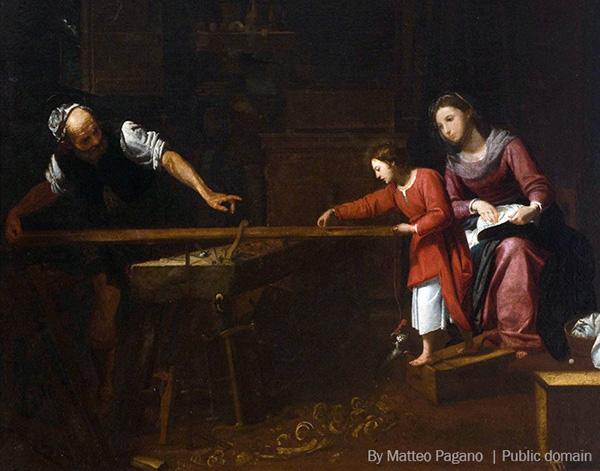 The most notable source is the apocryphal (that is, non-canonical) Infancy Gospel of Thomas. Written by an unknown source in probably the early to mid-second century, it contains stories in which Jesus resurrects a young boy and heals a young St. James. According to this account, he even miraculously elongated a piece of wood to help St. Joseph in his carpentry. These are nice stories that seem in concert with what we know about Christ from the Gospels, namely, raising the dead and healing the sick.
There are also stories in this “gospel” of Jesus performing “miracles” that are less comforting and more smite-y. These include drying a child out so that the child shriveled and died, striking another child dead because he messed with something Jesus was working on, and then blinding the parents of the child he just murdered, because they were unhappy about the murder. These are very much not in concert with what we know about Jesus, which is why even contemporaries of the Infancy Gospel of Thomas (like St. Irenaeus) said it was all made up.
Remember, Tradition formed Scripture in that if something written down about Jesus did not mesh with the Teaching of the Apostles, it was not considered authentic.
The canonical Gospels do not give any evidence to suggest Jesus performed miracles as a child. The few glimpses we get into the childhood of Jesus from the Gospel of Luke indicate Jesus was a thoughtful, prayerful, obedient child who – while clearly aware of being the Son of God – outwardly did nothing to demonstrate that in so dramatic of a way as performing miracles. If Jesus had performed miracles as a child, it seems like Mary would have included that when she was telling St. Luke about her experiences as the Mother of God.
In fact, there is good evidence to suggest that he did not perform miracles as a child. Following the account of the Miracle at the Wedding Feast of Cana, John the Evangelist says, “Jesus did this, the first of his signs, in Cana of Galilee, and revealed his glory” (NRSV John 2:11). The “first of his signs” seems to imply this was the first miracle He had performed.
One could argue that this was not the first miracle Jesus ever performed, but rather the first public miracle he ever performed, marking the beginning of His public ministry, as other translations of this passage imply, such as the NAB which uses the wording “the beginning of his signs in Cana in Galilee.” While this passage certainly does not explicitly establish that Jesus performed miracles prior to this, one could argue that it also does not preclude that possibility.
While that argument could be made, it does not take into account what we know of the perspective of those who knew Jesus to some degree while He was growing up, namely, His neighbors and close relatives. The people who knew Jesus from “back home” were very confused when He began His public ministry: “Is this not Jesus, the son of Joseph? Do we not know his father and mother? Then how can he say, ‘I have come down from heaven’?” They probably would have been less skeptical about Jesus coming down from Heaven if they had seen him raise one of their neighbors from the dead when they were growing up.
I am of the belief that Jesus did not perform miracles as a child, based on the Scriptural evidence we have on the topic. My belief is that Mary knew Jesus could help the couple at the Wedding Feast of Cana because she had “kept all these things, reflecting on them in her heart” (Luke 2:19). She trusted that Jesus could help, even if she perhaps did not know exactly how He would help. But she knew He would. It a beautiful reminder of the faith in Christ we are called to have, believing that He will always help, even if we don’t understand how.
This question was answered by Father Caleb La Rue, chancellor of the Diocese of Lincoln. Write to Ask the Register using our online form, or write to 3700 Sheridan Blvd., Suite 10, Lincoln NE 68506-6100. All questions are subject to editing. Editors decide which questions to publish. Personal questions cannot be answered. People with such questions are urged to take them to their nearest Catholic priest.
