

Q. Are non-Catholics permitted to take up the gifts at Mass?
A. I think I have said this before, but I am often asked how I decide which questions to answer for “Ask the Register.” Usually it is one I think is interesting, or that people will find the most interesting.
Sometimes (like this one) I choose one I think I can answer quickly, because I am busy and do not have the time to devote to a more complicated answer. Usually, though, when I do that, a question I think will have a simple answer turns into a deep-dive in theology I was not expecting, which is exactly what happened this week.
When speaking about who is to bring up the offerings at Mass, the General Instruction of the Roman Missal has this to say: “It is praiseworthy for the bread and wine to be presented by the faithful” (GIRM n.73). When an Offertory procession happens at Mass (which is not required) the “faithful” are to bring up the gifts. That’s about as much specificity as the Church gives on this question. Which is actually more specificity than might first be apparent.
The Church recognizes that all Christian faithful, through baptism, belong to the People of God (CIC c. 204 §1) and therefore belong to The Church of Christ. In this sense, “faithful” includes all of those who have been incorporated in Christ, including those who are not in visible unity with the Catholic Church. However, The Church of Christ subsists in the Catholic Church (Lumen Gentium 8), meaning that it is only in the Catholic Church that the fullness of The Church of Christ is visibly present in the world, even though “many elements of sanctification and of truth are found outside of its visible structure” (ibid.) Even these elements though, which are “gifts belonging to the Church of Christ,” impel those who are able to share in them (our Orthodox and Protestant brothers and sisters) toward Catholic unity (ibid.8).
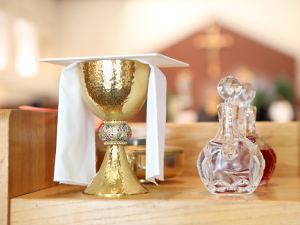
Those who are in visible unity with the Catholic Church are granted by the Church certain rights, foremost amongst them the right to receive the sacraments. There are other rights too which, though less lofty, nonetheless reflect that Catholics are able to fully participate in the life of The Church of Christ on Earth. These would include something as seemingly trivial as carrying up a cruet (the little glass container) full of wine or water or a ciborium (the gold vessel used to hold the bread that becomes the Body of Christ) at Mass.
I say seemingly trivial because, like all things at Mass, there is far more going on during the Offertory than we might always be aware of. The carrying of the gifts that will become the offerings of the Mass by the laity is meant to reflect the participation in the sacrifice of the Mass by all. While the priest in persona Christi (“in the person of Christ”) is the one who offers the Mass, all of the faithful participate in that one offering by offering their “first fruits” to God. To reflect this, it was (and still is in some places of the world) common for the bread and wine to come from the people themselves.
Even more than just a symbolic participation, the carrying of the gifts up to the sanctuary is meant to lead the faithful gathered around the Altar of the Lord to call to mind and actually offer everything they want to give to God. Stress, fear, anger, hurt: all the things we carry around and are burdened by can and should be united to the Sacrifice of the Mass. Just as Christ redeemed our humanity on the Cross, he redeems all our sufferings in the Mass. Completing the exchange is our reception of Communion. We give Jesus all of the garbage weighing down our hearts and He gives us Himself.
Because non-Catholics are not in visible communion with the Catholic Church and therefore in ordinary circumstances lack the right to receive Communion, they should not take up the gifts at Mass because they cannot complete the exchange initiated by the offering of the gifts. Similarly, those who, even though they are baptized Catholics, are not properly disposed to receive Communion or are unable to receive Communion, should not take up the gifts at Mass.
This question was answered by Father Caleb La Rue, chancellor of the Diocese of Lincoln. Write to Ask the Register using our online form, or write to 3700 Sheridan Blvd., Suite 10, Lincoln NE 68506-6100. All questions are subject to editing. Editors decide which questions to publish. Personal questions cannot be answered. People with such questions are urged to take them to their nearest Catholic priest.
