

“Trust in the Lord with all your heart, and do not lean on your own understanding. In all your ways acknowledge him, and he will make straight your paths.” Proverbs 3:5-6
During this Jubilee Year, many of us are making pilgrimages, whether all the way to Rome or to designated pilgrimage sites closer to home in our diocese. Through this Humanities Syllabus, we are embarking on another kind of pilgrimage, through some of the greatest landmarks of our cultural and literary tradition, which enliven our minds and imaginations.
 By rediscovering these treasures, we are tracing the human journey as beings who desire truth and seek to rest in goodness. Amidst the ardors of this pilgrimage, beauty continues to inspire us, so that we do not lose heart and keep the fire of love burning within us.
I was glad to see the enthusiasm for the first installment of this Humanities Syllabus, focused on the experience of faith in America. I hope that as this series continues to unfold, the faithful of our diocese and beyond will be enriched by these selections and will enjoy them together, as families, parishes, and schools. I would encourage you to meet in person to discuss the readings, recite the poetry, listen to the music, and watch the films (with age appropriate groups).
All human beings must journey through life. We begin in ignorance, slowly learning from our families, schools, and our own experiences. Like Abraham or Moses, we are also pilgrims on a journey of faith, called by God to a homeland beyond this world. The joys and difficulties of life are all meant to point us to this transcendent destination that can only be reached with the help of God.
Our theme this month unpacks both the human and supernatural dimensions of life’s journey as a great search for our identity and purpose, which can only be found ultimately in God.
Book
In our restlessness, we are all looking for the place we belong, to recapture in a more perfect way the security and warmth of our childhood and home. After 10 years of battle, Odysseus, a hero of the Trojan war, spends another fateful decade struggling to return to his own wife, Penelope, and his son, Telemachus, who desperately await his return. His wiles, pride, and prowess both impress and distress us, as he faces inhuman challenges and triumphs with help from above.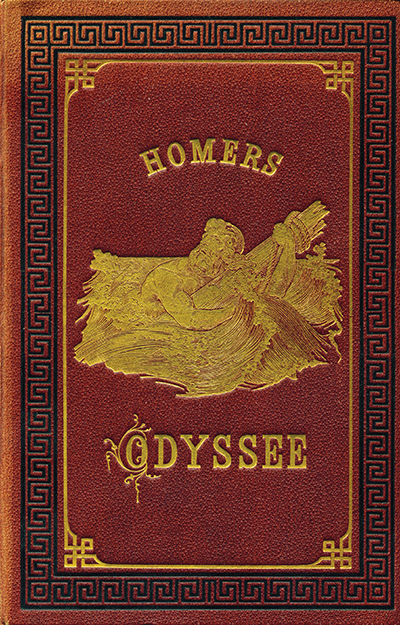
Homer’s epic poem the “Odyssey” was immensely impactful to me in college at the University of Kansas. I first read the book when I was 18 years old. I doubt if I understood even half of what I read, but I knew 100% that this was a great work of literature.
Over the past 50 years, I’ve returned to it time and time again, during the different seasons of my own life. The story never gets old for me. It is a story ultimately about going home. For Odysseus, it was the arduous journey to his island home of Ithaca, Greece. In our heart of hearts, we all have a longing for home. This longing of the heart signifies the universal human desire for belonging, and the struggles one faces to reclaim his or her rightful place within their family and community.
As Christians, our ultimate home is heaven. Life is a journey, a pilgrimage to our eternal home. We receive glimpses along the way, signposts and markers, to guide us along the journey.
I’m happy to say that in our Catholic high schools in the Diocese of Lincoln, all of our students will be reading the “Odyssey” at some point in their four years.
After I graduated from college, I spent a year traveling in Europe, mostly hitchhiking and taking trains. I picked up a little verse along the way that has always stayed with me. I think it’s from an old Protestant hymn:
Here in this body pent,
Absent from him I roam,
Nightly pitch my moving tent,
A days march nearer home.
I enjoyed my journey, but I also knew it would eventually lead me home. Odysseus focused on getting to his home. As Christians, we, too, need to keep our eyes on the horizon as we march toward our forever home—with God.
Film
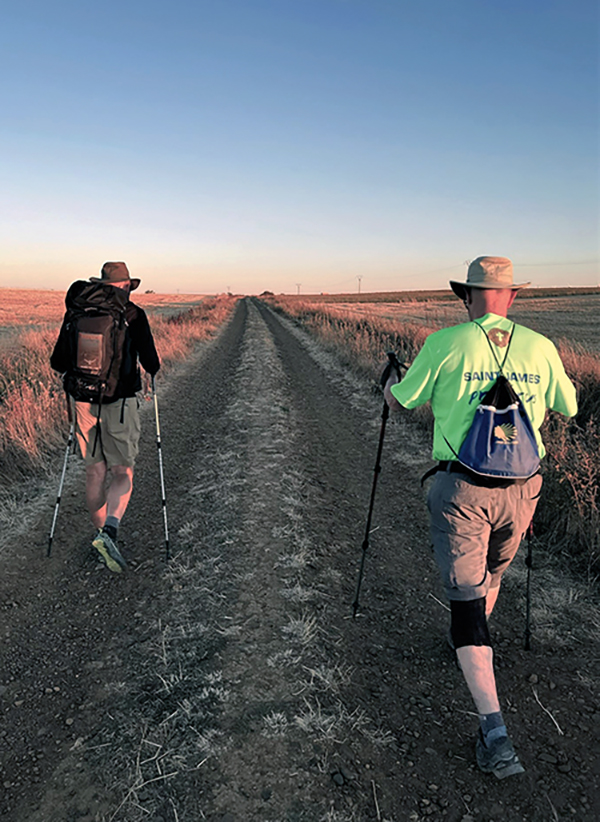
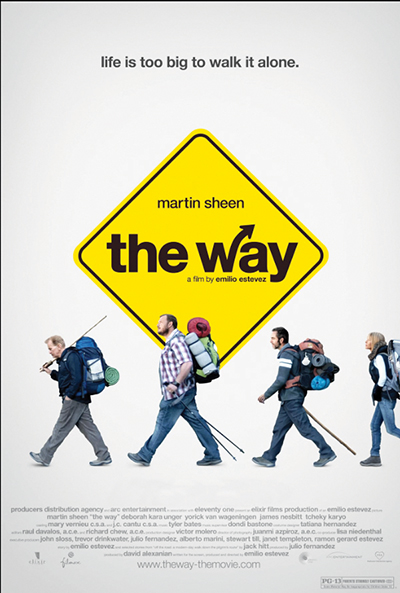 Odysseus may provide the archetypal journey of world literature, but, from the vantage point of faith, we know that we are trying to find a home that is not of our own making. Pilgrimage responds to God’s call to leave our homes behind, in search of greater conversion and transformation. The great Christian pilgrimage of Europe, the Camino, crosses the beautiful hamlets of the northern Spain to reach the great shrine of Santiago de Compostela.
Over the past 12 years, I have walked portions of the Camino four different times. Each time is a very different experience than the one before. Ultimately, the Camino is a walking pilgrimage, a journey of faith that traces the ancient route to the to the final resting place of Saint James the Greater. People walk the Camino for multiple purposes such as spiritual renewal, self-discovery, and connecting with the beauty of nature. The Camino can also be a metaphor for life, with experiences of pain, hunger, and exhaustion. But it is also an opportunity to experience culture, community and a deep sense of history.
A popular movie made by a father and son, director Amelio Estevez and actor Martin Sheen, “The Way” (2010) traces a modern experience of this medieval trek. It’s not a pious film, but accurately depicts the search for meaning in a secular world, which remains with us no matter how far away we stray from faith. The film is technically flawless and really captures the beauty, mystery and challenge, that pilgrimages like this provide.
Music
Turning from the siren songs of the world, a pilgrimage needs festive and devotional music to express its joyful expectation. Another delightful treasure of medieval Spain can be found in a collection of music, some of which would have been sung along the Camino, called “The Red Book of Montserrat” (“Llibre Vermell de Montserrat”). The musical collection known for its red binding was assembled in 1399 at the monastery and shrine of Montserrat, and manifests the exuberance of the pilgrims with its stunningly beautiful melodies, especially the song “Mariam matrem virginem.”
Poetry
In the pilgrimage of life, we thankfully do not search for our homeland on our own. We wouldn’t have much hope of reaching our eternal destination if God himself did not come to search for us. Our poem for this month expresses this essential truth.
Francis Thompson’s 1890 classic “The Hound of Heaven,” narrates Christ’s dogged pursuit of each one of us, as he does not allow us to rest in our failed attempts of finding happiness apart from him. Read the whole poem at www.houndofheaven.com/poem.
Art
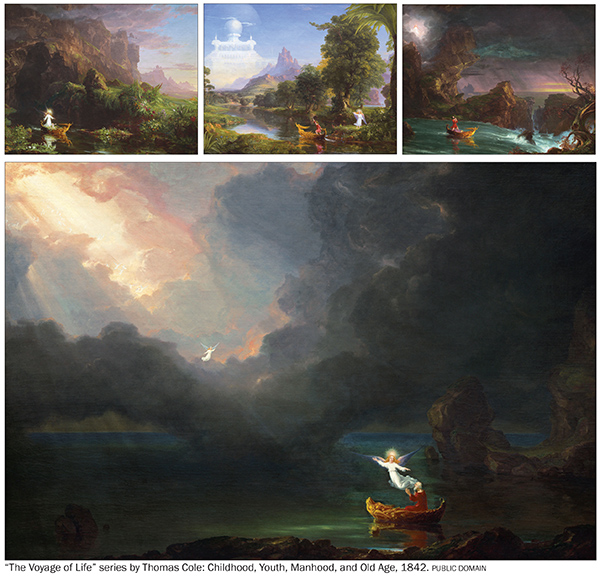
Life’s journey unfolds in major acts from childhood to old age, each with its own dynamics. The great American painter Thomas Cole depicted this reality movingly in a series of paintings, “The Voyage of Life.”
Childhood, Youth, Manhood, and Old Age make up the four scenes that follow the four seasons, each narrating the same figure traveling by boat with the aid of his guardian angel—closer or farther away, depending on his state. The beauty and tension of the scenery, a hallmark of the Hudson School of painting, embody the move from a dreamy idealism to the turbulence of challenges we face later in life that must be resolved before arriving safely to port.
The Journey
As we see in each one of these works, life is more than getting from the beginning to the end. It’s about the struggles, the joys and the relationships we encounter along the way. We are Odysseus making our way home. We are the pilgrims in “The Way,” learning life lessons.
Our soul is guided by the music that moves us just as it did for travelers centuries ago. We find ourselves fleeing from God at times, only to look over our shoulder to see Him pursuing us.
And as in “The Voyage of Life,” we are moving through different stages, different scenes in our lives, but always moving forward and growing with each experience.
Each of these points to the Bible verse that has guided us through this section of our journey through the arts: “Trust in the Lord with all your heart, and do not lean on your own understanding. In all your ways acknowledge him, and he will make straight your paths” (Proverbs 3:5-6). When we come to the ultimate realization that life is not about us, but about Him, and we truly trust in Him, our paths will be made straight to Him. So fellow traveler, I’ll see you down the road on this journey of life!
BISHOP CONLEY'S HUMANITIES SYLLABUS
February: “The Journey of Life”
Books:
“The Odyssey” by Homer
Film:
“The Way” (2010)
Music:
The Red Book of Montserrat (Llibre Vermell de Montserrat)
Poem:
“The Hound of Heaven” by Francis Thompson
Art:
“The Voyage of Life,” Thomas Cole
ADDITIONAL SUGGESTIONS
Books:
“The Lord of the Rings” by J.R.R. Tolkien
For children: “The Hobbit” by J.R.R. Tolkien
Film:
“O Brother, Where Art Thou?” (2000)
For children: “Treasure Island” (1950)
Music:
“String Quintet in C” by Franz Schubert
“The Moldau” by Bedřich Smetana
For children: “The Musical Life of Gustav Mole”
Poem:
“The Pillar and the Cloud (Lead Kindly Light)”by St. John Henry Newman
“The Canterbury Tails,” by Geoffrey Chaucer
“The Wanderer,” Anglo-Saxon poet
For children: “My Heart’s in the Highlands” by Robert Burns
Art:
“Altarpiece of Ghent” by Jan van Eyck
For children: “Father Hennepin at Niagara Falls (1678)” by Thomas Hart Benton
Website:
benedictinstitute.org
The Benedict XVI Institute for Sacred Music and Divine Worship’s unique mission is to open the door of Beauty to God
Editors Note: Click here for more Diocese of Lincoln Jubilee 2025 Resources
Click here for all the Humanities Syllabus postings
