

Q. Did Mary experience pain when she gave birth to Jesus?
A. A few years ago, a movie was released in anticipation of the Christmas season that depicted the birth of the child Jesus in Bethlehem. Almost overnight, the online Catholic world was in a tizzy because the movie depicted a portrait of Mary that experienced pain during her labor. Many decried the film because of its “inaccurate” depiction of the birth of Jesus. But was it actually inaccurate? How should we think of the birth of Jesus?
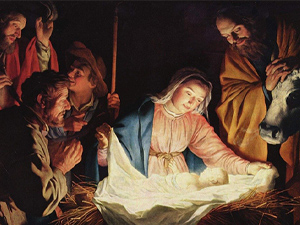 First, let’s establish a basis for the question. After the fall of Adam and Eve, God tells the woman: “I will surely multiply your pain in childbearing; in pain you shall bring forth children” (Gen 3:16). If Mary is conceived without sin (a dogma of the faith commonly called the Immaculate Conception), should she be subject to the consequences of sin? Put differently: if Mary was freed from the stain of original sin, does that mean she was also freed from the pain that results from original sin, including the pain of childbirth?
It is an intriguing question—and one that is as old as the Church herself. The Church fathers wrestled with it and came up with a variety of solutions. Ultimately, the Church does not definitively declare a ‘yes’ or ‘no’ on the matter, and a faithful survey of both Scripture and Tradition could lead us toward two equally valid options: either (1) Mary did not experience pain at the birth of Jesus; or (2) Mary did experience pain at the birth of Jesus. Let’s consider the reasoning behind each answer.
Option 1: The first supporting piece of evidence would be the issue raised in the basis for the question. Mary is presented to us not only as the mother of Jesus, but as the new Eve. One prominent example of this can be seen by observing how the first creation account in Genesis initially refers to Eve as the “woman” and how Jesus, in the Gospel of John, does not call his mother “Mary” but “woman” (cf. 2:4; 19:26) in order to highlight her role in God’s recreation of the world. Should not the new Eve, free from the stain of sin, be free from the consequences of a painful birth?
Additionally, Isaiah 66:7-8 speaks of a woman who brings forth a male child without any pain. It even asks, “Who has heard such a thing?” Both ancient Jewish and Christian sources see this text as a prophecy regarding the birth of the messiah. Again, if this is a passage that speaks of the birth of Jesus, then is not Isaiah telling us that it would be one without pain?
Lastly, the miraculously pain-free birth of Jesus is attested in the writings of early Christians. Take for example St. John Damascene, a doctor of the Church, who wrote of “those pains which she escaped at the birth [of Jesus]…” (On the Orthodox Faith, 4.14).
Option 2: While the arguments above are convincing in their own right, they do not conclusively settle the matter. One issue looms large that could dismantle their conclusion entirely: Jesus, the new Adam, was also free from the stain of sin—yet he still suffered the consequences due to Adam. Is it not fitting that Mary, the new Eve and the perfect disciple of her Son, would not likewise take on the consequences due to the first Eve?
Jesus modeled for us that the answer to the problem of suffering is not escapism but rather embracing it and persevering through it so that our suffering, united to his, can be redemptive and transformative. Given this option, what would Mary choose—to avoid the sufferings of Eve, or redemptively to embrace them as her Son redemptively embraced the sufferings of Adam?
Lastly, other Old Testament prophecies such as Isaiah 42:14 (over against Isaiah 66:7, above) and Micah 5:2-3 seem to give a contradictory account of the birth of the messiah, emphasizing the “travail” through which he will enter the world.
Did Mary experience pain in childbirth? Regardless of our conclusion, the one area in which all Church teachings and Church fathers agree is that at the foot of the Cross, Mary experienced a deep spiritual agony—sometimes referred to as her ‘spiritual labor pains’—in and through which all future Christians would come to share in the maternal relationship she enjoys with her Son, Jesus (cf. John 19:26; Rev 12:2, 17).
That is, as we are united to Jesus through his Paschal Sacrifice, we are also given a mother to accompany us on this journey toward heaven. It was the dying wish of Jesus that this would be so, and thanks be to God for this precious gift of Mary as our mother.
This question was answered by Joshua Burks, associate teacher at the Emmaus Institute for Biblical Studies. For more information, visit www.emmausinstitute.net.
Write to Ask the Register using our online form, or write to 3700 Sheridan Blvd., Suite 10, Lincoln NE 68506-6100. All questions are subject to editing. Editors decide which questions to publish. Personal questions cannot be answered. People with such questions are urged to take them to their nearest Catholic priest
