

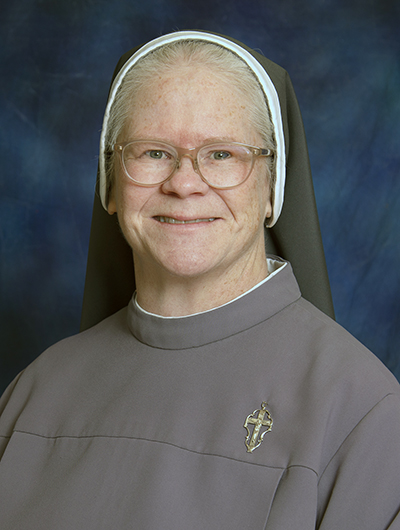
By Sr. Mary Kansier
Marian Sisters of the Diocese of Lincoln
Evangelization coordinator at St. Mary Parish in David City
As we think about Lent, I suspect many of us internally groan. And, when the topic of Lent (40 days plus Sundays—preceding Easter) comes up, most of us think, “What do I give up this year? Last year was a bust.” Then, we try to come up with something that will be easier to do so that we can have at least some semblance of success.
And if I’m honest, I must admit that I’m right there with you. I’ve had more than my fair share of less-than-fruitful Lenten seasons; however, some have been quite spiritually beneficial.
Traditionally, Lent is a time when Catholics concentrate on three aspects of their spiritual lives: prayer, fasting and almsgiving. There are many ways we can increase our prayer life, give up something enjoyable, or intentionally help others.
The real question, though, is not how, but why. Why do we fast, give, and pray? Again, answers abound, but the bottom line is simple: because Jesus did. The first Sunday of Lent, we hear the gospel from Luke about Jesus being led into the desert for 40 days. During those days, Jesus fasted and prayed. After coming out of the desert, Jesus gave—and gave—and gave—all the way to giving his life for you and me on Good Friday. Col 1:24 says, “Now I rejoice in my sufferings for you, and I fill up in my flesh what is lacking in regard to Christ’s afflictions for the sake of His body, which is the church.” Our sufferings can help others, but we need to unite them to Jesus.
It’s easy to think we can “muscle” our way through Lent by telling ourselves it’s only six weeks and “I can do this!” In short, we tend to rely on ourselves.
However, that’s not a Catholic approach. The Catechism of the Catholic Church (2099) quotes St. Augustine: “‘Every action done so as to cling to God in communion of holiness, and thus achieve blessedness, is a true sacrifice.’” In other words, when we feel weak, when we get to the point of realizing, “I just can’t!”—that is when we need to cling to Jesus even more strongly—that is when our sacrifice means something. We trust in Jesus more than in ourselves. Our dependence is on God.
Over the years, there are a few things which have helped me keep my focus on Jesus. One Lent really stands out, and its success had nothing to do with what I gave up; I don’t even remember what intentional sacrifice I made. What made it different is that I was motivated. There were several people dear to me who needed prayer in a special way: a niece going through chemo, a friend with marital problems, a priest going through a crisis, a sibling who seemed to have no faith. I made a list of at least 10 people who really needed prayer.
Prayer
To help me remember for whom I was praying, I printed photographs and kept them in my work area, choosing a new intention every five or six days. While not all of my prayers were answered in the way I had hoped, I knew that I had really prayed well and that my Lenten fasting had been offered to God in love.
Clearly, I am helped by tangible reminders. As humans, we are both physical and spiritual beings who long for true spiritual satisfaction. Material or fleshly satisfactions that we can obtain on a human level will never suffice to fulfill us at the deepest level of who we are. God, and God alone, is capable of providing this fulfillment. This is why “pray” is one of the most important Lenten practices. Do something to increase the amount of time spent with God, every day. I asked a few friends about their best Lenten practices, and most suggested a form of prayer:
> Pray the Church’s Liturgy of the Hours, also called the “Divine Office.” It is the “public prayer of the Church.” (CCC 1174) The purpose of this devotion is to sanctify the hours of each day to God. All priests and consecrated religious pray it, as do many lay people. It’s available online at https://divineoffice.org/, or as a mobile app (iBreviary). Commit to praying Morning Prayer or Evening Prayer and Night Prayer.
> Pray the Rosary (or a decade) every day. One friend said she finds it helpful to switch up how she prays it—with her family, while walking, kneeling or sitting in front of a small statue of Mary, or with a phone app.
> Go to daily Mass—there is no greater prayer.
> Get up 15-30 minutes earlier every day, and use the time praying with scripture.
> Find a Novena (traditionally prayed for nine days) and pray it daily for the entire season. The Surrender Novena, Litany of Trust, or Divine Mercy Chaplet were suggested by friends.
> Combine a fast of not listening to the radio in the car with using that time for prayer —intercessory prayer, talking to God, or the Rosary.
Fasting
The Church’s law on fasting is intended to be strictly kept on Ash Wednesday and Good Friday. However, there are other forms of fasting, undertaken for the entire season of Lent, which some friends found beneficial:
> Don’t use salt or pepper at the table.
> Drink coffee black. Buy simple black tea (with or without caffeine) instead of flavored teas.
> Don’t go through the drive-through, or avoid all fast-food.
> Don’t eat between meals.
> Give up a specific type of snack such as salty chips or crackers, substituting fresh or dried fruit.
More modern suggestions have to do with online time and mobile devices. Almost everyone agrees that it’s very easy to get caught in mindless scrolling, games or shows. Some ideas (again, from friends) include:
> Give up a specific social media.
> Turn off notifications on your phone.
> Instead of turning on the TV, read.
> Tell friends and coworkers you’re only responding to necessary text messages, and then only at specific times of the day (mid-morning, noon, mid-afternoon and early evening).
> Instead of games online, play board games with family or friends.
> Go old-school and send a snail-mail letter or card. Make it a goal to send three a week.
Almsgiving
Almsgiving is the act of giving money, food, or other material goods to help others. There are many ways this sacrifice can be made. Here are a few known, reputable suggestions:
> I had the opportunity to go to Mexico City with Hope of the Poor, and the Diocese of Lincoln has sponsored pilgrimages with them (see https://hopeofthepoor.org/).
> Rice Bowl (see https://www.crsricebowl.org/)
> Our local Catholic Social Services (https://csshope.org/)
Many parishes will have a specific group with which they partner. Small towns (I work in David City) will often have a ministerial association that coordinates support for the local poor who can call and receive help with utilities, car gas, car repairs, or food vouchers. Call your local parish to find out the best way to donate.
Finally, here are a few miscellaneous suggestions:
> Combine fasting with almsgiving. One friend gave up going through the coffee drive-through, and, at the end of Lent, she figured out she had saved nearly $150, which she donated to the food pantry.
> Use Lent as an opportunity to go through closets or the garage, and donate the clothes, games and toys no longer needed by your family. One friend made it a goal to give away one thing every day.
Finally, remember: unite whatever you choose to do with Jesus on the Cross. He takes it, unites it with His own sufferings, and makes it a gift to the Eternal Father. Have a great Lent!
