

By S.L. Hansen
for the Register
As part of the propaedeutic year at St. Gregory the Great Seminary in Seward, 20 first-year seminarians were sent out for three weeks of poverty immersion Jan. 26 to Feb. 16.
“Propaedeutic” means “preparation.” After the Holy See promulgated the sixth edition of the Program of Priestly Formation in 2022, St. Gregory the Great Seminary adjusted its curriculum to accommodate a propaedeutic stage for first-year seminarians. In addition to coursework in the Catholic faith, this includes three silent directed retreats and three weeks of poverty immersion.
Father Benjamin Holdren, who was appointed director of the seminary’s propaedeutic stage by Bishop James Conley in 2023, said he learned about the value of poverty immersion from propaedeutic directors at other seminaries.
“Poverty immersion refers to a couple different things,” Father Holdren explained.
The first aspect was immersing the seminarians in situations where they are serving the poor. Father Holdren identified different missionary organizations around the country that would take two or three seminarians for three weeks. Among them were the Missionaries of Charity in San Francisco, Houston, Baton Rouge, and Chicago; Shalom House in Kansas City; and Christ in the City in Denver.
The second aspect was personal poverty. Each man was allowed to bring a backpack with the minimum they would need (clothing, personal grooming items, a breviary, etc.), but no cell phones or other technology was allowed. None of them had a say in where they were going.
“When control is taken away, what happens within you?” Father Holdren considered. “The anxieties, the fears, the frustrations that come up are all very human, but when they come up what are we doing with them? Are we taking that to the Lord? Are we having healthy conversations about them with others? Are these guys able to lean into brotherhood?”
After holy hour and Mass early in the morning of Jan. 26, each man was given an envelope with their assignment, a transportation ticket for either bus, train or plane, and $50 to last them three weeks.
Leo Bykerk of St. Ann Parish in Doniphan went to work in a hospice run by the Missionaries of Charity in San Francisco. Once he arrived, the sisters “just kind of pushed us into the deep end,” Bykerk recalled.
He and his brother seminarian found themselves immediately feeding patients, changing diapers, and providing other personal care – things Bykerk said he had never done before.
The biggest impact on Bykerk was truly living in poverty.
“We just had to ask for everything we got – food, car rides,” he said. “The sisters changed my entire spiritual perspective because all they have in their life is God.”
Raised with a typical Nebraska “pull yourself up by your own bootstraps” mentality, Bykerk found himself in a position of true supplication.
“I took on the beggar role in prayer,” he explained. “As a man, I’m used to being a provider, but Jesus flipped the roles on me.”
Alec Langan of St. Patrick Parish in McCook had a similar experience in Kansas City. Assigned to Shalom House, a transitional housing ministry for men who were overcoming homelessness or transitioning from prison to an independent life, he and his two brother seminarians were invited to join the Little Brothers of the Poor one Saturday.
The Little Brothers of the Poor are a missionary order based on Dominican spirituality (sharing the Gospel) and Franciscan spirituality (serving the poor from a life of poverty). The Little Brothers spend their days knocking on doors to beg for food and hitchhiking to get from one place to another.
“A lot of missionaries knock on people’s door and take the moral high ground,” Langan said. By contrast, the Little Brothers of the Poor “take the low ground. They come to each door, and they need something.”
In that, Langan saw the Little Brothers exemplifying Christ, who “comes knocking on each person’s heart, not to overpower you or force you into a relationship, but as a humble servant, a beggar saying, ‘Will you let me love you?’”
The seminarians and their Little Brother companion faced a lot of negative, sometimes rude, responses. But Langan saw that any kindness they received was the Holy Spirit working in people’s hearts, and He can change lives.
That includes Langan, who recognized, “I try to keep enough control in my life, where God is part of my life but not in control of my life.”
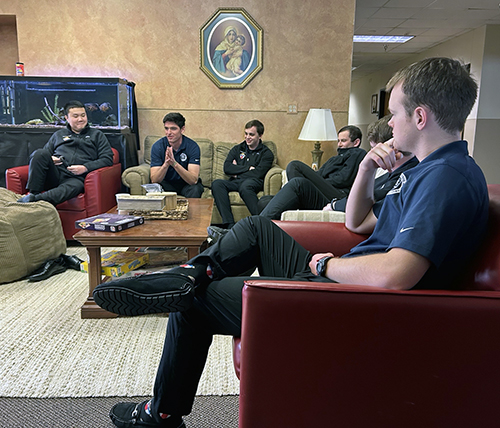
On Sunday, Feb. 16, the seminary was buzzing with joy as the men returned from their poverty immersion assignments. The following day, Father Holdren had the propaedeutic seminarians share some of their experiences with each other. In particular, he asked each man to note where they had been a bridge or a barrier to others while they were away.
Langan realized he must apologize for being impatient with the two brother seminarians who accompanied him to Shalom House. He recognized that poverty immersion taught him a godly humility that led to him being able to own up to his fault.
“I don’t think I would have made this apology three weeks earlier,” he admitted. “I would have justified it.”
That is the kind of introspection that Father Holdren wants to see.
“We want to help these guys,” he said. “We surround them with resources, with spiritual directors, counselors, formators, who can say, ‘Let’s help you bring that to the Lord, receive His grace more, receive His healing more.’”
Father Holdren believes that the propaedeutic year, including poverty immersion, will have a profound impact on these seminarians, whether they continue toward the priesthood or discern another vocation.
“Many times in any given vocation, we are put into situations that we would not have chosen,” he said. “Having this awareness for yourself, you can grow and become a greater gift to others.”
The seminarians are excited about the personal growth they experienced.
“God just did a lot for me on this trip,” Bykerk said.
Langan agreed. “It was one of the most gut-wrenching and faith-forming experiences in my life.”
