

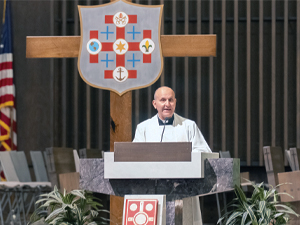
Father Paul Check, a priest with the Diocese of Bridgeport, Conn., accepted an invitation from Msgr. Thomas Fucinaro, pastor of the Cathedral of the Risen Christ in Lincoln, to preach a Lenten parish mission March 9-11.
Father Check is a nationally known priest. He spent nine years in the US Marine Corps before his ordination in 1997. He is a former seminary rector, the former executive director of Courage International, and of the Shrine of Our Lady of Guadalupe at La Crosse, Wisc. He is currently on a leave of absence granted by his bishop for a few months, to care for his parents.
Dennis Kellogg, director of communications for the Catholic Diocese of Lincoln, interviewed Father Check while he was in Lincoln. The conversation included the biggest moral threat the Church faces today, the Church’s current outreach to those with same-sex attraction, and where Father Check sees the greatest sign of hope in the Church during the current Jubilee Year of Hope. What follows is an edited version of the interview.
Southern Nebraska Register: You have taught courses in moral theology and ethics. What do you feel is the biggest moral threat to the Catholic Church at this time?
Father Paul Check: It’s become more clear to me in recent times, that the challenge of our era is not, first, the obvious moral controversies. They are present certainly in questions related to sexual identity and sexual ethics, beginning of life questions, end of life questions. But I think foundationally, the most important question is the question that our Lord asked the apostles: “Who do you say that I am?”
Because that sets the course then for our understanding of our relationship with Christ and close on that follows the question in the light of suffering, particularly of the innocent, or the problem of evil, as philosophers would call it, and that question is, “Is God good? How can God be good if there’s so much suffering in the world? How can God be good if evil seems to assert itself in the way it does, and there’s so much violence and pain?” Those questions precede the moral questions in my mind.
SNR: You also spent a number of years as executive director of Courage International, which is a Catholic apostolate to those with same sex attraction and those who love them. What is the Church’s outreach to those with same-sex attraction, and do you think it’s been effective?
Fr. Paul Check: The best way, I suppose, to think about this question of same-sex attraction, those who experience it and those who are closest to them, typically family members, is to distinguish three things that are related.
The first is to say that every person is created in the image and likeness of God, and through the grace of baptism, becomes a disciple and a child of God, and the person is good and is always good, even if we’re living at variance or distance from God because of sin or because of disinterest or because of neglect. Nevertheless, God loves us and we have the potential notwithstanding our frailty and weakness, to be good, to be virtuous, indeed, to be holy… The Church wants to take care in her pastoral outreach not to give the impression that she’s focusing and singling out one group of people for a kind of severe or harsh treatment… Think about (the Lord’s) encounter with the woman caught in unchastity. “Neither do I condemn you. Now go and do not commit this sin again.” Neither do I condemn you. That’s the call to compassion. Now, do not commit the sin anymore. That’s the call to conversion. We need to hit both messages and notes equally.
So to break the sixth commandment is to put ourselves in danger of mortal sin, and that includes contraception, masturbation, fornication, adultery and homosexual activity. And notice that I there am being specific with regard to the action. The action is considered in the Catechism to be intrinsically disordered, but that’s also true of the other sins against chastity that I mentioned. So that’s a second distinction, the distinction in the middle, really.
The third distinction is that the Church considers the attraction or the inclination before it’s acted on, before a choice is made, to be something that’s not consistent with the fulfillment of the human heart, and that also can be difficult for people to hear, because they could say, “Well, I’ve always been this way. I’ve always felt this way about myself. So for me, this is very natural, and you’re telling me that what I am experiencing or feeling is not something that I can act on and therefore fulfill my heart…” But I think the strongest testimony to this would be the group of people to whom I ministered for a long time, and their personal witness in this. They are the ones who, in a way, are “the sign of contradiction,” a phrase from the Gospel that Simeon uses to describe the Christ child. They know that what the Church teaches is true, and it’s often through their own sacrifice, suffering, perseverance, their humility and their courage that they come to embrace this, and not with widespread help, sometimes not even with the help of their family, but the Church has reached out to them and said, “We can help you in this.”
That was transformative for my priesthood, because I understood some of these things, the anthropology. But until I started sitting with people and heard their stories, there was no face on this question for me. Now, there is hundreds of them, if not into the thousands, and that, to me, is what the Church does best. She listens to people’s stories, and she helps them to understand their story in the light of the story of Jesus Christ in the Gospel.
SNR: Your life experience includes work as a rector of St. John Fisher Seminary. And you’re going back to seminary (work) for the third time. What’s your advice to a young man who is discerning whether or not the Lord is calling him to priestly formation?
Fr. Paul Check: To have confidence in the fact that the Lord knows his own heart – the man discerning the priesthood – better than he does, and that it is in the Lord’s interest, if I could say it that way, for Him, the Lord, to impart that insight and understanding to the man, and He will do that. The Lord will do that according to his way and his time.
It is an adventure to embark on that quest. It is, if I can say it this way, a kind of a romance, a love story between the soul and God… It’s the adventure and the love story which are moving the man to discover what it is that the Lord already knows. If the man believes that God is good, which might be a challenge that he needs to also work with for a while, then that will give him patience and perseverance, and in time, he will be rewarded with the clarity and the confidence and the strength that he seeks.
And nothing will have been wasted, because through that process, he will become a better disciple, and he will become more of a faithful instrument in the hands of the Lord for whatever it is that will be asked of him in his life. And so, no harm can come. It can only be good, no matter how the adventure and romance work out.
SNR: We’re in the middle of a Jubilee year. Pope Francis has designated the theme of “Pilgrims of Hope” Where do you find hope in the Catholic Church?
Fr. Paul Check: For centuries, the cross has been called “spes unica,” which means “our only hope.” It is the cross that saves us. It is the cross that is the instrument in the hands of the Divine physician to heal the wounds of sin and to vanquish evil and death, and that is why it is our only hope, and the crucifix is the central symbol of our Christian faith. But we know that it’s not the end of the story. The end of the story is the resurrection and to complete the paschal mystery, the sending of the Holy Spirit, which makes it possible for us to be joined to Christ in that mysterious way.
My patron is St Paul. I think he summarizes the goal of the Gospel in this life most perfectly when he says, “I’ve been crucified with Christ, and the life I live is not my own, but Christ lives in me.” That is the hope of the world, and it is the privilege, not only of the priest, but of all disciples in the Church herself, to lift up that hope to people, because everyone is made for it, and everyone needs it and everyone is searching for it.
Editor’s Note: Watch the full interview with additional questions for Father Paul Check on the Catholic Diocese of Lincoln YouTube channel,
@CatholicDioceseofLincoln.
