

Buried in Cortland: Joseph Riley was the first agent on the northern border to die in the line of duty
By Dennis Kellogg
Director of communications
The name written on the grave marker at St. James Cemetery in Cortland isn’t that easy to read. The stone has been through a lot. A century of Nebraska dust has covered it, only to be swept away by strong winds and pounding rains. It’s weathered freezing ice and snow and faded under the blistering summer sun. You can make out the letters, though: J-O-S-E-P-H.
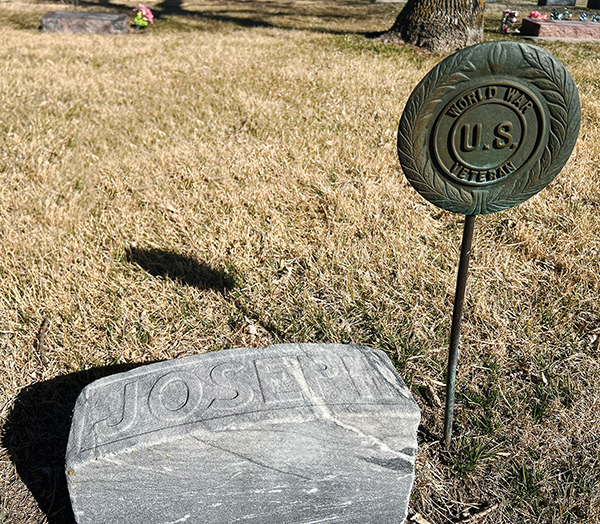
The “Joseph” is Joseph Riley, but it’s understandable if you don’t recognize that name. Riley died April 6, 1925, at Sacred Heart Hospital in Spokane, Wash. He was a patrol inspector for the U.S. Border Patrol for just seven months.
“The very basic job that he had was to go out along the international boundary and try to locate individuals who may have entered the country illegally by circumventing the ports of entry,” said Nathan Albertson, a Border Patrol agent since 1997 who has also served as a chaplain with the agency for about 10 years.
“That was the very basis of his job, and quite frankly, is the very basis of our job today.”
Two days before his death, Riley and his partner, William Blundell, were driving near Eureka, Mont., in what was likely a Ford Model-T. They spotted a car they believed had crossed the northern border illegally. They began a high-speed – at least for that time and that vehicle – pursuit. A tie rod on their vehicle broke during the chase, flipping their car as it crashed onto the side of the remote road.
Two people passed by and found both men unconscious. Blundell had suffered only minor injuries. Riley, had a cervical spine injury. After taking him to the local hospital, the next day he was loaded on a train for a trip to the hospital in Spokane. After arriving there, he died the following morning.
“To this point, there’s been a lot of work just going through different files and online resources, trying to access information on Mr. Riley,” Albertson said. The research Albertson and others at the Border Patrol have done is the reason we know what we do about the life and death of Joseph Riley.
“When somebody has been gone for almost 100 years, and you really aren’t that familiar with the family, there’s not a lot of personal connection to it. It begins to get easy to not maybe remember or think about that individual quite as much,” Albertston said. “When you develop that personal connection, all of a sudden now you’ve got something connecting you to 100 years ago.”
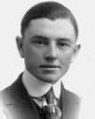
Riley was born in Princeton, Neb., a small community in southern Lancaster County, in October of 1894. He attended school in the area, but Albertston has not yet been able to find out what year he graduated. Albertson discovered through newspaper clippings Riley’s mom was involved with the “Catholic ladies’ organization.”
“There were several instances when it commented about her being at different functions with the Catholic ladies,” Alberston said. “The papers also mentioned that two of his younger siblings and several of his cousins went through Confirmation down at St. James (in Cortland).”
In 1917, Riley joined the Knights of Columbus Council in Beatrice. Newspaper clippings show he and his dad traveled to at least one of the events in Beatrice, and Joseph made a five-dollar donation to help build hospitals, chapels and reading rooms for the training camps at different U.S. Army installations around the United States. That five-dollar donation would be the equivalent of $124 today.
“That was something that just specifically spoke to me,” Albertson said. “You have a young man who’s working hard on the farm and that five dollars didn’t come easy…. It required, in 1917, some purpose to his life to go to (Beatrice) just to join, but then to go down there to donate to this cause. When you start looking at those aspects and the historicity of his family within the Catholic Church, it starts to show, at least to me, there was definitely a very strong faith background between he and his family.”
Riley signed up for the Navy on his 23rd birthday in October of 1917 to fight in World War I. He worked on transport ships. Newspaper clippings reveal during a furlough, he returned to his family in Nebraska and spoke at the school in Princeton, telling students about his travels to France. He also told them he was homesick.
By 1920, Riley returned home to the family farm. A year later, though, newspaper reports list a sale of the family farm. Riley moved to Colorado, where he held a few different jobs. It was in October of 1924 when he was hired by the U.S. Border Patrol and moved to Montana to work on the northern border. Seven months later, he would pass away following the car accident, becoming the first Border Patrol agent on the northern border to die in the line of duty, and the only one ever to lose his life in the Spokane Sector of the agency. In all, 159 U.S Border Patrol agents have died while serving the country.
Albertson has reached out to numerous organizations in Nebraska to try and discover everything he can about Riley. He’s contacted the Catholic Diocese of Lincoln; Father Thomas Lux, current pastor at St. James Parish in Cortland; the Lincoln Lancaster County Genealogical Society; The Nebraska State Historical Society and the Norris School District. Albertson encourages anyone who might have a photo of Riley, any personal correspondence from him or any information about him – such as his graduation date – to contact him at the Border Patrol’s Eureka, Montana station.
In the many hours of work Albertson has put in researching Joseph Riley, he has developed a special appreciation for him as a person.
“Riley was a Midwest farm kid, which I can certainly relate to, having a similar background,” Albertson said. “He appeared to have the values and experiences many would relate to and appreciate today – faith, background, dedication and involvement with his family and friends, willingness to help neighbors at different times, a sense of fortitude and adventure and just going out and volunteering to do things he’d never done before, like joining the military for World War I, or just up and deciding to move to Colorado or Montana, for that matter.”
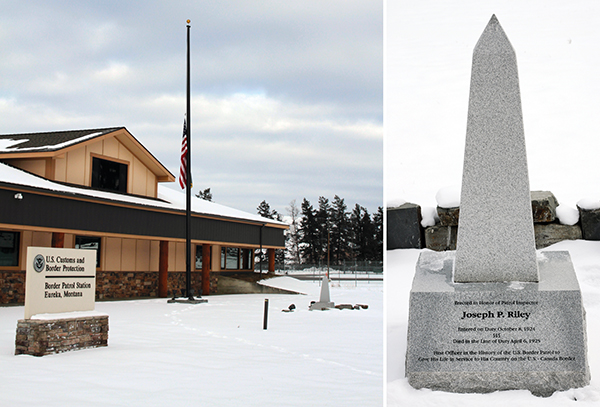
In 2006, the Border Patrol honored Riley with a special ceremony in Montana that included some of his descendants. A memorial was also built for Riley. It sits in front of the Border Patrol station in Eureka.
The agency is planning to share Riley’s story with its agents as the centennial anniversary of his death approaches on April 6 this year. His descendants were invited to a private ceremony in Montanta in April, and to Police Week ceremonies in Washington, D.C., where his name is already etched into the National Law Enforcement Memorial. Albertson also hopes to be able to locate the exact spot of Riley’s car accident, so a historical marker can be placed there.
Albertson said the U.S. Border Patrol is going to great lengths to remember and honor the service of Joseph Riley because it’s the right thing to do. It’s a sort of an unofficial “never forgotten code,” he said.
“The whole idea is to just ensure that we do not forget those who have given their lives in the line of duty and sacrificed their lives for the greater good of the nation.”
Brock Lohr is the current grand knight of the Beatrice Knights of Columbus council. When he found out about Riley’s story and his involvement with the Knights in Beatrice, he went to the group’s archives to see if he could find any photos or mentions of him. While he didn’t find anything related to Riley, he did find numerous other historical photos, certificates and stories from that time period. The council was founded in 1914.
Lohr will share that material next week with the other Knights of Columbus in Beatrice.
“We will have a council meeting on April 3, and I will be bringing all of this history to the council in celebration of all of the great brother knights who have come before us to sacrifice and lift our order to new heights,” Lohr said.
As a Border Patrol agent and chaplain, Albertson knows well the sacrifice made by Riley and the sacrifices made today by the men and women who protect our country’s borders.
“When you join the Border Patrol, you know very well that there are a lot of outcomes that can occur with a law enforcement career, and yet these men and women still serve. They still volunteer to do so,” he said. “How much gratitude is owed to someone when they’re willing to pay with their life so somebody else can be safe?”
