

‘In the end, the Church belongs to Jesus Christ’
Archbishop Timothy Broglio, the president of the United States Conference of Catholic Bishops, served as the keynote speaker for the annual LIFE Runners banquet March 28 in Papillion. LIFE Runners is a pro-life organization with more than 24,500 members across 50 nations.
Archbishop Broglio is the fourth Archbishop of the Military Services USA. He serves military men and women in the United States and those serving the country across the globe.
Dennis Kellogg, director of communications for the Catholic Diocese of Lincoln, interviewed Archbishop Broglio before the banquet about a range of issues, including the U.S. bishops’ relationship with the Trump and Biden administrations, and Pope Francis and the Vatican. What follows is an edited version of that interview.
Dennis Kellogg, Southern Nebraska Register: You have served in a lot of different countries across the world as part of your service for the Church, and you’re currently the archbishop for military services in the United States. That means your flock is probably men and women who are highly motivated, who are seeking leadership, who are willing to put their life on the line. What kind of unique opportunities or challenges does that bring for you as an archbishop with that kind of flock?
Archbishop Timothy Broglio, president of the United States Conference of Catholic Bishops: The opportunities are many in the sense that people are enthusiastic. They’re already geared, in a certain sense, to a higher goal, so that certainly makes talking about faith very, very direct. Also, at least when I came to the archdiocese, we were engaged in the longest war of our history in the Middle East, and so they were asking fundamental questions about life and death and afterlife challenges. Obviously, it’s a diocese over which the sun is always shining, so it’s all over the world.
SNR: Right now, we’re in the middle of conflict in Ukraine. We still have conflict in the Middle East, and Pope Francis has tried to step forward and be sort of an international peacemaker in these regions. What role do you think the Church should play in these kinds of conflicts around the world?
Archbishop Broglio: I think the Church can always be a place where adversaries can meet and at least talk. And I think that’s something that we offer.
I think we also offer a message of respect, of dialogue, of listening. Pope Francis has been very, very insistent on the importance of listening to the other. So, I think at least we can offer those lessons. Now, obviously it depends on the belligerents to decide whether they want to listen to those messages or take advantage of those opportunities, but at least we can offer the space.
SNR: Of course, Pope Francis is continuing his recovery from his long hospital stay, and we wish the Holy Father all the best. Can you summarize for me where you think the relationship is right now between the United States Church and the Catholic bishops in the US and the Vatican and Pope Francis?
Archbishop Broglio: I think the relations are good. Certainly, the pope understands very well where we are; even when he wrote the letter to us about immigration, that was done with consultation. And so, there may be some differences of opinion with certain offices, but I think in general, relations are good. My own meetings with Pope Francis have always been very, very cordial. He’s always interested in listening, and then when he asks questions, he asks very, very direct questions. And of course, at the moment, I think all of us are united in praying for his health and his recovery.
SNR: You and the bishops have not been silent when it comes to the Trump administration. In the first few months, the refugee resettlement contracts have been an issue. Immigration. IVF. I want to get your opinion on where do you think that relationship (with the Trump administration) stands right now, and where is it headed?
Archbishop Broglio: I think it stands, perhaps where it should be, in the sense that there are some decisions that the government has made that are very helpful. And my own personal position, it’s much easier to work with this administration than it was with his predecessor, just in questions of right to life, of freedom of conscience, things that are very, very important to us as Catholics.
On the other issues, the policy issues where there’s a great divergence of opinion, I think my own goal is to try and engage in dialogue so that they can understand where we’re coming from. I’m president of an organization that was founded to deal with refugees, and so it’s almost part of our DNA. We’re going to have to cede that responsibility, because we can’t do it to the extent that we were doing it. We’ll certainly continue on the level of Catholic Charities, but it won’t be a national effort, just simply because we don’t have the means to do that.
But I think we should be able to meet with the president. I’ve talked to the vice-president on the telephone, and I think there are avenues to move forward and at least to be able to dialogue. I don’t expect to convince the president of the Catholic position, but I would at least like him to understand it.
And I think on the issue of immigration, it’s important to recognize that we all want legal immigration, and we all want a reform of the immigration system, which, at present doesn’t work. I’ve seen it from both sides of the border, because even when I was a representative of the Holy See outside of the United States, it was clear that something had to be changed.
SNR: Do you think that’s the pressing issue right now? And how do you strike that balance between protecting the borders and helping people who are fleeing war and violence?
Archbishop Broglio: They were beforehand, in the sense of carefully vetting people who are coming, interviewing them, and also looking, well, two things, looking at the reality that they’re coming from, and then secondly, also doing something about that reality. We have immense possibilities in this country to try and ameliorate some of those situations that cause people to flee. We’re not always successful, but I think we can try.
SNR: You mentioned the Biden administration. How frustrating was it for you, at least on the issue of abortion, to have to deal with President Biden, who is a Catholic and yet is probably one of the most pro-abortion presidents we’ve seen in recent memory?
Archbishop Broglio: It was very, very difficult for me to understand how he could take some of the positions that he did, because it was more than just passively allowing. It was actually being almost an abortion advocate and forcing it in areas where it had never been forced before.
So for me it was difficult to understand and I often wondered was he the one making these decisions, or was someone else making them for him? I don’t know that, because I never met the man.
SNR: When it comes to abortion, the bishops came together five years ago and put together a program, “Walking with Moms in Need” now observing its five-year anniversary, reaching out to pregnant women and parenting mothers who need some accompaniment. How effective do you think that has been, and what do we need to do more to get to the point where abortion is unthinkable in our country?:
Archbishop Broglio: I think the program has been very effective, but it does need to be expanded. And I think we have to try and reach more women and more and more expectant mothers and to let them know that this help is present, and that we that we’re very happy to offer it.
SNR: Another program is the Eucharistic Revival. It was a big year last year, with the pilgrimage and with the (Eucharistic) Congress. The bishops put that together to try to bring people closer to Christ through the Eucharist. Do you think that’s met its objective?
Archbishop Broglio: We’re still in the third year of the revival, and so I think it’s an ongoing process. I think one thing that we learned, though, is that this catechesis and this development of an understanding of the Eucharist and a relationship with Jesus Christ in the Eucharist is an ongoing project. It’s not one and done. And I think that’s important.
As a people, we’re very task oriented, and so we want to be able to check things off on the box. But I think this is something we have to continue, to continue the catechesis, continue to ensure that our young people, as they approach the Eucharist, they understand Who it is they’re receiving, and that they continue to deepen that faith. And so I think it’s going to be an ongoing project.
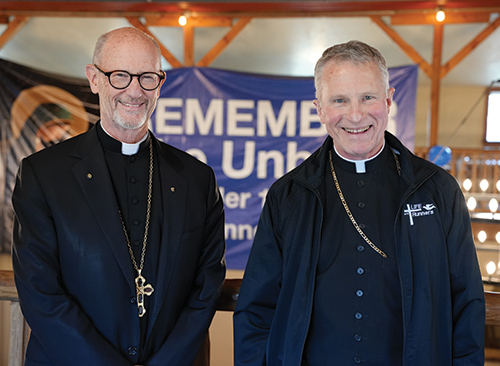
SNR: I want to ask you about your friendship with Bishop James Conley of the Catholic Diocese of Lincoln that I know goes back many years. And also, from your national perspective and even worldwide perspective, can you give us a feel for how the Diocese of Lincoln is perceived -- what we’re doing right and what we’re doing wrong?
Archbishop Broglio: Bishop Conley and I lived in the same house in Rome when he was working in the then Congregation for the Bishops, and I was working in the Secretariat of State. And that’s really where we got to know one another, and we continue to nurture that friendship.
I once preached a retreat for the priests of Lincoln, and I remember being struck by the tremendous camaraderie that existed. It was a silent retreat, but you could see how much they cared for one another. And I remember when they would have a break after lunch, and they played baseball, the longer ordained with those who were ordained more recently, and it was just a wonderful experience of a very, very healthy presbyterate.
And then, of course, I do have some Lincoln priests who are in the military, or serving the military. And I’m, of course, very grateful for that contribution as well.
As to how the diocese is perceived. I can give you my impressions. With 198 dioceses in the United States, it’s hard to know what the perception is, I think, though it would be viewed as a healthy diocese. You certainly have many vocations and an enviable Newman Center at the University of Nebraska. Something the rest of us can only dream of.
SNR: We’re in the middle of Lent. If there’s one piece of advice, Archbishop, you would have to Catholics across the country to draw closer to Christ during this time. What would that be?
Archbishop Broglio: I think it would be the three pillars of Lent, so prayer, sacrifice and charity. And those are really the hallmarks of this season. And I think if we take extra time and prayer and really appreciate the dignity that is ours because Christ came and died in order to save us. And if we sacrifice so we clear away what’s not essential, so that we really can dwell on the Lord’s call. And then, I think, as we reach out to those who might be in need and share something of what we have. I think those are really the hallmarks of this season.
SNR: What worries you most about the future of the Catholic Church in the United States? And along those same lines, what gives you the most hope about the Church in this Jubilee Year of Hope?
Archbishop Broglio: I think what worries me most is the issue of formation. I think we have to teach Catholics their faith and make sure that they are well formed in that faith, and hence the importance of media, because that’s how we reach people today. I think Bishop Barron has given us a very good example of how to do that. What gives me the greatest hope are the young people. I am the archbishop of the youngest archdiocese in the United States. Most of my people are between the ages of 18 and 38 and they are really a fantastic generation. They’re enthusiastic. They have a lot to offer, and they want to learn. And so I think that’s certainly the greatest hope. And then, to quote Saint John XXIII, in the end, the Church belongs to Jesus Christ. And I think that’s what we have to remember -- when we do the best we can, then we know that the Church is the Lord’s.
SNR: You’re a LIFE Runner. We’re talking to you at the LIFE Runners banquet. What can you say about this organization?
Archbishop Broglio: I’m enthusiastic about the witness that they give. I understand you don’t have to run to be a member. Consequently, that old men like me can be members as well. But I think that witnesses is crucial. The Church is always spread by the witness of her members. And I think respect for human dignity and respect for human life is also going to be spread by the witness that we give.
Editor’s Note: Watch the entire interview with Archbishop Broglio on the diocesan YouTube channel, @CatholicDioceseofLincoln.
