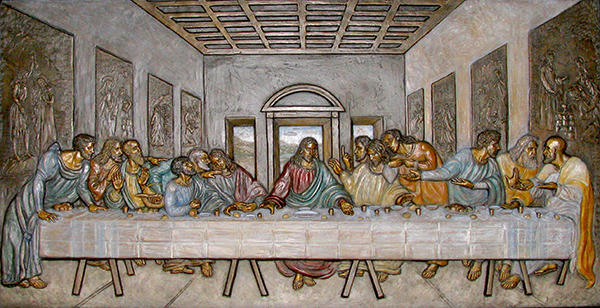
Guest column by Sondra L. Jonson
A member of St. John the Baptist Parish in Cambridge, Jonson entered the Catholic Church in 1981.
From the opening moment of the Eucharistic liturgy, I am riveted. Father lifts first the bread, then the wine, and I am transported to all the Passover Seders of my childhood.
My great Uncle Abram, wrapped in a white silk prayer shawl embroidered with blue bands and Hebrew letters, tenderly, reverently lifts the wine chalice, bends over it and chants the Baruch prayer: “Baruch atah Adonai, Eloheinu Melelch ha’olam …” The Hebrew words wash over us and the Seder begins, drawing us into a stunning history of Divine visitations, miracles, sacrifice, waywardness and ultimate courage that chronicle our people’s deliverance from ancient slavery.
The cup my Uncle Abe lifted held more than wine. It held a millennia-year-old relationship between an often-oppressed, marginalized people and the Creator of the universe. It held countless prayers chanted, sung, and sighed down through the ages by struggling souls who, despite the odds, knew they had the ear of the Most High. No wonder Uncle Abe’s hands all but trembled to lift the chalice and once again lead his family in the holy Seder service.
Similarly in the Mass, from the first lifting of the paten at the altar to the last prayers of thanksgiving and dismissal, we too are immersed in a breathtaking voyage from the struggles of our Hebrew ancestors to the incarnation of God as man, to the dark and sacred day when Jesus laid down His life, then His wondrous resurrection. The Seder celebrates the rescue of God’s people from temporal slavery, the Mass deliverance from eternal slavery.
Echoes of the Passover are easily recognized in the Mass. The opening prayer of the Seder sounds very like the initial prayers of the Eucharistic liturgy: “Blessed art Thou O Lord our God, King of the Universe Who creates the fruit of the vine…” The second prayer and action of the Seder are called the Urchatz, or the Washing of the Hands, and the third is the prayer over the unleavened bread (Matzos): “Blessed art Thou O Lord our God, King of the Universe Who brings forth bread from the earth….” Then with a loud “crack” the leader holds up and breaks in half one special matzoh, the Afikomen, and sets it aside, wrapped in a linen cloth, to be later distributed among all at the Seder table as dessert.
Over the next hour, the modern Seder liturgy recalls, by prayers and symbols, the entire sequence of the Exodus. We dip green vegetables in saltwater, tasting the tears of the Israelites; we eat bitter herbs to recall their sufferings; we are treated to Charoseth, a mixture of crushed apple, wine and walnut, representing the bricks they were compelled to produce.
We pray also for the people of Egypt who suffered under the 10 plagues. And an extra place setting is reserved at the table for the prophet Elijah. The children open the door to welcome him who would precede the long-awaited Messiah, bringing God’s reign of peace.
The progression of the Seder is a narrative in which everyone at the table has a role. A child asks the initial four questions, beginning with “Why is this night different from all other nights?” The rest of the service is in reply, chronicling how “with a mighty hand and an outstretched arm we were brought forth from the land of Egypt.”
The liturgy format is responsorial – a back-and-forth dialogue between the leader and the participants:
Leader: “With great and loving kindness did He redeem us from Egypt…”
Participants: “With awesome might did He divide the Red Sea.”
Leader: “With tender care did He protect us in the wilderness…”
Participants: “Sending Manna from Heaven, food and water to sustain us.”
Leader: “With abundant love did He give us the Sabbath…”
Participants: “To Mt. Sinai did He bring us at an hour supreme…”
And so on. This pace and cadence continue through the long narrative, right up to the Hallel (Praise) Psalms. Finally, the meal is served, the Afikomen distributed, the after-meal prayer intoned, the last cup of wine blessed, and the final Hallel of Praise sung: “How can I repay the Lord for all His bountiful dealings towards me?...” (Ps. 116).
While the Eucharistic Liturgy is noticeably concise compared to the Passover liturgy, one resonates in the other. The Seder recalls the blood of the lamb, which shielded the Hebrews from the Angel of Death. In the Mass, we receive the blood of the true Lamb, shed to shield all people from everlasting death. The Seder reveres God, our great deliverer. The Mass proclaims God our eternal deliverer. The Seder pleads for the coming of the Messiah. The Mass welcomes the Messiah. The prayers and petitions of the Seder are all fulfilled in the Mass: Elijah has come! And with him an innumerable crowd of witnesses (Heb. 12:1) bending low before the altar, where the long-awaited Savior offers Himself for us, and we surrender ourselves to Him.
Thus in each Mass, the past and present collide. The Mass brings us back 2,000 years to the Seder table of the Last Supper; that Seder draws us 1,500 years earlier to the Exodus from Egypt; then step 600 years further back and we are at the side of Abraham sealing a solemn covenant with God, forged after one sleepless, star-drenched night. And suddenly, while kneeling quietly at Mass, we find ourselves poised over an abyss of faith so deep into time, history and human yearning that the promise made to Abraham, the Exodus led by Moses, and the ultimate Exodus wrought by Jesus are all merged into one complete and perfect plan of God, with each of us an indispensable player.
This Good Friday, when we pray for our Jewish brothers and sisters, let’s remember how closely we are connected and how much we have received from them. They sought and embraced the Almighty, persevered through hardship and affliction to belong to His covenant, received and preserved the Word – the same Word who was with God and is God from the beginning (John 1:1), the Word we receive, body and soul, at every Mass.
Seder quotations: Haggadah composed by Rabbi Martin Berkowitz, 1958, Merion, Pa.