

Q. Can you explain the church’s stand on the changes of wording in the Hail Mary prayer from ‘thee, thou, and thy,’ to ‘you, and your’? Who instituted the change?
A. The Hail Mary is considered by many to be the quintessential Catholic prayer. I don’t know that I agree with that – my vote would be for the Mass – but I do think it is the prayer non-Catholics most associate with Catholics. The interesting thing about that assumption is that for almost three-fourths of our history as a Church, there was no “official” version of the prayer.
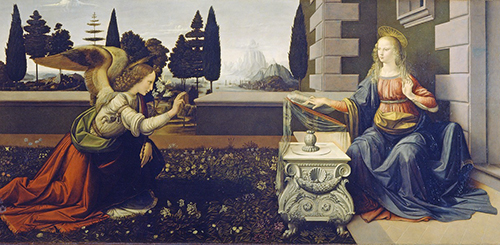 The Catechism of the Council of Trent identified three different sources or “authors” of the Hail Mary, each corresponding to a different part of the prayer. The first section (Hail full of Grace, the Lord is with you, blessed are you among women) comes from the greeting the Archangel Gabriel gave to Mary and is therefore considered to have Gabriel as the “author.” There is evidence that this portion of what would become the Hail Mary as we know it today was used as early as the 500s in the liturgy, meaning it was likely used popularly much earlier than that.
These words were seen as being truly a greeting used to greet our Blessed Mother. As in, when you wanted to say hi to Mary, you would say “Hail Mary…” and accompany the greeting with a formal genuflection or bow, as if you were physically in the presence of the Queen of the Universe. It was not so much a formal devotional prayer, but more of a pious practice.
As time went on and the Salutation of Our Blessed Mother began to become more formularized into a devotional prayer, there were additions to it. At some point in the Middle Ages, “Mary” and “Jesus” were added. Elizabeth’s greeting of Mary was added sometime by the late 12th century or early 13th century (at least in France and England) making her the second “author” of the Hail Mary. They were not added by formal decree, but by natural devotion. These are the two occasions in the Gospels in which Mary is greeted, so it makes sense they would be merged together.
The final part of the modern Hail Mary was formally adopted after the Protestant Reformation. Even prior to the Reformation, beginning at least in the 14th century, it was common practice when saying the Salutation of Mary to add a petition of some kind after the “fruit of your womb, Jesus.” However, this was not formally done, so when the Reformation occurred, the Reformers attacked the Salutation of Mary (although Luther retained the use of the Salutation of Mary in his prayer book) as not being a true prayer because it lacked any petitions.
In response to this charge, and because it was already common devotion in private, the Catechism of the Council of Trent included the Hail Mary as we know it today with the additions of “Pray for us sinners now and at the hour of our death. Amen,” leading to the Church being considered the third author of the Hail Mary. This became official when the Roman Breviary was published in 1568, which gives us the official version of the Hail Mary as we know it today.
That was a lot of words to not answer the question, but it does provide important context. The Hail Mary was not handed down from the Church as a prayer but developed organically, using the words of Scripture.
Similarly, moving from the use of “thou” to “you” was not a formal act of the Church, but rather a simple matter of common usage changing. Some people when praying the Hail Mary in English still use “thou” and “thee,” presumably because that is how they were taught, and some use the more modern “you” and “your,” also presumably because that is how they were taught. Since it does not change the intention of the prayer, it does not really matter which form is used.
This question was answered by Father Caleb La Rue, chancellor of the Diocese of Lincoln. Write to Ask the Register using our online form, or write to 3700 Sheridan Blvd., Suite 10, Lincoln NE 68506-6100. All questions are subject to editing. Editors decide which questions to publish. Personal questions cannot be answered. People with such questions are urged to take them to their nearest Catholic priest.
