

By Bishop James Conley
“In this you rejoice, though now for a little while you may have to suffer various trials, so that the genuineness of your faith, more precious than gold which though perishable is tested by fire, may redound to praise and glory and honor at the revelation of Jesus Christ.” 1 Peter 1:6-7
Moving from Lent to Easter may be the hardest transition of the liturgical year. As our 40-day fast gives way to the feasting of our celebration of the Resurrection, we can lose our spiritual focus. Without the urgency of prayer and penance, the joy of Jesus’s victory may pass us by. During the season of Lent, we embraced the Cross, and it is only through suffering that we come to the joy of the Resurrection. Jesus’s wounds did not disappear on Easter Sunday, and they invite us to bring our own wounds to him for healing.
 It may seem odd to begin the Easter season with a reflection on Christ’s wounds, but we approach them like the Apostle Thomas on that first Easter Sunday, probing them so that we, too, can understand the new life that comes to us through them. Have we acknowledged the wounds that we carry, bringing them to Jesus so that we can understand and bear them with the help of his grace so that He may reign even in them?
In light of Jesus’s lingering wounds, we can stop pretending that everything is perfect and, instead, become vulnerable both with God and others on the road to healing. Suffering alone, simply trying to tough it out, can lead to discouragement, and a self-reliant attitude that stifles the spiritual life. We come to the Cross, seeing what Jesus has done for us, knowing that his wounds offer us healing and open a road to restored life.
Art
One of the joys of living in Rome, which I had the blessing to experience when I served in the Vatican Congregation of Bishops, is the constant immersion in the world’s greatest art. Michelangelo, Raphael, Bernini, and Caravaggio are among the many greats you regularly encounter in the great pilgrimage city, now the focus of the Jubilee Year crowds. Caravaggio was known for his vivid realism, making the scenes of the Gospel come to life with ordinary-looking people in everyday clothing who pose with very human reactions. He transformed art with his bold use of chiaroscuro, the interplay of light and darkness, also known as tenebrism for the dark backgrounds he employed.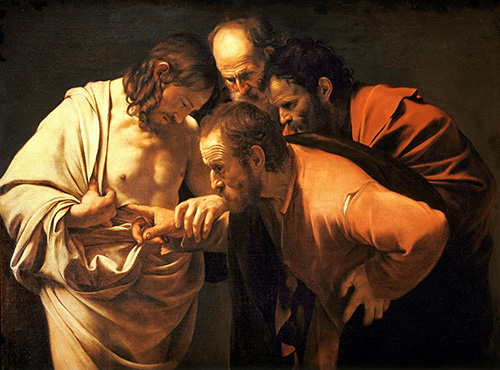
Caravaggio’s famous “The Incredulity of Saint Thomas,” now housed at the Sans Souci palace in Potsdam, Germany, employs these characteristics to make Easter Sunday come to life. The apostles stand in darkness as they approach Jesus, who is bathed in light. You can almost feel the effect of Thomas’s finger as it probes the open wound in Jesus’ side, which led to the healing of his doubt. The painting gives us a sense that the resurrected Jesus is available to us, offering his flesh to us in the Eucharist so that we, too, can say with Thomas “my Lord and my God!”
In the chapel in my residence, I have a print, hand-painted by a friend of mine, of just the portion of the Caravaggio masterpiece of the left hand of Jesus guiding the right hand of Thomas into his wounded side, inviting Thomas, almost forcing Thomas’ hand into his wounded side.
It’s interesting that the word vulnerable comes from the Latin word vulnus, which means wound. When we are vulnerable, we invite people into our own woundedness. This is something we do not like to do. We instinctually want to hide our woundedness, cover it up, pretend it’s not there, or ask the Lord to remove it. But it’s precisely in this vulnerability that we are made strong. This is what St. Paul is speaking about when he writes about the mysterious “thorn in his side.” He says that “three times I pleaded with the Lord about this, that it should leave me. But he said, ‘my grace is sufficient for you, for my power is made perfect in weakness.’ …For when I am weak, then I am strong.”
This is all counterintuitive, but it is true. When we invite people into our woundedness by being vulnerable, we allow ourselves to be affected by others and we allow others to be affected by us. Thomas was changed when Jesus invited him into his woundedness. His doubt was resolved, and he believed – “my Lord and my God!”
Poem and Music
A great medieval poem, “A Rhythmic Oration to each of the Members of Christ Suffering and Hanging on the Cross” (often known as Membri Jesu Nostri), draws out the way Christ’s wounds heal us, as he draws us to the Cross to transform our suffering. Bishop Erik Varden drew attention to this poem-prayer in his Lenten reflections entitled “Healing Wounds” (Bloomsbury, 2025), offering his own translation from the 13th century Latin of his fellow Cistercian, Arnulf of Leuven (but you can also find one online). The poem movingly meditates on the parts of Christ’s body in his Passion—feet, knees, hands, side, chest, heart, and face—relating them to our own suffering and healing.
Through this excerpt of Varden’s translation, we get a sense of the poem’s spiritual power:
O sweet, most beloved heart,
purify my heart that has been tricked, hardened by vanities;
make it faithful and God-fearing:
drive its dreadful coldness away.
I am a sinner and a guilty man:
let your love pass through my heart of hearts,
that my whole heart may be ravished
and languish with a wound of love.
Open up and broaden
like a wonderfully fragrant rose;
bind yourself to my heart.
Anoint it, let it know compunction.
What will one who loves you suffer?
Varden also comments on the depth we find in the poem’s depiction of Jesus’s suffering:
“The Rhythmica oratio is concerned to lodge meditation on Jesus’s medicinal wounds in our heart... Our wounds, configured to his, can likewise become sources of grace for ourselves and others even while we await eventual, perfect restoration to full health... Our wounds will finally heal when they have become so one with Christ’s, so fully surrendered, that we no longer know where his passion ends and ours begins. We are caught up, then, in the inexorable victory of his life over our death, of his light over our darkness, of his wholeness over our fragmentation.”
The poem’s moving depiction of Christ also inspired the hymn, “O Sacred Head Surrounded,” and making its way into Bach’s St. Matthew’s Passion. It was another Baroque Lutheran composer, Dietrich Buxtehude, who set large portions of the poem to music in 1680 with the title “Membra Iesu Nostri.” The music, set in seven cantatas, helps us to meditate on the healing wounds of Christ through its delicate portrayal of Jesus’s tenderness and healing vulnerability.
Book
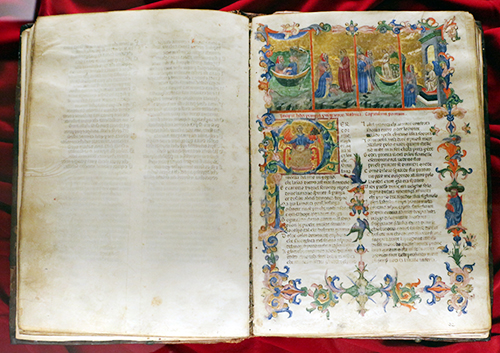
Last month, we left Dante as he emerged from Hell and began his ascent to Mount Purgatory, where he arrives before dawn on Easter Sunday. His pilgrimage of mercy now emerges as a healing purgation in the second segment of “The Divine Comedy,” the Purgatorio. Having witnessed the complete destruction caused by sin, he now ascends Mount Purgatory one story at a time to address the seven deadly sins, wiping away their effects until he reaches the innocence of the Garden of Eden at its peak. The Purgatorio is the most relatable portion of the Comedy because it models what should be happening within us now, as God’s grace can begin to heal the effects of sin to enable virtue to blossom.
In the Ring of Pride (Canto Ten), Dante describes this interior transformation as a metamorphosis, as rendered by Anthony Esolen:
Weary, pathetic Christians
full of pride,
whose minds go tottering on
and hardly see,
while in your backward
paces you confide—
Have you not learned that we are only worms
born to form the angelic
butterfly
which flies to justice
shorn of its cocoon?
Though we struggle with our minds buried in the cares of this world, God uses our suffering to prepare us for the glory that will unfold through his purifying grace.
Movie
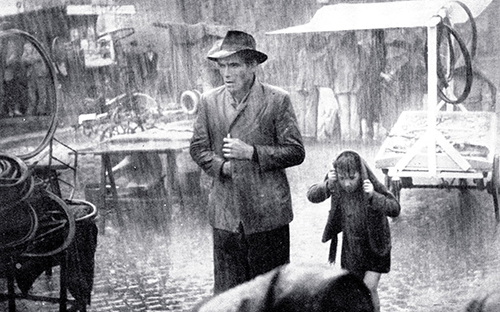
Since most of us cannot tour purgatory, we experience it through the daily difficulties that often wear us down. Vittorio De Sica’s classic realist film, “Bicycle Thieves” (1948), often considered one of history’s greatest, tells the story of a father and son trying to recover a stolen bicycle necessary for the family’s survival in post-war Italy.
The excruciating exploit portrays the relatable experience of being broken down, feeling like everything is against us, and the pressures of everyday life are overwhelming. Sometimes we need these purifying experiences to approach life anew with humility and sacrificial love, appreciating what God has given us even when things seem impossibly hard. There is not always an easy fix, but, as we are drawn closer to others in our need, we find ways to endure. The final image of a defeated father experiencing the loyal love of his son embodies the gift of mercy he unexpectedly receives.
Conclusion
Our transition from Lent to Easter is reflective of our journey through suffering. It’s not that the Easter joy will negate all our suffering, but instead that we are purified by the immense love and mercy we experience in Jesus’ sacrifice for us. Our faith is truly the gold that is tested in the fire. That doesn’t mean as Dante points out that pain is not a part of the process, but instead that pain – that testing by fire – results in a stronger faith as we move ever closer to God.
Our purification can come in different ways as we’ve seen in these classic works of art. We see both despair and forgiveness in “The Bicycle Thieves.” We can almost feel the pain from each wound of Christ in Buxtehude’s Membra Jesu Nostri, inspired by Armulf of Lenven’s medieval poetry. And we experience the healing Jesus offers Thomas as he reaches into Christ’s wounds. Those wounds are still there even after the resurrection. Just like Thomas, those wounds can be healing for us as well. Let us not avoid the pain that leads to that healing, but instead be purified by it as we take up our cross, even as we focus on the joy of the resurrection and new life.
BISHOP CONLEY'S HUMANITIES SYLLABUS
April: “Healing and Purification”
Books:
“Purgatorio” by Dante
Film:
“The Bicycle Thieves” (1948)
Music:
“Membra Iesu Nostri” by Dietrich Buxtehude
Poem:
“A Rhythmic Oration to each of the Members of Christ Suffering and Hanging on the Cross” by Arnulf of Leuven
Art:
“The Incredulity of Saint Thomas” by Caravaggio
ADDITIONAL SUGGESTIONS
Books:
“Come Rack, Come Rope” by Robert Hugh Benson
For children: “Joan of Arc” by Mark Twain
Film:
“Brideshead Revisited” (1981 miniseries), Charles Sturridge and Michael Lindsay-Hogg
“A Man for All Seasons” (1966) Robert Bolt
For children: “Ben-Hur” (1959) William Wyler
Music:
Bach, St. Matthew’s Passion and Easter Oratorio
For children: “Sleeping Beauty ballet,” Tchaikovsky
Poem:
“I See His Blood Upon the Rose” by Joseph Plunkett
“The Pulley” by George Herbert
For children: “Death be not Proud” by John Donne
“When I was one-and- twenty” by A.E. Houseman
Art:
“The Seven Deadly Sins and the Four Last Things” by Hieronymus Bosch
For children: “Christ embracing Saint Bernard” by Francesc Ribalta
Editor's Note: Click here for more Diocese of Lincoln Jubilee 2025 Resources
Click here for all the Humanities Syllabus postings
