

‘Let us celebrate this great mystery of His rising from the dead’
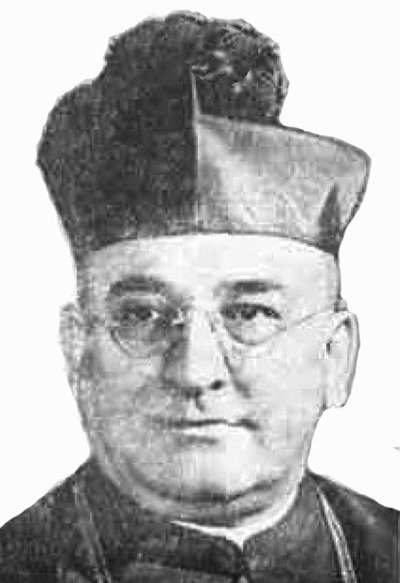
By Bishop Louis B. Kucera (1888 - 1957)
A native of Minnesota, Kucera was ordained a priest in June 1915 and consecrated Bishop of Lincoln in October 1930. He served as the diocese’s fifth bishop until his death May 9, 1957.
Note: Bishop Louis B. Kucera was Bishop of the Diocese of Lincoln from 1930 – 1957. In those 27 years, he preached a homily nearly every Sunday at St. Mary Cathedral (the current St. Mary Church) in downtown Lincoln. In addition, he preached Advent and Lenten series on Sunday evenings on various topics such as the Stations of the Cross and the Beatitudes.
He wrote out his sermons in exquisite, long-hand cursive. About 2,000 of these texts have been preserved in the diocesan archives. Approximately a fourth were written in Czech. Some of his sermons addressed the challenges, heartaches and sacrifices of the Great Depression and the Second World War.
The sermons are being catalogued with the possibility of a select number of them, for example, those on the Eucharist, being published in the future. The following is Bishop Kucera’s homily on Easter 1934. Minor edits have been made for punctuation and sentence structure. - Father Kenneth Borowiak
A.M.D.G.
Easter Sunday
April 1, 1934
“He is risen as He said, hallelujah.” Matthew 28:6
Having considered our Savior’s descent into hell on the day of his death on Good Friday, we now turn to our contemplation of His glorious resurrection, that great Truth in which we express our belief today when we say: “on the third day He rose again from the dead.”
Christ often foretold that He would rise again on “the third day.” He compared himself to Jonah who had been three days in the whale’s belly. On the occasion of His driving the money sellers out of the temple, He said of his own body: “destroy this temple and in three days I will raise it up again.”
The actual event of Christ’s resurrection was in fulfillment of His own prophecies concerning it. So well attested is this crowning miracle of the life of Christ that St. Paul did not hesitate to insist that all else would fall to naught if the resurrection of the Savior were not an undoubted fact. “If Christ be not risen, then is our preaching in vain, and your faith is also in vain.”
It is always to eyewitnesses that one looks for the confirmation of any great event. You will recall that it is recorded that the enemies of Christ obtain permission from the civil authorities to seal the tomb of Christ, lest His remains be stolen and then the claim be made to another miracle – His resurrection. Accordingly, a huge stone was rolled up against the sepulcher, and soldiers were placed on guard to make sure that no one could tamper with the grave. The sentinels testified to the resurrection of Christ, and it is well to note that no effort was made to punish them for a breach of duty. Obviously enough, it was admitted that a great miracle had taken place.
Moreover, we have the testimony of the apostles and disciples who saw Christ after His resurrection. If you met this morning, here on the street, someone whom you knew to have gone to Minneapolis recently for a game, you would confidently assert that he had returned from the journey. Just so, the apostles saw Christ, whom they knew to have been buried under the direction of the civil authorities. He was seen by two disciples going to Emmaus, and that same evening he appeared to the assembled apostles in Jerusalem. Thomas was absent and upon his return, refused to believe the report of the other 10.
St. Gregory the Great used to say that this unbelief of St. Thomas was a greater help to our faith than the belief of all the rest. This showed that the apostles were not gullible or too credulous. They refused to believe the women who had first brought the report that Christ was risen; they doubted the evidence of their own senses when Christ first appeared to them. Then it was that He showed them His wounds and allowed them to touch Him and ate in their presence.
He appeared to them again when Thomas was present and invited the unbelieving apostle to put his finger into the print of the nails and place his hand into the wound in His side. The profession of faith St. Thomas then made still echoes throughout the Christian world.
Christ was seen not only by the apostles but by at least 500 other followers, who had known the Savior intimately. Every feature and line in His face was fresh in their memory, every tone of His voice was familiar to them. This is more than abundant reliable testimony to prove the Resurrection of Christ. These witnesses had no reward to hope for; they expected and looked for nothing, but they received, namely, ridicule, contempt and persecution, and death.
When we consider the objections urged against the Resurrection, our position is strengthened. The enemies of religion have alleged that Christ was not dead, and so did not rise, but revived.
Consider the testimony of the bystanders at the Crucifixion. Pilate inquired if Christ was really dead. His friends, His mother would not have buried Him. His body could not have been stolen and if so, what came of it?
The Blood and Water from His body is truly a sign of his death. The proof of the Resurrection is strong; any objections are weak, paltry and far-fetched. The resurrection of Christ is a type in figure of our own.
Let us celebrate this great mystery of His rising from the dead. Hallelujah.
