

Q. In the Creed, we say the Father and the Son are one substance (‘consubstantial’). So what does Jesus mean on the cross when he asks why God abandoned him (Matt 27:46)? Are they no longer one? This is confusing.
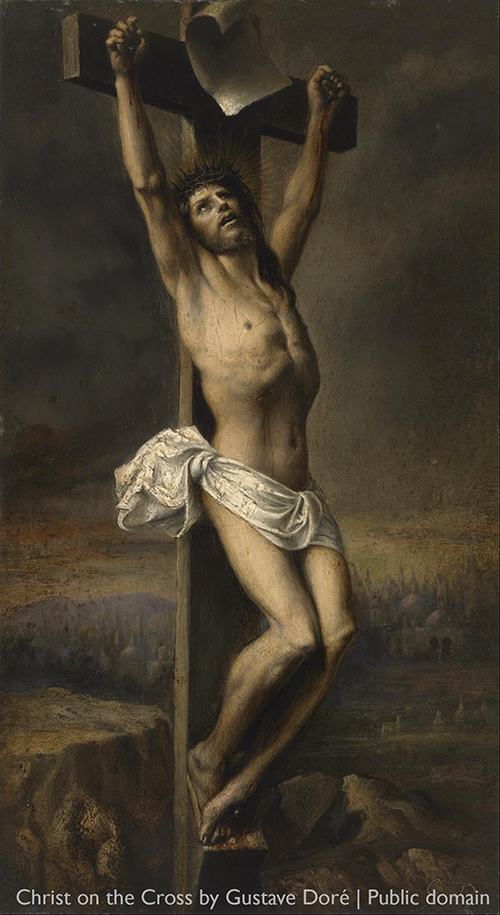 A. You’re quite right that something about these desperate words near the climax of the crucifixion is confusing. Jarring, even. “My God. My God. Why have you forsaken me?”
In one theologian’s poetic description, Jesus now “goes into the far country.” But we mustn’t misunderstand what is happening. This crux moment in God’s plan to defeat sin and to reestablish communion between himself and humanity has become a lightning rod for disagreement between rival views, beginning with the Reformed view which emerged in the 16th century as an alternative to the Catholic view.1
The Reformed view is that in Christ’s Passion and death, Christ bore the punishment of the Father’s wrath in himself that the elect deserved for their sins. (The term ‘elect’ refers to all the people throughout history whom God has in mind to save through the Son’s sacrifice.) In the Reformed conception, this is the meaning of ‘atonement.’
More explicitly, in this view, God the Father transferred all the sins (past, present, and future) of all the elect onto His Son. Then God the Father hated and cursed His Son who was now evil in the Father’s sight, on account of all the sins of the elect being concentrated in the Son. Consequently, what we see in the crucifixion is God the Father punishing Christ for all the sins of the elect of all time through the hands of those who tortured Jesus to death.
This view first came to prominence in a homily Martin Luther preached in 1519 called, “A Sermon on Preparing to Die,” in which he exhorts:
“So then, gaze at the heavenly picture of Christ, who descended into hell [1 Pet. 3:19] for your sake and was forsaken by God as one eternally damned when he spoke the words on the cross... ‘My God, my God, why hast thou forsaken me?’ [Matt. 27:46]. In that picture your hell is defeated and your uncertain election is made sure.”
More recently (though now over a decade ago), Thabiti Anyábwile wrote the following in a blog post on The Gospel Coalition website:
“At 3 o’clock that dark Friday afternoon, the Father turned His face away and the ancient, eternal fellowship between Father and Son was broken ... In the terror and agony of it all, Jesus cried, “My God, my God, why have you forsaken me?” ...We dare not speculate lest we blaspheme. But something was torn in the very fabric of the relationship between Father and Son” (emphasis added).
As laudable as the Reformed view is in a number of respects (e.g., its emphasis on the desolation Christ experienced; the love with which he offered his life), it is fundamentally unworkable for a number of reasons, only one of which we have the space to mention here—and in brief.
The Reformed view of atonement traps itself in a legal dilemma: either Jesus is innocent (which he must be in order to offer himself as an unblemished lamb according to God’s instructions) and God is therefore unjust, by committing the greatest evil of all time when he pours out his wrath on an innocent victim; or Jesus is not innocent (and therefore not unblemished) and God is thereby just to punish the Son, while Jesus’ sacrifice—which must be unblemished, but isn’t—is of no benefit.
The Catholic perspective avoids this conundrum by understanding that what was ‘atoning’ about Christ’s sacrifice on the cross was its nature as self-offering love to the Father, obedient even unto death. When Christ was on the cross, God the Father was not pouring out his wrath on his Son. It was we humans who poured out our enmity with God on Christ, by what we did to him in his body and soul—and which we still do whenever we sin, as St. Francis reminds us. Yet he freely chose to let us do all this to him.
What then of Jesus’ cry of forsakenness on the cross?
The Father never abandons the Son—they never “come apart” to form two separate gods rather than one. Yet the Father does withhold the divine protection (e.g., Luke 4:28-30) and consolation (e.g., Matthew 4:11) which the Son had previously enjoyed for a time, so that the Son, now forsaken of these things, may experience their absence in his humanity, and offer a full and perfect sacrifice to the Father. In fact, the Father is never more united with the Son than in these very moments, when he beholds with great love the extraordinary sacrifice the Son offers with great love.
Out of all his earthly ministry, the Father regards nothing as more beautiful than the Son’s self-offering on the cross. This self-offering wins the Father’s favor, such that it now outweighs his disfavor toward our sin. The Son loves us enough to die for us. And in the Father’s love for the Son and for us, he kindly cancels, as judge, the debt we could never pay in view of the payment the Son never owed. Together, as one essence, their identical commitment to us deals with and resolves the problem of our sin.
1 For a fuller explanation of the Reformed view, see Bryan Cross’ blog post, “Catholic and Reformed Conceptions of the Atonement” at calledtocommunion.com. I’ve borrowed and adapted some of his wording for the descriptions throughout.
This question was answered by Chad Steiner of the Emmaus Institute for Biblical Studies in Lincoln.
Write to Ask the Register using our online form, or write to 3700 Sheridan Blvd., Suite 10, Lincoln NE 68506-6100. All questions are subject to editing. Editors decide which questions to publish. Personal questions cannot be answered. People with such questions are urged to take them to their nearest Catholic priest.
