

By John Soukup
for the Register
Since the 1970s, Vietnamese refugees have played a pivotal role in shaping the cultural and social fabric of Lincoln, Nebraska. Their journey to the city began in the aftermath of the fall of Saigon in 1975, when Lincoln was designated a “Refugee Friendly” city by the U.S. Department of State. This designation marked the beginning of a thriving Vietnamese community that continues to leave a lasting impact on the city.
A key player in this effort was Catholic Social Services of Southern Nebraska (CSS). Founded in 1932, the organization expanded its mission in 1948 to include refugee resettlement. Working closely with the U.S. Conference of Catholic Bishops and the U.S. Department of State, CSS provided vital assistance to arriving refugees—including transportation to medical appointments, cultural and community orientation, English and citizenship classes, and job placement support.
In 1975 alone, CSS helped resettle 257 Vietnamese refugees within the Diocese of Lincoln, mostly in Lincoln but also in Hastings. They secured housing, furniture, food, and sponsors, while also arranging job interviews. By 1979, more than 450 Southeast Asians had made Nebraska their home. Although federal funding for refugee resettlement through CSS ceased earlier this year, the legacy of their work remains visible throughout the community.
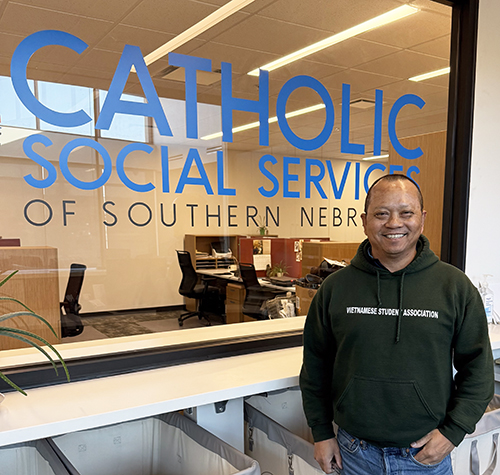
Among those first arrivals was Alex Tran, whose Vietnamese name is Chuyen. He was around 10 years old when his family, along with more than 20 relatives, fled their home in South Vietnam after the country’s president announced an unconditional surrender to the North Vietnamese. With little more than hope, they escaped by boat, navigating only in the direction of safety.
Three days into their journey, they spotted an American ship. Clinging to the chance of rescue, refugee boats clustered around the vessel.
“All we knew was that the Americans would save us,” said Tran. “They’ll take care of us.”
U.S. Navy sailors dropped cargo nets and skids over the side. Women and children, including Alex and his younger brothers, climbed the nets while their mother held onto them. Their father followed with the remaining family members.
It was during this voyage that Alex saw his first dolphins, which he remembers as a symbol of hope, leaping from the sea with what looked like smiles on their faces. Later, from the ship’s high deck, he spotted his first whale.
“As children, we heard stories of whales that could eat a house, but these whales just swam alongside us, probably because they feared America,” laughed Tran.
The Tran family was taken first to Guam, then to Hawaii, followed by a brief stay at a refugee camp at Fort Chaffee, Ark. Eventually, they made their way to Lincoln, where CSS offered the support and resources they needed to begin their new life. Years later, the family would go on to help establish the Immaculate Heart of Mary Vietnamese Parish, a spiritual and cultural home for many Vietnamese families in the city.
Though many of Tran’s relatives have since moved away from Lincoln, the city still holds a special place in their hearts. As they prepare to celebrate the 50th anniversary of their arrival in America, the family plans a reunion in Lincoln—revisiting the place that first welcomed them and reflecting on the journey that brought them here to find Hope in the Good Life.
Editor's note: listen to Tran's story on the CSS Hope in the Good Life Podcast.
Courtesy photos
