

By Joshua Burks,
Director of Mission Development; Associate Teacher at The Emmaus Institute for Biblical Studies
In AD 451, the fourth ecumenical council of the Church convened in Chalcedon, Turkey. In defense of the full divinity and humanity of Jesus Christ, the famous Tome of Leo was read aloud to the council, after which was heard, “Peter has spoken through Leo!” More than 1,500 years later, the Catholic Church still hears the “voice” of Peter speak through his successors—specifically now through another Leo, Pope Leo XIV.
How has the Church arrived at such a belief, connecting the biblical Peter to the 21st century pontiff? In this column, we will explore the biblical roots of the papacy in order to better understand our faith as well as inspire us in ways we can pray for the newly elected pope.
Perhaps the most central motif to the biblical depiction of Jesus Christ is that of his kingship. Even from the Old Testament—with passages such as God’s covenant to David in mind (cf. 2 Samuel 7), alongside many more—the anticipation of God’s messiah is inextricably tied up with regal themes and illustrations. Turning forward, the very first line of the New Testament opens with a royal proclamation: “The book of the genealogy of Jesus Christ, the son of David” (Matt 1:1).
The rest of the New Testament only advances this portrayal: the display of Jesus’ kingly authority throughout his earthly ministry (e.g., Matt 1:1-17; 7:28-29; 28:16-20; Mark 11:1-11; Luke 6:6-11; John 18:36-37), the Apostles’ preaching of Jesus and Lord and King (e.g., Acts 17:7; Col 1:18; Jude 25), or the cosmological depiction of the King of Kings in the Book of Revelation (e.g., Rev 1:5; 12:10; 15:3; 17:14; 19:16). It is an inescapable conclusion from reading the Bible that Jesus of Nazareth is the rightful heir and king over the house of David, as well as the exalted Lord and King of all the earth.
This vision of Jesus as King, rightly celebrated each year at the culmination of the Church’s liturgical calendar, forces us to consider: what kind of king is Jesus? The biblical depiction invites us to understand Jesus as a King after the Kingship and Kingdom of David. David was king of God’s people, one who ruled after God’s own heart (cf. 1 Sam 13:14). The books of Kings and Chronicles detail for us the shape of his kingdom: in his kingdom were many officers, rulers, and positions, much like our governments today. One office of distinction was that of the al-bayit, or the one who was “over the household.” A great example of this can be found in 2 Kings 15:5 when Jotham, the one who was “over the household,” governed the kingdom in the absence of the king (see also 1 Kgs 16:9; 18:3; 2 Kgs 18:18; 18:37; 19:2).
Perhaps the greatest detail of this office, though, comes not from Kings or Chronicles but from the Prophet Isaiah, in which Isaiah was commanded to go to the current al-bayit, Shebna, and cast him out of his office on account of his wicked deeds (see Isaiah 22:15-25). In this episode, we learn some key details on the role of the one “over the household” in David’s kingdom: (1) it is an office that is filled and eventually replaced by another (vv. 20-21); (2) it is no lowly office but a royal one (v. 21); the one who holds this office is given the “key of the house of David. He shall open, and none shall shut; and he shall shut, and none shall open” (v. 22); lastly, he will be known as a father (or, papa) to David’s people (v. 21).
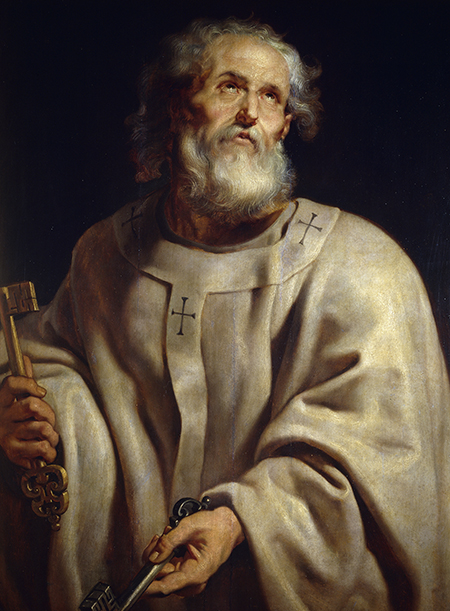
Fast-forward a few books and a few centuries in history and this language appears again in the written record of the Bible, but this time it concerns a new King and a new al-bayit. Jesus, a king after the heart and kingdom of David, is establishing his kingdom, goes to one of his apostles, and gives him the “keys of the kingdom of heaven” (Matt 16:19). This language is too familiar to Isaiah 22 to be a coincidence. The obvious conclusion is that Jesus the King is establishing his kingdom, and of top priority is establishing who his al-bayit will be to govern his people as a father in the earthly absence of the King.
In other words, habemus papam!
The Bible goes on to depict Peter in his role as Apostle and Overseer (episkopos), leading the nascent Church in her preaching (cf. Acts 2:14-41), doctrine (cf. Acts 15:6-11), and as shepherd (cf. 1 Pet 5:1-11). After his martyrdom, both history and tradition tell of how Peter’s office would be succeeded by others in an unbroken line, leading to the election of Pope Leo XIV twenty centuries later.
The biblical depiction of Peter and his office, as well as the name selected by our new Holy Father, invite some final reflections as opportunities of prayer. First, from Simon of Galilee to Robert Cardinal Prevost, the pope is human and is need of our prayers. Let us pray that Pope Leo XIV walks faithfully, open to the graces that are now operating in his heart which were previously absent.
Second, let us pray that Pope Leo XIV is a faithful shepherd. Our Lord instructed Peter to strengthen his brother bishops (Luke 22:32) and to feed his lambs and sheep (John 21:15-19). Let us pray that Leo XIV is a shepherd after the heart of the Chief Shepherd, Jesus, in caring for the Church and witnessing to the world (cf. 1 Peter 5:4).
Lastly, let us pray that Pope Leo XIV leads boldly under the patronage of his namesake, Leo, of which many of his holy predecessors courageously defended the faith amidst times of turbulence and heresy in the Church and in the world.
