

By Bishop James Conley
“I came that they may have life and have it abundantly. I am the good shepherd. The good shepherd lays down his life for the sheep.” John 10:10-11
Life is essentially good, and it brings joy. Even if we haven’t always felt its goodness, we can—and even must—affirm it in faith. All that God has made is good and is meant to bring about communion and love, redounding to his glory. God loves life. He came into the world to bring us to an abundance of life and love. He even commands us to be fruitful, to share the gift of life with others in many different ways. The entire goal of human life is to come to the fullness of life by entering into perfect communion with God—who is Life itself.
 Spring draws our attention to the theme of life as a time of initial blossoming and the planting of seeds, of cultivating potential and nurturing. The thawing of winter, which has taken its time for us who live further north, and the rains of early spring, bring us beautiful May flowers. Spring is a time of hope, bolstered by the joy of the Resurrection. The gift and potential of spring encourages us to reflect on our own lives, as we are made in the image and likeness of God and called to perfect happiness in him. This must be why we also remember our mothers, living and deceased, this month. They are the ones who brought us forth, nurtured us, and showed us unconditional love.
Art
Spring is a time for planting. Vincent Van Gogh, a deeply religious Dutch Calvinist who served as a missionary for years, found his way to Catholic Southern France as he sought to recover from the challenges of mental illness. He found himself drawn to the sun and to the marvelous colors of the Provence countryside. Even as his mind grew darker, he strove deeply to recover spiritual peace. His painting “The Sower” of 1888, which found inspiration in Jean-François Millet’s rendition, drew both from the Gospel and the spiritual force of nature.
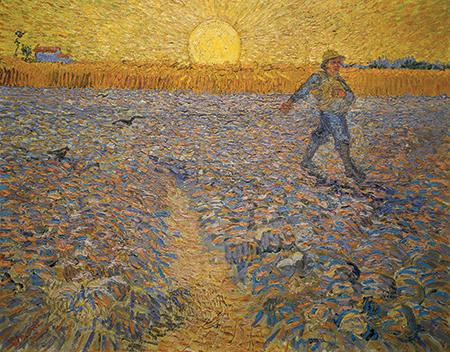
The painting radiates, even pulsates, from the sun’s central position, through which van Gogh depicted God’s creative action that undergirds all things. The work of the sower depends upon this source, especially in a cool world, suffused with contrasting blue and purple, that, if all goes well, will swell with similarly golden wheat (and we see an example of a mature field in the background). The soil presents challenges, as it appears chaotic, as well as outside sources, such as the black crows that hover about. The scene presented hope for the struggling Van Gogh, who looked to a future harvest of the seed that had scattered in the uncertain soil of his life. “One does not expect,” he mused, “to get from life what one has already learned it cannot give; rather, one begins to see more clearly that life is a kind of sowing time, and the harvest is not here.”
I was delighted to see our new Holy Father, Pope Leo XIV, engage this painting in his first Wednesday audience.
Poem
On the other hand, we know that we do sometimes experience a ripe harvest already in this life, both from the soil and the soul. At the Easter Vigil, we saw record numbers of people throughout the world entering the Church, finding within her a fount of new life. One of the twentieth century’s most famous converts, G.K. Chesterton, poetically described how his baptism changed everything, righting the world and bringing him to life like Lazarus emerging from the tomb. Chesterton became Catholic in 1922 at the age of 48 after a valiant and celebrated literary career defending Orthodoxy from the outside. His poem, “The Convert,” describes how he finally found his way home:
After one moment when I bowed my head
And the whole world turned over and came upright,
And I came out where the old road shone white.
I walked the ways and heard what all men said,
Forests of tongues, like autumn leaves unshed,
Being not unlovable but strange and light;
Old riddles and new creeds, not in despite
But softly, as men smile about the dead
The sages have a hundred maps to give
That trace their crawling cosmos like a tree,
They rattle reason out through many a sieve
That stores the sand and lets the gold go free:
And all these things are less than dust to me
Because my name is Lazarus, and I live.
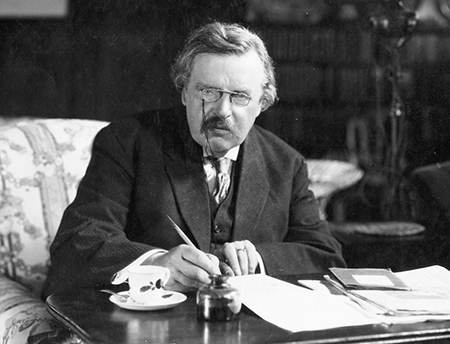
Beginning with the conversion of St. John Henry Newman in 1845 to the death of JRR Tolkein in 1973, there was a true Catholic revival in English literature, that included names like Gerard Manly Hopkins, Hilaire Belloc, G.K. Chesterton, Grahm Greene and Evelynn Waugh, just to name a few. On this side of the Atlantic one could include names like Flannery O’Connor, Walker Percy and Thomas Merton, all of whom wrote through the clear lens of their Catholic faith. These are the authors that influenced me the most during and after my journey into the Catholic Church at the age of 20. I continue to read and reread these brilliant and influential Catholic authors to this very day.
Movie
As Christians, we have received the seed of new life sown by the Savior in our own baptism. The life he has given us is good, but it is also marked by sin and suffering. To preserve it and to enable it to blossom, we are called to generosity and sacrifice, for our life grows especially when we pour ourselves out for the good of others.
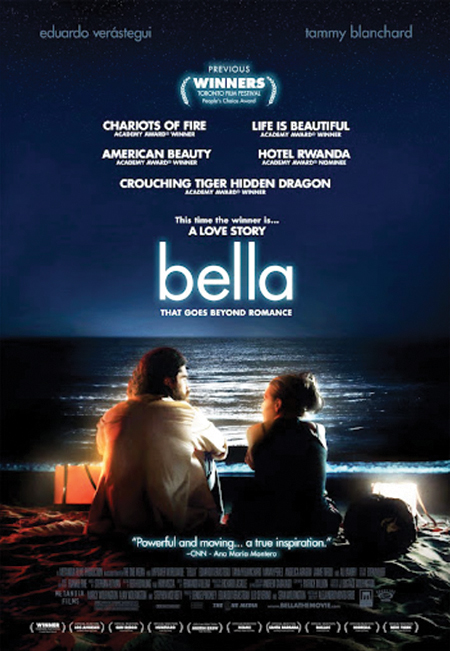
The 2006 pro-life film, "Bella," directed by Alejandro Gómez Monteverde, drives home this point, reinforcing how God’s grace offers us a new start with unexpected help from others. It’s a heart-warming movie that offers encouragement for those who need a reminder of how beautiful the gift of life is. It takes place almost entirely over the course of one day in New York City, focusing on how our plans often shift beneath our feet.
José, who tragically lost his career as a soccer star, finds redemption by coming to the aid of his co-worker Nina, when she finds out she is unexpectedly pregnant. A crucial moment of healing for both comes when they together plant flowers, experiencing, as José’s father tells them, “food for the soul.” It’s hard to appreciate the beauty of life unless we stop to see and listen to others so that we have the opportunity to help.
Book
We have been following Dante Alighieri’s Paschal pilgrimage through the afterlife, which began on Holy Thursday and now reaches heaven on the Wednesday of Easter Week in the “Paradiso,” the third and final cantica of the great trilogy of “The Divine Comedy.” Love stands at the center of the divine poet’s cosmic vision, l’amor che move ‘l sole e l’altre stelle, “the love that moves the sun and other stars.” As God’s love sets and keeps all things in motion, Dante follows the movement of the heavens to organize the poem’s structure, progressing with the saints from one orbit to another as steps toward the ever greater effulgence of divine charity.
Dante’s whole journey has been a lesson in love, moving from being lost in the woods of his passions, learning the consequences of rejecting love, and being purged of vice, especially of lust, through cleansing fire. Now, it is Beatrice, his ideal of courtly love, that leads him beyond his old way of loving, which would have led to death, to one that moves out of self and into God’s perfect life.
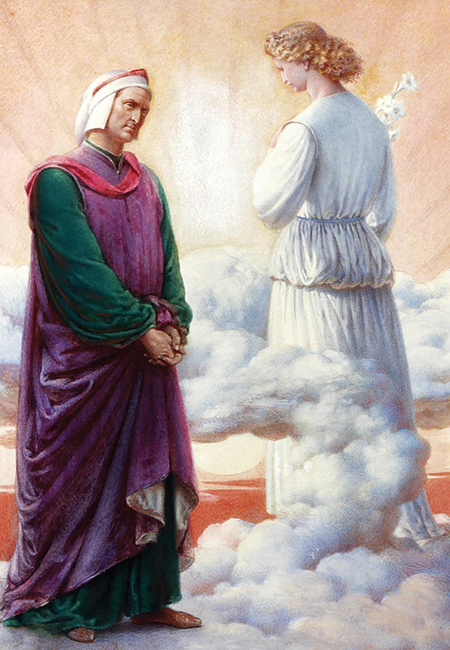
Even this perfected earthly love gives way to a greater tutelage. St. Bernard leads Dante to contemplate a celestial rose composed of the souls of the martyrs, the ones who gave their lives back to God as a gift. The contemplation of this divine garden culminates with the beauty of Our Lady, who leads Dante to the vision of the Blessed Trinity. The final line drives home how our soul must pulsate with the same love that orders the cosmos: “Here ceased the powers of my high fantasy. / Already were all my will and my desires / turned—as a wheel in equal balance—by / The Love that moves the sun and the other stars” (Esolen translation).
If you’ve made your way through this three-part epic poem, I’m sure you feel satisfaction in having completed one of the greatest works of Christian and world literature.
Music
Gustav Mahler’s “Symphony No. 8” offers surprising resonance with the conclusion of “The Divine Comedy.” Often called the “symphony of a thousand,” it is one of the largest-scale choral works ever composed, with a full orchestra, eight soloists, two mixed choirs, and a boys’ choir. Mahler, who nominally converted to Catholicism to serve as director of the Vienna Court Opera, composed it in 1906, with its premiere following four years later in Munich, offering it as a spiritual testament to the saving power of love.
It combines unlikely texts, the “Veni Creator Spiritus,” which the cardinals pray at the beginning of the Conclave, and the closing scene of the second part of Goethe’s play “Faust,” often considered the greatest work of German literature. The ninth-century Latin hymn praises the creative power of the Holy Spirit, who fills our hearts with his love, as we invoke his aid: “the weakness of our flesh supply,” and “far from us drive the foe we dread.”
These invocations come to fruition in Mahler’s symphony through the example of Faust, who had sold his soul to the devil. The rescued soul of his tormented lover, Gretchen, acting as Beatrice, supported by the Sinful Woman of the Gospel, the Samaritan Woman, and Mary of Egypt, seek to obtain his salvation. The holy penitent women act as roses before the most high, as Gretchen, now known as “A Penitent,” prays: “Those roses, from the hands / of love-sanctified women penitents / help us to achieve victory / and fulfill the noble work / of capturing the prize of this soul.”
The decisive turning point comes when the character named “Marian Doctor,” like St. Bernard, points to the vision of Our Lady in heaven to overcome evil and enable even the most terrible sinner to be snatched out of the devil’s hands.
“Faust” may stand as a symbol of the modern world’s abandonment of faith in its search for power and self-obtained happiness. But God breaks through this self-imposed isolation, offering the ultimate redemption out of evil through his lifegiving love, which gave us life and calls us back to him like a tender mother. Mahler’s symphony captures the power of love and the forces that attempt to thwart it through the interplay of bombastic outbursts and tender touches, solemnity and playfulness, glorious praise and humble supplication, straining tension and joyful exuberance—all pointing to a final moment of musical triumph that wraps around us like a loving embrace.
I recommend having the English text or subtitles available as you listen so you can appreciate how he expresses the lyrics.
Conclusion
The works highlighted for this month’s theme, “The Gift of Life,” portray at times and in different ways hope, searching, sacrifice, suffering and joy, but love is the thread sewn through all of them. Van Gogh’s “The Sower” scatters his seed mixed with the hope of a fruitful harvest. The love with which he does so is illuminated by the sun. It is the love of the Son which allows each of us to flourish. G.K. Chesterton’s search for truth brings him to the Catholic Church and the ultimate loving relationship – becoming one with God.
“Bella” portrays the brokenness we all feel deep inside at times, yet we know God’s love ensures we are all extremely valuable in his eyes. Through his musical composition, Mahler shows us how God will break through any obstacle—including those we ourselves create—to call us back to his lifegiving love. Dante’s “Paradiso” lifts us up to the Source of love where our souls are constantly longing to reside. And the Bible passage from John 10:10-11 is a perfect illustration of the extent to which God will go—laying down his life for us—and the reason he does so—that we may have life and have it abundantly. God is love, and he loves us so much he does whatever it takes to give each one of us “The Gift of Life.”
Bishop Conley’s Humanities Syllabus
May: “The Gift of Life”
Book:
“Paradiso” by Dante
Film:
“Bella” (2006) Alejandro Gómez Monteverde
Music:
“Symphony No. 8” by Gustav Mahler
Poem:
“The Convert” by G.K. Chesterton
Art:
“The Sower” by Vincent Van Gogh, 1888
ADDITIONAL SUGGESTIONS:
Books:
“Quo Vadis” by Henryk Sienkiewicz
“The Catholic Revival in English Literature, 1845-1961” by Ian Ker
For children: “The Tale of Peter Rabbit” by Beatrix Potter
Film:
“Life Is Beautiful” (1997) Roberto Benigni
For children: “Chariots of Fire” (1982) Hugh Hudson
“Horton Hears a Who” (2008) Jimmy Hayward and Steve Martino,
Music:
“Easter Oratorio,” Bach
For children: “Spring,” Vivaldi
Poem:
“The Canterbury Tales: General Prologue” by Geoffrey Chaucer
“Let Me Not to the Marriage of True Minds” by William Shakespeare
“Spring” by Gerard Manley Hopkins
“My Heart Leaps Up” by William Wordsworth
For children: “About the Sheltered Garden Ground” by Robert Louis Stevenson
Art:
“The Resurrection of Christ” by Matthias Grunewald
For children: “The Cross of San Clemente,” Rome
Editor's Note: Click here for more Diocese of Lincoln Jubilee 2025 Resources
Click here for all the Humanities Syllabus postings
