

Msgr. James Shea is president of the University of Mary in Bismark, N.D., and also a well-known Catholic author and speaker. He was in Lincoln this week to teach missionaries for the Fellowship of Catholic University Students (FOCUS), which is holding one of its nationwide summer training sessions on the University of Nebraska-Lincoln campus again this summer.
Dennis Kellogg, director of communications for the Catholic Diocese of Lincoln, talked with Msgr. Shea after he celebrated Sunday morning Mass for the FOCUS missionaries at the St. Thomas Aquinas Church at UNL’s Newman Center about a new era in the Catholic Church, the sainthood cause of FOCUS missionary Michelle Duppong who shared her faith on the UNL campus, and what inspires him.
Dennis Kellogg, Southern Nebraska Register: I want to start by talking about your books. “From Christendom to Apostolic Mission.” Can you walk us through that title, which is the crux of the book, and tell us what that means?
Msgr. James Shea, president of the University of Mary, author, speaker: That book is a surprise and a little bit of embarrassment to me, because it’s the fruit of a conversation that a small group of friends, people who Bishop Conley would know I think, kind of “Newmanians” and people who love the Church, have been sort of talking about in the midst of everything that’s happening all around us, and at a certain point, a manuscript came to the fore, and we started working on it and it sat on my desk gathering dust for about three years. I just didn’t have time to put the thing into publication.
And when we finally did, it was during the pandemic. It was May of 2020, and we published it mostly as an internal piece for the University of Mary. I just wanted people to know what was happening in the wider culture and why we were making certain decisions at the University in a particular way. But to our great surprise, it started selling, and it has touched a nerve. It’s very brief, of course, and so I suppose that helps, because people don’t really read books anymore, and so if you can have a piece that’s not a book, then that’s good.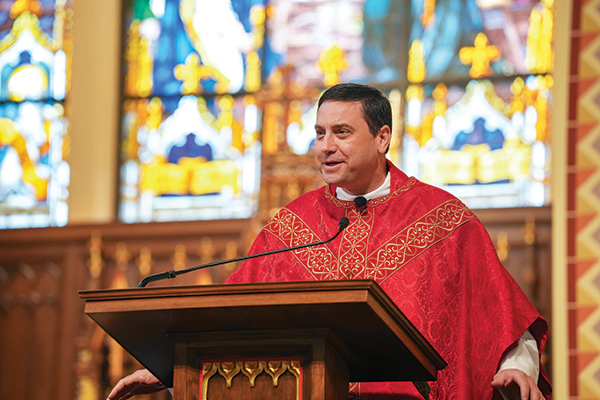
But it is a reiteration of what the popes of the last 60 years have been saying over and over and over again, that we’re not living in an age of change, but a change of age. That there are some moments in history when you can draw a bright line between everything that went before and everything that’s coming after, and we’re living in such a time and that touches upon the Church and her mission, because it means that long standing strategies that worked in a time of Christendom, by which we mean a time in which the gospel and the ideas of the gospel, the imaginative vision that was imparted to us by Christ and that animated the first apostles, that the civilization which was built by that has, through a slow but steady process thoroughly rid itself of its Christian basis, and so we’re living in the first post-Christian civilization in history.
That’s what C S Lewis says. And he says that it’s complicated, tricky times because that’s the difference, Lewis says, between winning the heart of a young woman who’s never a maiden, who’s never fallen in love before and trying to win the heart of a cynical divorced person back to a previous bond. The second is, of course, more tricky. That’s the circumstance in which we’re living now. And so if we don’t change our strategies, long time strategies that worked in a time of Christendom won’t be as effective anymore. And so we wanted to get the Church thinking about those kinds of things. But first of all, we wanted the University of Mary to get thinking about those things. And that’s the funny thing. This is providence. In other words, we weren’t looking to publish a book that would have much resonance beyond our campus, but it did accidentally. Of course, we published it in a very humble, simple way. It just says University of Mary on the front and I think that there is a beauty in that, and I’m grateful for it.
Southern Nebraska Register: And so the follow up to that is “The Religion of the Day” and it seems to talk about the false creed of our society. What’s your advice to people who are trying to fight the culture that wants to define its own “brand” of religion, so to speak?
Msgr. Shea: The end of the first essay from Christian apostolic mission said that the key task in the New Apostolic age, which is what we’re living in, is the conversion of the mind. It’s to recapture a Christian way of seeing. It’s to recapture what we call the atholic imaginative vision. And that’s contrasted to a progressive religion, which takes many of its cues from Christianity, but which in fact is a counterfeit. It’s not an authentic form of Christianity, and in fact, departs from it in decisive ways, quite on purpose.
And so, the second essay, “The Religion of the Day,” was written to explicate that. It’s a touch longer. It’s a little bit heavier, in terms of philosophy, theology, history, the implications of that. That, I think, is simply to flesh out what is the religion that’s all around us. So when you ask about advice, my first bit of advice is, don’t be asleep. Don’t think that we’re just living in a purely secular age. We’re living in a highly religious time. But the religion is not Christianity, but in many ways, it masquerades as Christianity, because it takes many of the of the founding principles of Christianity, adopts them as its own, and in fact, borrows as well the great mythic force of Christianity.
And so, this is a great triumph for the enemies of God in this respect that now we have a religion which nobody thinks is a religion. We have a religion which somehow has succeeded in taking the Good News and making it seem like bad news, and which borrows the mythic force, the potency of Christianity and metastasizes it, changes it. And so, we really need to be aware of that. People aren’t aware of it. As a result, a lot of believers, a lot of fervent Christians and a lot of solid Catholics can find themselves caught up in causes which seem Christian because they’re caring or they speak of good Christian values like freedom or hospitality and yet, if you scratch the surface, you see that there’s something profoundly contrary to the gospel right beneath them that’s easy to get caught up in if you don’t understand the principles according to which the new religion of our time operates.
Southern Nebraska Register: It seems to me, both of these books urge people to live intentionally, and you’ve already talked about some of the practical ways to do that, first, by staying awake. But what are some other ideas you have for people on how to live intentionally in this culture today?
Msgr. Shea: My biggest piece of advice would be to find books that are deeper and better than those two essays, which are not hard to find. Here’s the thing, we’re living in an embarrassment of riches. For those who are looking to be formed deeply in the faith, to have their minds transformed, there are all kinds of resources out there that were never available to past generations, or not as readily available. And so to tap into those, I think, is profoundly important.
And then to live a life of faith which is not fundamentally characterized by anger or reaction. This is really, really important, because I think one of the rotten fruits of this new religion, of the times in which we live, is an obsession with utopian schemes. This idea that we can somehow work through human effort or through politics or through some kind of technique, whether it be psychological or social or economic or political, to build the perfect society together. This idea is very much around us, and so as a result, when people see that things aren’t going in that direction, when the inevitability of progress isn’t so apparent, whether in our civil society or in the Church, people become fundamentally angry, and that can become their stance, by which they live their civic life and by which they live their faith.
This is precisely what the enemy wants, and we want nothing to do with it. We’re not utopians. Catholics believe in the doctrine of the fall and that means that our parishes and our dioceses and our schools and our families and our workplaces and our civic society are not meant to be utopian schemes that we can somehow bring to perfection through social reform and revolution and the right kind of education and technique, or scientific progress or any of these things. They’re arenas for failure. There are places for the dying and the rising of Jesus, where God can have his way and where the renewal of the human race can continue to happen in every time and place, and I think that that’s super, super important. If we don’t understand that, we’ll misunderstand the church, we’ll misunderstand our lives, and we’ll live kind of these angry, furtive lives, half in the shade. We’re not meant to live like that. We’re sons and daughters of a good God. God is not anxious. God is not angry. God is not concerned, wringing his hands. The Lord has the world firmly in his grasp. And our work is to be obedient, to be cheerful warriors here below, to fight the good fight, and to know that that’s the work we’ve been given to do in this life, and that it’s an honor for us.
Southern Nebraska Register: We’re speaking to you today at the summer training session for FOCUS missionaries from across the country. You also serve as president of the University of Mary. You’re around young adults all the time. When it comes to the faith, what gives you hope about today’s generation?
Msgr. Shea: The good news about living in a post Christian age, the good news about being in a New Apostolic time instead of in Christendom, is that there are certain things that come with that. The faith tends to be lived in a more high-hearted way. The faith begins to attract those who are most pure in intention, who really have a heroic spirit about them, and who really are intent on heading for glory. And so the young people that I work with at the University of Mary, or the missionaries of FOCUS, or those who are involved in FOCUS bible studies or other amazing organizations.
I think of Christ in the City out in Denver, or St Paul’s Outreach. It’s amazing. We’re living in a time in which there are all these kinds of movements which brighten the darkness and young people are at the root of it all. I remember when I was just going into college is when John Paul II came for World Youth Day in Denver in 1993. That was a watershed moment for the Church in our country. Your good bishop, Bishop Conley, I think, would remember with fondness that moment, and since then, maybe even before, but certainly since then, the Church in the United States has been characterized by a kind of youthful energy, a heroic, high-hearted spirit that’s ready for reform and renewal and repentance, joyful repentance, not the other kind.
And it’s really an exciting time in which to live. And I see it here at FOCUS. I teach all kinds of different things to these missionaries. Some years ago, they had me teaching just the basics of Christian anthropology, because our civilization has lost sight of what it means to be a human person. Now, I’m teaching questions about the renewal of the mind, which touch very deeply upon these questions of “The Religion of the Day,” which is that second essay that we talked about earlier. And to see them come alive to that, it’s amazing.
There’s a certain sense in which they haven’t been given very much, most of our young people. Certainly, if you attend a large public university, even if you’ve got an amazing Newman Center, the classes that you take will be filled with this new “religion.” The large universities of the West, the large universities of our country, are the monasteries and the seminaries of the new religion. And the young people’s minds are marinated in this stuff. And inchoately, deep down, they know that it’s not sufficient. They know that the revolutionary cry, “the only thing we have to lose is our chains” is going to devolve sooner or later into “shop till you drop.” We squander our freedom. Everybody. Freedom is like an incantation, but how do we use it? Well, we go on Amazon and spend hours reading the reviews so that we can order the perfect tea pot or some crazy thing. That’s a waste of freedom. It’s a squandering of it. And so, I think young people are not impressed by what we’re handing down to them. The civilization that they’re inheriting is not embracing for them. It’s not challenging enough. It’s not enough. And so they want more, and the faith has more to give them.
Southern Nebraska Register: What role do Catholic colleges play in forming the next generation of leaders in this post-Christian society? And how does that change the offerings that you have at a Catholic college when it comes to education?
Msgr. Shea: So we’re sitting here at the wonderful Newman Center at the University of Nebraska-Lincoln, which is just an amazing place. And if a student goes to a large public university, they sure ought to be involved in a place like this. And what’s amazing and unique about UNL’s Newman Center, this is a tribute to the Lincoln Diocese and to Bishop Connolly’s leadership, is that the intellectual formation is very much in earnest here with the Newman Institute and those kinds of things. Catholic universities, of course, are able to take things further than that.
How is that? Well, I think, for a long time, and here I’ve talked, for instance, with Patrick Reilly, who’s the president of the Cardinal Newman Society, and he publishes the Newman Guide for choosing a Catholic college. For a long time, the Newman Guide selection process was involved in asking the question, at this Catholic university, is there something happening, something being taught, some club that they have, which is fundamentally opposed to Catholic teaching, and as a result, a student is going to be sort of contaminated by coming to a place like that, their mind will be really affected in a negative fashion?
And I’ve suggested to him, and I think he’s known this all along, and I think this is true for students choosing a Catholic college, it’s true for parents assisting their children in making this decision. It’s no longer enough to say, is there an absence of that which is wrong? You also have to look and see, is there some powerful counternarrative in the blood at this place. In other words, in a place like the University of Mary, one of the things that we strive for, and we do it very intentionally, is that every one of our five academic schools, all of the different programs, are deeply engaged in excellent professional preparation, of course, in excellence in study and in instruction at a very high level, but also we’re constantly looking for ways in which we can push back against the darkness.
And so it’s not just that our School of Health Sciences, which is our largest school, for instance, that we’re not training our students in IVF and abortion and tubal ligations and all these things. It’s not enough. Instead, we have a partnership with the National Catholic Center for Bioethics, where strong bioethical principles are being imbued in every single aspect of the curriculum. True also in our School of Education and Behavioral Sciences. It’s not enough that we would prepare teachers for our schools, or therapists, social workers and counselors, not to have crazy ideas, to make sure that some of the most problematic ideas of this new religion aren’t shot through their education, as is the case in education and in the behavioral sciences everywhere. That’s not enough for us. Instead, we make sure that solid Catholic anthropology, a true and adequate vision of the human person, is part and parcel of the education of every one of our students.
And that’s important, because long after I’m gone, there will be new metamorphoses to these terrible ideas, and we need our students to be instructed, not just in a superficial way, but according to the firm, vibrant principles. Or over in the School of Business, we’re talking all the time about virtuous leadership, that leadership has to be rooted in the cardinal virtues and also then in the theological virtues. These are questions which are very much alive to us.
People think that a good Catholic University is just like a really solid secular university with a tremendous campus ministry. No, no, that’s not true. It’s meant to be a Catholic university such that the faith and its ramifications are apparent in every aspect of the life of the place. That’s not an easy thing to do. In the age in which we’re living, it’s like building a house in a gale force wind. But those are the times in which we live, and they’re exciting times.
Southern Nebraska Register: You’ve certainly been supportive of the cause of sainthood of Michelle Duppong. She walked this campus. She walked on your campus. A beautiful young woman who was filled with joy. What can we learn from her life?
Msgr. Shea: That’s an enormous question. Dennis put a very good one. Michelle was an amazing human being. She was alive with joy. She was a connector of people. She loved Jesus with all her heart. She was amazing. She was also super ordinary. She was just a farm kid from the middle of nowhere. I think the main lesson of her life, in an introductory fashion, would be that anyone can be a saint, and that those of us who live on windswept prairies in eastern Nebraska, western North Dakota, we’ve all got a shot. In fact, that’s God’s will for us. So that’s one lesson.
Another lesson is this. Michelle died in her prime. She was very effective as an evangelizer, and those of us who were gazing at her suffering, praying with all our hearts that she would be cured, were really perplexed by what God could possibly be doing, taking from us someone with so much promise. And yet it’s a perilous thing to have an argument with God, because you stand to learn lessons in that, and that’s what’s happened here. Of course, Michelle’s reach as an evangelizer is way, way more now that she’s in heaven than it would have been had she stayed here below. That’s a difficult truth, but an amazing truth as well.
Of course, the caveat is that she’s not yet a canonized saint, so the Church has to say whether or not she’s in heaven. That’s not for me. But we sure take to heart her example. She tells us, she shows us that we need to trust God with our lives, that he knows what he’s doing. This is an important lesson. Sometimes we think he doesn’t.
Southern Nebraska Register: What does it mean for young adults to have a Michelle Duppong, or a soon-to-be-saint Carlo Acutis, out there who they can look to and see someone who’s been through the fight and who has persevered. How important is that?
Msgr. Shea: it’s important in the measure in which we have saints at all. That’s why the Church gives us saints, such that we can find in them inspiration. Saints were men and women like us, held together by water, a handful of dust and the saints help us to know that God works in extraordinary ways in ordinary lives. The indwelling of the Holy Spirit is invisible and unnoticeable. We have to believe it by faith and then exercise it as best we can to walk by faith. But the saints are the great exemplars who tell us, no, it’s really possible and it really happens.
And it’s amazing when it happens, when a person really does say, “No, God, I’m done with this. My life is totally available to you. Do with me entirely, as you would.” That availability is something, that generosity is something that God will never waste. And we see that in the lives of the saints. It’s really beautiful. I mean, think of Michelle or Carlo. These are our young people, very close to us. Some of the saints are lost in the mists of history, and then some, it’s as though they were just here yesterday.
Southern Nebraska Register: We’re just beginning the pontificate of Pope Leo XIV. How do you feel about that? What are your hopes and expectations?
Msgr. Shea: I’m so thankful Dennis. You deserve some kind of a Pulitzer Prize or something, because the way that you ask questions is good. You didn’t ask me how I “think” about it. You asked me how I “feel” about it. Normally, I wouldn’t like that question. I like to be asked what I think.
But in respect to this question, I’m super grateful, because I have no idea what I think about Pope Leo, except that he’s the pope. You know what I mean? He’s the pope. Nobody I know knows anything about him. And so people are like grasping at straws and posting things on the internet that he might or might not have said. But the signs are sure, great, you know, at the beginning, aren’t they? And so I have a great feeling about him. And of course, I love him. You know, he’s the successor of St Peter. All of us owe fealty and obedience to him. And, yeah, I feel very good about him. So, we’ll see how things go, but it’s great.
Southern Nebraska Register: So, every pope faces challenges. What do you see as the greatest challenges ahead for the Church? Culturally, morally, pastorally?
Msgr. Shea: See, you’re good, because now you’ve asked me what I think about Pope Leo in this respect that he’s already told us what he sees as the challenges by the taking of his name. In other words, he took Leo XIV after Leo XIII, Leo the Great of course, and all the Leos, all the 13 Leos before, in various ways. Leo the 10th, yeah, yikes.
But Leo XIII, of course, wrote Rerum Novarum. He lived in a time of monumental change, in the course of the Industrial Revolution, wrangling between communism and certain forms of capitalism and all kinds of things happening at that time. And Leo XIV believes that we’re living through such a time as well. In other words, we’re living through a change of age. It’s this Christendom, apostolic mission question. This Holy Father acknowledges it, and he says that the technological revolution which we’re living through now, which involves artificial intelligence, all kinds of things, and in that regard, is something that the Church can bring to bear the great tradition upon.
We’ve been thinking about things for a long time. We’re meant to be, as I think Pope Paul VI said, experts in the human person. And so, this is a moment in which we can really contribute, not just internally in an insular way to the life of the Church, but to the human race as a whole. Nobody else has the ballast to deal with these types of questions. I mean, most people have thrown in the towel in terms of that pesky question, just because we can do something, should we do it?
But we care about that question, and that question is a question which needs to be asked in every watershed moment where the Church is facing the winds of new technologies and massive changes, and those are the times in which we live. AI, somebody asked me about it the other day. I’m not an expert. Don’t know a whole lot about it. But on these questions, I’m a short-term pessimist and a long-term optimist, in that every massive civilizational shift that’s come about because of technology has brought with us particular perils, sometimes very grave perils, but also promise.
And so, it’s a matter of the human race digesting this new thing and determining how best to use it for good and not for destruction. And that’ll take a long time. But in order to do that, we have to rely upon God, because He’s the one who imparted that creative power. We have new technology. We have technology in every age because God made us in His image. And so, part of his image is that he’s a creator. He’s the Creator, and we participate in his creation through our ingenuity and through our responsible stewardship and leadership of that which we have created, and God doesn’t abdicate that we can’t either.
Southern Nebraska Register: In your homily this morning to the FOCUS missionaries, you shared the story of a FOCUS missionary in the past who had come up to you and talked to you about virtue. He told you virtue, for him anyway, was not a chore, but a war. What is the virtue that we need to be praying for the most? How do we get that virtue?
Msgr. Shea: That missionary had said he’s starting to believe that the Christian life is not a chore, but it’s a war. This is so important for us, because so often we think of our faith as a burden. You know, wouldn’t it be something if we had never heard the gospel? Then we could live however we pleased, and without consequence? Of course, that’s not the right way to look at it. We’ve been set free by God through His grace and the Christian life is not a chore. It’s a war. That’s gladsome battle. That’s the kind of battle which fills your lungs with air and your limbs with strength.
I think that it’s important for us to not lose sight of that and to remember that the Lord is fighting with us all the time and to not lose hope in the midst of that. The question of how we keep that strength within us is a question of communion. It’s a matter of the life of prayer. It’s a matter of the sacraments. It’s a matter of staying close to God all the time. The Lord will draw us to himself as quickly as we can take it, and he’ll infuse those virtues in us too, which we need, and he’ll help us to develop those virtues which we are able to develop.
And so that strength, that excellence, can come. You asked about the particular virtue, and I would say this. One time, not long ago, someone sent me a letter in a card, and on the front of the card was an excerpt from one of the letters of St Catherine of Siena, with this phrase, “start being brave about everything.”
Start being brave about everything. Well, there you go.
I think the times in which we live require courage. I think that we’re being summoned to an extraordinary kind of bravery in the midst of a darkened world, to be the light of Christ, to shine brightly with joy and to exemplify the Christian life, such that people all around us who are weary with the world and who sought all the pleasure and it just turned to ashes in their mouth. At a certain point, they look around, they’re meant to see us and say, “What has he got? What’s going on in her? There something going on there. I think I want it.” That kind of witness, that contagious faith is what we see in the Acts of the Apostles. That’s for us too. It’s for all of you here in Lincoln.
Southern Nebraska Register: Your writings and your talks have inspired millions of people across the world. What inspires you?
Msgr. Shea: Oh, my goodness, wow. Well, the Lord Himself. It’s an amazing thing to know Him, to have a life that’s given over to him, to have been asked to be his priest. This is something that moves me deeply every time I ponder it, because it’s such a great blessing and an unexpected joy. And then I have been given a task at the University of Mary for the care of young people that arises out of my previous life, where I was a high school chaplain.
And so I’m deeply inspired by the fact that in every age, young people arrive on the scene eager for the living of the highest life, eager to know what to do, how to live, how to love, what to do with a broken heart, what suffering means, why it’s worth it to get up every morning and fight life’s battle. To have a chance to be a part of that. I say this to our faculty all the time at Mary, “Who gets to do what we get to do? It’s amazing. It’s incredible. We have the greatest task in the world. You can’t pay us enough to do that.” And the faculty say, “You don’t pay us enough!” (laughs) This is the reward for this is there’s joy in the striving in the Christian life, when you found what it is that you’re meant to do. And so that’s great. I’m just really grateful for that.
And then the example of the saints. There are saints in my life, as in every life, who have had a particular grasp on me. I’ll give one example. We talked about Michelle Duppong and Carlo Acutis. Michelle hasn’t been beatified. Carlo hasn’t been canonized. There is a priest from Oklahoma, Blessed Stanley Rother. He’s a great inspiration. I was at his canonization in Oklahoma City. Of course, the archbishop of Oklahoma City is a very close friend of your bishop, James Conley. They were fellows together, buddies in college, walking the path together, fighting the good fight, coming alive to truth.
Anyway, so I was down for his beatification and Cardinal Angelo Amato was the Holy Father’s representative during the beatification. In his homily, he kept using this phrase “he would not spare himself” about Father Rother. That in his work in Guatemala, in Santiago, Atitlan, where he had his little parish, he would not spare himself, and I was just pierced to the heart as I listened to that.
And I think about it often -- that that’s the real work of a priest. Would that that could be said about me or about any of us who have been given the great calling to follow Christ, he would not spare himself. She would not spare herself. This should be the motto of our lives, that we’re not looking for our own interests. We really want the glory of God. And if there’s a cost to that, where do we pay? Where’s the register? I’m ready.
