

Southern Nebraska Register
In celebration of the Jubilee Year of Hope initiated by Pope Francis, the Emmaus Institute for Biblical Studies hosted its first pilgrimage to Rome and Assisi, to “Encounter the Word from the Heart of the Church.”
Emmaus Executive Director Joshua Burks was joined by 24 pilgrims from the Diocese of Lincoln and the Archdiocese of Kansas City, as well as Father Cole Kennett, pastor of St. Michael Parish in Lincoln, and Jeff Runyan, founder of Encounter Travel.
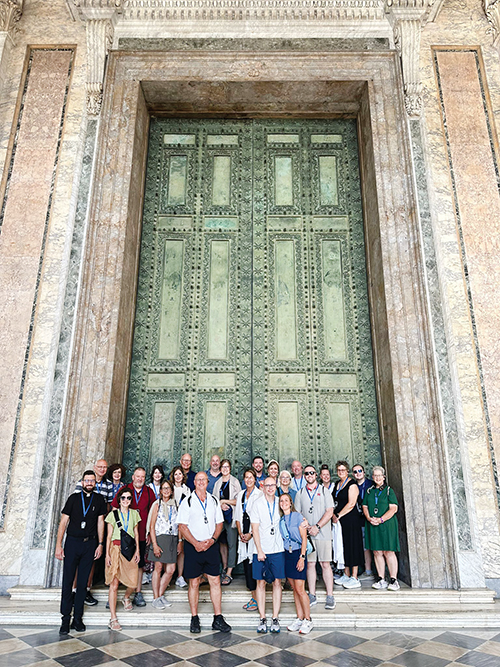
“It was deeply moving to see the universal Church flock to Rome, the geographical heart and home of our faith, to seek these very graces,” Burks said. “The graces of the experience—especially the unique jubilee graces, such as walking through the Holy Doors—were palpable for our pilgrims.
“Catholic biblical faith is steeped in the tradition of festival pilgrimage,” Burks continued. “In the days of the old covenant, faithful Israelites and God-seekers would trek on foot to Jerusalem to celebrate the holy feasts. Today, God’s people similarly venture to places of historical and theological importance to seek an encounter with the risen Lord and his Church—as St. Gregory of Nyssa said, ‘He who beholds the Church beholds Christ’” (Song of Songs XIII).
While Christians are welcome to make a pilgrimage at any time, the jubilee pilgrimage is a special opportunity that only comes every 25 years. The jubilee has its origins in the Mosaic law, in which the Lord instructed Moses to celebrate the Year of Jubilee every 50 years (or every seven cycles of the sabbath year; cf. Lev 25). The purpose of the Mosaic Jubilee was to celebrate and to manifest the rest and freedom won for them by God in the first Exodus. The Christian jubilee fulfills that purpose by celebrating and manifesting the graces won for all in the exodus of Jesus, that is, his Passion, Death, and Resurrection.
To be a pilgrim is to be one who seeks something greater than oneself, Burks said. Often times, this means abandoning daily habits and comforts, and being submersed into something entirely new. While Assisi and Rome are arguably two of the most beautiful places in the world, they also provided their own distinct challenges.
“The hills of Assisi and the summer heat of Rome were constant reminders that we were not there for comfort or vacation but rather to be immersed in the living witness of our faith,” he said. “In hindsight, I am extremely grateful for the daily challenges, as each obstacle was an invitation to have childlike dependency on Jesus. That dependency paved the way to have the right openness of heart to receive the ample graces that our Lord was pouring out upon us throughout the pilgrimage.”
An example of those graces came in a highlight of the pilgrimage: meeting Cardinal Robert Sarah after the welcome dinner in Rome. The Guinean prelate served as prefect of the Vatican’s Congregation for Divine Worship and the Discipline of the Sacraments from 2014 to 2021. He is well known to Catholics around the world for his writings, such as “God or Nothing: A Conversation on Faith” and “The Power of Silence: Against the Dictatorship of Noise.”
Cardinal Sarah led the pilgrims in prayer before bestowing his blessing upon them, specifically the children with the group, born and unborn.
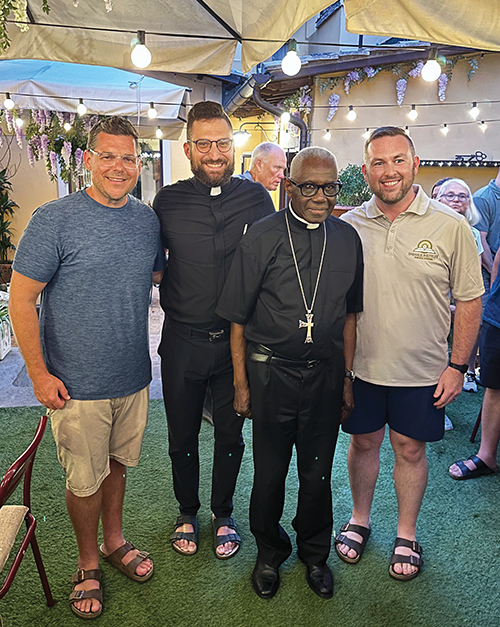
One of the pilgrims, Rebekah Knobeloch of St. Joseph Parish in Lincoln and founder and director of Feminine Genius Ministries, said meeting Cardinal Sarah highlighted her overall experience, especially since she and her husband Roger, who was also on the pilgrimage, recently learned they were expecting twins.
“Some of the unexpected moments of grace were obvious, like having Cardinal Sarah bless our unborn twin girls, and others were much more subtle, such as being overcome with peace at the tomb of St. Francis or a fellow pilgrim surprising me with a cannoli for the bus ride,” Knobeloch said. “God’s presence was everywhere: in the art, in the saints’ tombs, in the fellow pilgrims – in the Church as a whole.”
Cardinal Sarah remained with the pilgrims to listen to Father Kennett talk about the Catholic Diocese of Lincoln and Burks share information about the mission of the Emmaus Institute.
“I can say with all confidence that Cardinal Sarah is a man who is deeply in love with Jesus of Nazareth and that it shows in his words and actions,” Burks said. “His presence set the tone of the room, and I will treasure the opportunity to have met him on this side of heaven. “His parting words to me were, ‘pray for me.’ I ask that each of you join me in doing so, that he may continue to be an instrument of Christ Jesus in his office and ministry.”
Each day, the pilgrims were able to attend Mass and listen to a morning talk given by Burks or Runyan, before exploring the holy sites of Assisi and Rome, including the Papal Basilica of St. Mary Major. Burks took advantage of the Marian theme to reflect on how Mary could be a model for all to preserve the holy memories made throughout the experience.
“We considered how Mary “treasured up” and pondered the birth of her son (cf. Luke 2:19) and used that preserved memory as a place of encounter,” said Burks. “Likewise, Mary stands as a model for us to keep and preserve these special moments of encounter so that when things become difficult—which they inevitably will—we can go back to these holy memories, these wellsprings of grace, through which we can refreshingly experience the grace(s) of our Lord with clarity and confidence.”
While the group was in Rome, Natalie Bender, the director of public relations for the Emmaus Institute, ran a virtual edition of the pilgrimage for people to follow along with each day. Virtual pilgrims registered at no cost to receive a daily email of exclusive content from Rome. The emails included recorded talks by Runyan and Burks, homilies given by Father Kennett during private Masses throughout Assisi and Rome, photos of churches, relics, and holy sites, and a daily recap from Burks. Bender said followers were enthusiastic about the virtual pilgrimage and expressed gratitude for the opportunity.
“It was beautiful to see the graces of this pilgrimage be extended to everyone—especially those who were unable to go on pilgrimage in person, due to cost or family obligations. It’s a joy to share the hope of the pilgrimage with all of our diocese and beyond.”
The emails are accessible to all on the Emmaus Institute website at www.emmausinstitute.net/virtual-pilgriamges throughout the rest of the Jubilee Year. All are invited to journey from home with the pilgrims through each virtual day.
The Emmaus Institute is now planning its next pilgrimage, “In the Footsteps of the Apostle Paul,” for the spring of 2026. The land and sea pilgrimage to Greece and Türkiye will be conducted with Father John Riccardo of ACTS XXIX and Bishop James Conley of the Diocese of Lincoln. Pilgrims will retrace the footsteps of Paul, the mighty missionary and friend of Jesus. The Emmaus Institute pilgrimage will include stops in many of the communities Paul founded and visited in the early days of Christianity – such as Athens, Philippi, Thessaloniki, and more – seeking the saint’s wisdom, and asking his intercession. Details of the pilgrimage and registration information are available at www.emmausinstitute.net/pilgrimages.
