

By Reagan Scott
for the Register
When thinking about objects that can be blessed, one might picture religious items like rosaries, medals or scapulars; those things that someone could easily bring to a priest to bless. Less commonly thought of, though, are larger, non-religious items like cars, homes and even pets.
Father Matthew Schilmoeller, parochial vicar at St. Cecilia Parish in Hastings, explained that a blessing is a “sacramental.” While sacraments are instituted by Christ to give grace, sacramentals are instituted by the Church, the bride of Christ, to lead people to grace and dispose them toward cooperating with grace.
Sister Mary Cecilia, C.K., who has a master of arts degree in liturgy, explained that asking a priest to bless material things is a way of asking the Lord to use those things to lead us closer to the Church and the sacraments.
She said that because sacramentals – and blessings, by extension – are instituted by the Church, they’re able to “move with the times,” meaning that the invention of the automobile heralded blessings that can be bestowed upon it.
And why would one have an automobile blessed?
“If you’re going to get your car blessed, you want to make sure you’re doing it not because you’re superstitious and think that it’s never going to get into an accident or anything like that, you’re doing it because you want to use it to lead you closer to Christ, to use it in the service of Christ,” Sister Mary Cecilia said.
She also said the devil is very active and can use inanimate objects to draw people away from God. Blessings, with their ability to help ward off evil, can help people to see things in their right perspective, like cars, which transport people to and from Church, their jobs and errands – all things necessary for supporting oneself spiritually and physically.
Father Schilmoeller said when someone asks a priest to bless a home, it’s not necessarily because something scary is happening, or the house needs to be purged of an evil spirit. More often, it’s because people want their home to be a sanctuary of truth and a stronghold of virtue.
“A house is meant to be a formative place for immortal souls who are destined to go to heaven, and it’s the place of the family,” he said. “We know from the scriptures and from our faith that God has great intentions of the family and his desire is for the home to be a place of peace.”
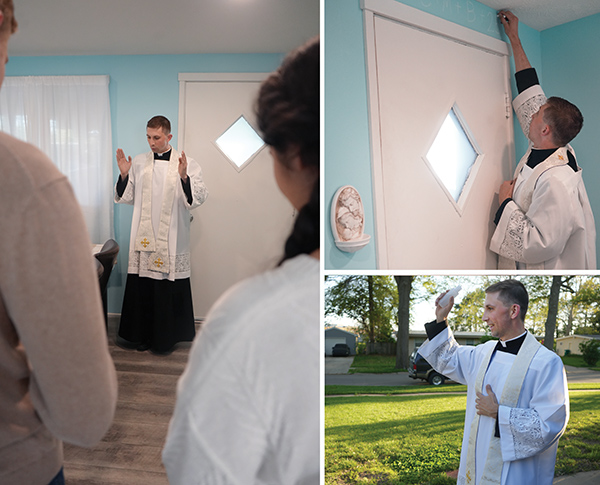
When it comes to blessing a home, Father Schilmoeller said the blessing is, in a sense, calling upon God and asking him to extend his hand of blessing upon the people who live in the home, and upon the space itself, so that it can become a place where people are disposed to grace and living a life dedicated to the Lord.
When it comes to the logistics of having one’s home blessed, individuals should work with a priest to find a time that works for both parties. The process of blessing a home can take as little as 15 minutes, or families can make an event out of the evening, maybe having the priest join them for a meal.
The priest will follow a ritual for the blessing, and will dialogue back and forth with the family in prayer. After completing the main prayers, the priest and family will go to each of the rooms in the home where the priest will sprinkle holy water.
“[This] serves as another reminder to all of the people who are there of the blessing of God that surrounds us,” Father Schilmoeller said. “Holy water also reminds us of the dignity that we receive in baptism, and we want to allow the graces of baptism to flow into all of the other places in our life.”
After moving through the home, the priest will say another prayer of blessing over the house to conclude the ritual.
It is usually after this that Father Schilmoeller will bless the threshold of the home with the chalk blessing of the Epiphany, which he described as a unique aspect connected to a house blessing, as it remains visible to all who enter the home.
This ritual is one that doesn’t have to be included in the blessing of a home, and is also able to be performed by the leader of the home outside of a blessing performed by the priest on the Feast of the Epiphany. It involves a prayer, and then using blessed chalk to inscribe the year, and the initials of the Magi above the home’s front door. For the current year, this would appear as “20 + C + M + B + 25.”
Father Schilmoeller said, “You’re basically asking for the Lord to come and visit your home throughout the year, and that you would see Christ in the people who come to your home. The chalk that’s written over the door can be changed each year, so the leader of the house can take blessed chalk from the priest each year and make that blessing again.”
Father Schilmoeller said a house blessing also gives the priest an opportunity to recommend that the family consider how their home is going to witness to the blessing that it received.
“What do people first see when they walk into your home? I think that’s a good question to ask families,” he said. “Would they know that this is a Christian home? Would they know that this is blessed by the Lord? Do people see an image of Our Lady or a Sacred Heart of Jesus, a crucifix or even words of blessing? Those are just little things that help go a long way in helping us cooperate with the grace that comes from that blessing.”
Father Schilmoeller said in his previous assignment at St. John the Apostle Parish in Lincoln, they were beginning to discuss ways to welcome new families to the parish, and he sees the offering of a house blessing as one of the ways that priests can do that.
“I think it’s a good thing for a priest to make that offer, especially for a new family who’s come to the parish,” he said.
Just as anyone is able to ask their priest to bless their home, they are also able to ask for a blessing of a car as well.
Father Stephen Graeve, the pastor for St. Peter Parish and its mission St. Joseph in Bellwood, is a teacher at St. Mary and Aquinas Schools in David City. His experience with car blessings dates back to his time studying at Mount St. Mary Seminary in Emmitsburg, Md., where the deacons would offer car blessings at the beginning of the year for any seminarians or students who wanted them.
In Father Graeve’s role at Aquinas High School, a student who had been meeting him for spiritual direction got into a car accident. After she got a new vehicle, Father Graeve suggested a car blessing.
“It’s not like magic, but something that the Church has historically done is had a blessing of modes of transportation,” Father Graeve said. “And so I mentioned it to her and she was super excited, and we went out and blessed her car.”
Within a short period of time that same student had a “near-miss,” but was so happy that her car had been blessed that she told all of her friends. It was this group of girls who approached Father Graeve about having their own cars blessed.
“I brought that to our campus minister and she said, ‘Let’s open that up one day during our study hall period and we’ll have some priests available in the parking lot for anyone who wants to have their car blessed,’ and tons of people showed up. It was really humbling,” Father Graeve said.
Last year was the first year for car blessings at Aquinas, and it’s something that Father Graeve is sure they’ll want to do again.
When it comes to receiving or asking for blessings, Father Graeve recalled hearing someone once say that sometimes God doesn’t bless us not because we ask too much of him, but too little. He said that part of our faith in God is knowing that we can ask him to bless whatever is important in our lives, even our vehicles.
Father Graeve said, “We see it as an act of faith, and God asks us to trust in him… this student was pretty convicted that her near-miss was a result of the blessing. And who’s to say? But it helped inspire and foster other people’s faith, so it seemed to be of God, which is great.”
When it comes to homes and cars that have been blessed, there may be a time when these things need to be sold, but one should be careful to avoid the sin of simony – the buying or selling of spiritual things.
Sister Mary Cecilia explained that blessed items can be sold, but they must be priced for their intrinsic value; no additional cost can be added to the item because it was blessed, and the item shouldn’t be sold simply because it is blessed.
“For instance,” she said, “if you sell a house, you’re going to sell the house for what it’s worth, regardless of whether or not it has been blessed. If we had to hold on to everything that we had blessed, imagine how many houses some families would have because they couldn’t sell them. You sell the house, you don’t sell the blessing.”
