

Southern Nebraska Register
This fall, incoming freshmen at high schools in the Catholic Diocese of Lincoln will be the first students to experience a new diocesan theology curriculum.
“We have been so blessed by the curriculum originally put together by Archbishop (Michael) Jackels when he directed our Office of Religious Education in the 1990s,” said Jeff Schinstock, director of evangelization and catechesis. “It has served us incredibly well. The truth is timeless, but new circumstances in schools and culture prompted us to seek relatable ways to preach the ancient gospel.”
The current curriculum was developed in 2002 and a new textbook series was introduced in 2012. In recent years, the diocese has been seeking a renewal in theology instruction that would best serve the student population of the diocese of today, and those educating them.
A committee was formed that included representation from each of the six high schools in the diocese. The committee began a process by identifying the mission followed by a strategy to get there.
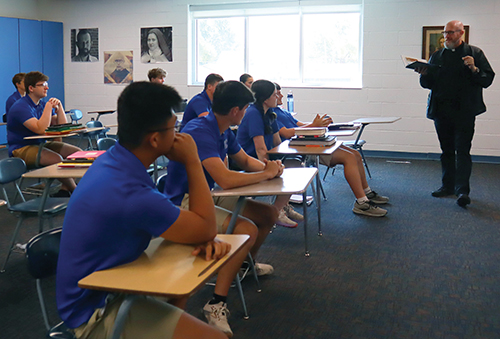
“Bishop Conley was very clear that he wanted us to form disciples of Jesus,” Schinstock said. “Theology isn’t just another subject we introduce people to and then leave it to them to decide if they are interested. It is meant to engender a radical encounter with Jesus Christ that should shake our foundations and make us consider it in every situation.”
The curriculum development was enhanced by Bishop Conley’s pastoral letter “The Joy and Wonder of Catholic Education.”
“Throughout the process, the bishop was consistently listening and guiding our efforts,” Schinstock added.
Bishop Conley said it was important for the diocese to develop a revitalized approach.
“The primary goal of Catholic education is to make saints,” he explained. “This involves the entire institution, including the classroom, the locker room, the stage – the whole enterprise is about knowing God, receiving his love and taking God’s design and plan into every part of our world.”
Conley added, “If we can realize that vision, our students will be more successful in family life and vocations. In their careers they will bear more fruit and be happier. To know God in a real way transforms everything. Real disciples become the missionaries that transform a culture.”
Bishop Conley emphasized the importance of diocesan schools and the legacy of transformative education.
“Our schools have been the driving point of evangelization in our diocese for decades. We have had heroic teachers who have given their very selves for the betterment of our young people. Our teachers are incredibly selfless. I constantly tell my brother bishops about the disciples leading our schools, we are richly blessed.”
The bishop added that supporting those teachers with an intentional and fully Catholic vision is paramount.
“The truth is, there are new realities in our culture and in our schools that call us to a moment of renewal,” he said. “Theology is a beginning point for us and we can use that renewal as a connecting point to everything else in the school. We cannot assign God to a single subject that is not a Catholic worldview. God’s fingerprints are all over creation, and an integrated Catholic education, reveals Him, no matter what subject we are studying,” he stated.
As part of the curriculum development, veteran and current priest theology teachers were brought together to a workshop in the summer of 2024. The focus of the gathering was the approach and design of the curriculum. A small team then began the work of editing the content.
In June, a second workshop was hosted at the Pope St. John XXIII Diocesan Center in Lincoln. The goal of the training was less about the content educators would be teaching and more about the approach. The focus was student engagement. Educators are competing for attention in a new reality where all the facts are available in the palm of one’s hand.
“The task of educating isn’t just a transfer of information from teacher to student,” Bishop Conley said. “Our goal is transformation that begins in wonder. We need to inspire and sustain that wonder. We are walking with students as they unlock an understanding of reality. That reality begins with God, the cause of everything!”
The workshop focused on several methods to enhance memory and inquiry-based learning.
Keeping in mind the mission to form disciples, the new curriculum will begin every semester with a brief unit on prayer. Father Matthew Kovar, a participant in both workshops and a freshman theology teacher at Pius X in Lincoln this year, said it is “vital for students to not simply know about God, but to know Him.”
“I don’t want them to graduate with lots of facts and no idea how to live it,” he explained. “We need to prepare them to live a fully Catholic life when we aren’t with them every day. Prayer is how we respond to God’s action. He is always the source and we respond; we can help each other learn to hear him.”
The beginning prayer section will focus on the practice of lectio divina. Over the course of four years, students will engage this technique and slowly and carefully read the four gospels and large sections of the psalms.
“We want people to hear the voice of God,” Schinstock said. “Praying with the word of God in the scriptures is a real encounter that forces us to wrestle with the reality of God’s plan for me, and his constant presence with me.”
In addition to prayer, there will be a unit on logic. The rest of the freshmen year will be focused on the Old Testament and ancient cultures. Schinstock said the interweaving of prayer, logic and scripture provides a framework for growing in discipleship and the intellectual life that is lifelong.
“In order to be successful in higher ideas, sometimes we need to slow down and strengthen foundations. The ancients began education with teaching about words. Logic, rhetoric and grammar were the foundation of all learning. Each had its own place, but logic is about truth and how it can be known. This unit is going to help the students, not just in theology, but in every avenue of seeking what is true.”
Schinstock then connected the points: “A student who begins with an encounter with the person of truth, then is taken through a method of seeking and knowing truth is in a good place to enter fully into God’s incredible story.”
For the freshmen, that story will take them right up to the historical point of a world that is prepared for the coming of Christ in the Incarnation. A journey that begins with an encounter and then follows a method by way of a scriptural narrative that allows one to watch and see God’s plan unfold. The journey will take them to the stage where God is ready to show his people something new and reveal the depth of his love.
Bishop Conley concluded, “I am so excited for our freshmen to experience real encounters with Adam and Eve, Abraham and Moses, some of the first heroes of God’s story with us.
“I am most excited to see our students realize that they are a part of the story,” he said. “It’s their story and it’s our story. God needs heroes in our time, too. We hope that this new curriculum will inspire new heroes of the faith.”
