

Q. Some clergy wear skullcaps, which I believe are also called “zucchetto.” What do the various colors mean and how do they prevent it from blowing off the head?
A. There are a few things I know a lot about. There are many, many things I know very little about. One of those things is liturgical garb. Sure, I know the names of the common things, like chasubles and alb, but that’s mostly just because I wear them every day. Outside of that, I am not an expert, by any stretch of the imagination. So, when it came to this question, I knew what a zucchetto was (the questioner is correct, that’s the name of the skullcap the pope and bishops wear) but that was about it.
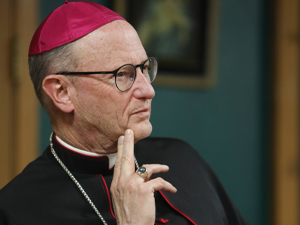
As I learned, “zucchetto” comes from the Italian word for gourd, which according to the Catholic Encyclopedia is apparently a reference to the shape of the cap. The official name for it is pileolus, which means “little cap” in Latin. It seems that the practice of wearing one started sometime around the 1200s and, like many things in the Church, its origin was practical. Because of the practice of being tonsured (think of the haircut Friar Tuck had), the tops of monk’s heads would get cold. So, they started covering the bald part of their heads with a little cap to keep themselves warm.
Over time – as is also the Church’s way – the practice of wearing a zucchetto became more formal until it became part of the liturgical dress of bishops and cardinals. A distinction in color also emerged, with the Bishop of Rome being the only one who can wear a white zucchetto, cardinals being the only ones who can wear red zucchettos, and bishops being the only ones who wear amaranth (which Google informed me is a reddish-pink color that is somehow different from purple) zucchettos.
The zucchetto is customarily worn by the pope, cardinals, and bishops when they are in cassock and may be worn during the liturgy (Ceremonial of Bishops 120). You would not (or should not) see a bishop walking around in a clerical shirt and suit jacket while wearing a zucchetto. During the Mass, the zucchetto is worn under the miter (also sometimes spelled mitre depending on where you are) and remains on the head during the majority of the Mass, even at times when the miter is removed.
The Ceremonial of Bishops specifies that “the bishop removes the zucchetto before the Prayer over the Offerings and does not put it on again until after the distribution of Communion.” While this is clearly done out of reverence for the Blessed Sacrament, it is also a sign of humility.
In the western world, removing a head covering as a sign of respect is rooted in the practice of knights removing helmets in the presence of a superior, as a sign of vulnerability and therefore trust (you were trusting they were not going to hit you in the one part of your body that was exposed to danger) as well as submission (if they did want to hit you, they could, because your life was theirs). It was a way of acknowledging that the one you were removing your helmet for was greater than yourself. When we remove our hats during the National Anthem, it is meant to reflect that the nation is bigger than each of us and to reflect our trust in it. When a bishop removes his zucchetto, it is a sign that he both trusts and humbles himself before Christ who is greater than he is.
As for how do they keep them from blowing off their heads? I can’t say for certain, but I assume the science of aerodynamics is involved.
This question was answered by Father Caleb La Rue, chancellor of the Diocese of Lincoln. Write to Ask the Register using our online form, or write to 3700 Sheridan Blvd., Suite 10, Lincoln NE 68506-6100. All questions are subject to editing. Editors decide which questions to publish. Personal questions cannot be answered. People with such questions are urged to take them to their nearest Catholic priest.
