

Q. Which translations of the Bible are approved for Catholics? Which are best and how different are they?
A. Reading and understanding the Bible are essential to the life of the Church. The Catechism of the Catholic Church teaches that in Sacred Scripture, “the Church constantly finds her nourishment and her strength, for she welcomes it not as a human word, ‘but as what it really is, the word of God.’ ‘In the sacred books, the Father who is in heaven comes lovingly to meet his children, and talks with them’” (§104; cf. Dei Verbum §24, 21). Therefore, something seemingly as simple as pursuing a right translation of the Bible is a fundamental step in each Christian’s journey of knowing and being known by the living God.
Before exploring some approved translations, it would be well to consider the history and the gravity with which the Church approaches the task of translating and transmitting the Scriptures.
The Christian Bible is comprised in two major divisions, the Old Testament and the New Testament, in which are found a total of 73 books: 46 in the Old Testament and 27 in the New Testament. The Old Testament was predominantly composed in Hebrew, with some small portions written in Greek and Aramaic. The New Testament was composed entirely in Greek. While these languages still exist in some capacity today, the biblical languages of Hebrew, Aramaic, and Greek are not equivalent to their modern counterparts.
About 200-300 years before the birth of Christ, the Hebrew Scriptures (what we would now call the Old Testament) were compiled and translated into Greek, the dominant language of that time. This work of the Greek Old Testament is known as the Septuagint.
Almost 400 years after the birth of Christ, St. Jerome compiled the Hebrew and Greek Scriptures and translated all of them into one Latin Bible, known as the Vulgate (Latin being the ‘vulgar’ or common language of his day). From Jerome to the Council of Trent (16th century) and beyond, the Vulgate had a dominant influence in the Latin Rite of the Catholic Church.
Since the Council of Trent, and especially since the pontificates of Pope Leo XIII (1878–1903) and Pope Pius XII (1939-1958), the Church has encouraged the study and dissemination of the sacred writings in local vernaculars.
Translating any text, let alone the Word of God, is no small feat. It is difficult not only to detect the original meaning of a word but to translate that meaning into an entirely new language. This has resulted in two major methods used to translate the Scriptures: that of a formal or a dynamic equivalence. Briefly, a formal translation prioritizes the wording of the original text, whereas a dynamic translation prioritizes the meaning of the original text.
A brief example can illustrate the point: 2,000 years from now, humans of a new language recover an English manuscript from the year 2025. In it, they find the phrase, “once in a blue moon” describing a particular event. A translation of formal equivalence would render the phrase in similar words, depicting an event taking place under a moon of blue. A dynamic translation would depart from the exact words but keep the meaning of the phrase, rendering it as something like, “happening only very rarely.”
Instead of thinking of texts as either formal or dynamic only, it is best to understand these as two ends of a spectrum along which translations can fall. This accounts for why there can be multiple translations of the Bible in one language, each with equal approval.
Approved Catholic translations of the Bible
Finally, what follows is a list of Bibles that (1) have magisterial approval, (2) avoid extremes on the formal/dynamic spectrum, and (3) will be a sure companion to your reading, study, and prayer.
> RSV2CE (Revised Standard Version, Second Catholic Edition); popularized by the Ignatius Catholic Study Bible
> NRSVCE (New Revised Standard Version Catholic Edition)—Lectionary in Canada; popularized by Bishop Barron’s Word on Fire Bible
> ESV-CE (English Standard Version Catholic Edition)—Lectionary in India, England, and Wales; popularized by the Augustine Bible
> NAB/NABRE (New American Bible/New American Bible Revised Edition)—Lectionary in the USA; copyright owned by the USCCB
> RNJB (Revised New Jerusalem Bible)—Lectionary in Scotland, Australia, and New Zealand
> CSV (Catholic Standard Version)— project underway by the Augustine Institute
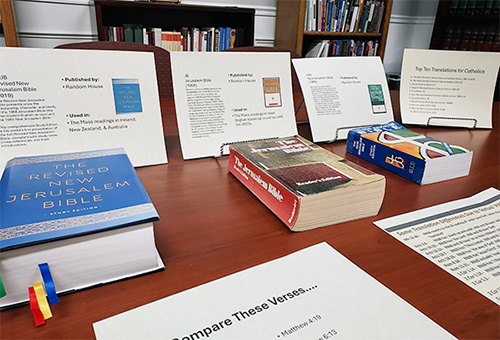
This is not a comprehensive list of approved Catholic Bibles. As a general guideline, keep an eye out for magisterial approval, signified by an Imprimatur by a Catholic bishop (usually found on the inside cover). You will also want to ensure that your Bible has all 73 books, usually denoted by the inclusion of “CE” or “Catholic Edition” in the translation title, though this is not always the case. No translation is perfect, therefore I do not recommend any one of these as better than the rest. Most of these will be found easily online, as well as at your local Catholic bookstore.
This question was answered by Joshua Burks, executive director of The Emmaus Institute for Biblical Studies in Lincoln.
Write to Ask the Register using our online form, or write to 3700 Sheridan Blvd., Suite 10, Lincoln NE 68506-6100. All questions are subject to editing. Editors decide which questions to publish. Personal questions cannot be answered. People with such questions are urged to take them to their nearest Catholic priest.
