

By Bishop James Conley
“And God is able to provide you with every blessing in abundance, so that you may always have enough of everything and may provide in abundance for every good work.... He who supplies seed to the sower and bread for food will supply and multiply your resources and increase the harvest of your righteousness. You will be enriched in every way for great generosity, which through us will produce thanksgiving to God.” - 2 Corinthians 9:8, 10-11
 November is a month for gratitude, the time of harvest and remembrance of the dead. In the United States, Thanksgiving Day calls us to pause, gather as families, and thank God for his many blessings. Earlier in the month, Martinmas Day, in honor of St. Martin of Tours, serves as a Catholic celebration of the fall harvest and its new wine. Giving thanks is at the heart of our faith through the Eucharist, our perfect sacrifice of Jesus’s Body and Blood to the Father. Bread and wine, the fruit of the earth, are drawn into the infinite gift of Christ’s own sacrificial love that gives life to the world.
This is how we should understand the harvest—not simply a matter of grain but of love. Ultimately, we are God’s harvest, for he has cultivated us. “You are God’s field,” Paul teaches, because God wants us to bear abundant fruit in love (1 Corinthians 3:9). God is a communion of persons, and he made us for everlasting union with him. He created human love to participate in his own, to be drawn into the great expanse of his divine charity. To prepare for this, he calls us to love and serve others, building up the communion of charity in our families and the Church throughout the world.
The home is the place where most of us will grow in love through the graces of matrimony and family life. Pope Pius XI, in his great encyclical Casti Connubii, pointed out that “through their devout love and unwearying care,” fathers and mothers can make “the home, though it suffer the want and hardship of this valley of tears,” a place where children may experience a “foretaste of that paradise of delight in which the Creator placed the first men of the human race.” As a place of preparation, the life of the home often entails the difficult work of coming to reconciliation and healing that takes place over a lifetime. Our selections this month draw out the power of charity in crowning human love, drawing us through trials to the enduring peace that comes only from God.
Movie
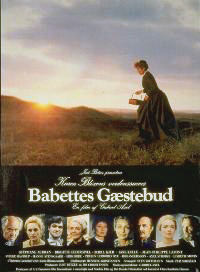 When we gather to celebrate as families, why do we focus so much on food and drink? In the Catholic tradition, things have a deeper meaning than we see on the surface. If we are made for communion, as bodily beings, we need signs to express our love and draw us out of ourselves. Feasting can become a communal means of celebrating the most important things and giving glory to God through culture. The great philosopher of leisure, Josef Pieper, reflects on the nature of festivity in his work, “In Tune with the World,” saying: “A festival is essentially a phenomenon of wealth; not, to be sure, the wealth of money, but of existential richness. Absence of calculation, in fact lavishness, is one of its elements.” The extravagance is essential to festivity because it shows the importance of what we celebrate: the beginning and end of life, marriage and family, and the mystery of salvation on the holiest days.
Our secular culture has practically banished this kind of festivity, seeking to keep faith within the bounds of the church and using extravagance only for the purpose of worldly pleasure. This then leads many believers to look at cultural means of celebration with suspicion, banishing them in puritanical fashion. The Danish writer, Karen Blixen (who used the pen name Isak Dinesen), explored this tension in a short story, “Babette’s Feast,” which Gabriel Axel adapted as a film with an international cast in 1987.
The story traces a small community led by a strict Lutheran pastor and his two daughters, Martine and Filippa. The girls both turn down prospective suitors to remain with their father—Martine, a soldier, and Filippa, a Parisian opera singer.
The story picks up decades later, after their father has died, and the community has become bitter and fractious. A French refugee, Babette, arrives at the sisters’ door, who, unbeknownst to her hosts, as she takes up menial work, was a chef at one of Paris’s finest restaurants. The hundredth birthday of their departed pastor presents the occasion for her hidden talents to emerge in a way that reconciles the small group of remaining followers.
Babette’s feast became a profound moment of grace that broke through the petty disputes of the stern community. Even though they resolved to put aside their sense of taste and refrain from commenting on the meal, the soldier returns, now a general, to guide them through the culinary delights prepared by Babette. The sisters’ mercy in taking in a refugee from revolution in France is now repaid in an unexpected way as she offers what they had been lacking: a fullness of life and culture that completes their faith by calling forth communion and love.
The general stands up to make a toast, echoing the words of their pastor and the outpouring of grace they are experiencing: “The moment comes when our eyes are opened, and we see and realize that grace is infinite. We need only await it with confidence and acknowledge it in gratitude. Grace makes no conditions. And see! That which we have chosen is given us… and that which we have refused... is also granted us. Yes, that which we rejected is granted us. Mercy and truth have met together. Righteousness and bliss shall kiss one another.”
God is the only one who can make up for all that we have lost by sin, the brokenness of our relationships, all that we could not accomplish in this life. All that we seek is in him, and he can offer it all to us in his gratuitous love that comes to us in his mercy. The feast embodies this extravagant love that expresses the fullness of life that God intends to cultivate within us.
Music
The joy of the feast anticipates the fullness of heaven. Just as Babette gives up her cooking, so Filippa turned down singing in Paris to delight the masses with her beautiful voice. After the dinner, Filippa shares the words given by Achille Papin, her singing instructor and lost love: “But this is not the end, Babette. In paradise you will be the great artist God meant you to be. Oh, how you will enchant the angels!” Filippa had turned away Papin after singing a duet with him, taken from Mozart’s opera “Don Giovanni,” “Là ci darem la mano,” which became its own enticement to leave her rural village: “Come, dearest, let me guide thee.... Let’s go! Let’s go!”
Remaining with the opera draws us into one of the most poignant corruptions of love as the profligate Don Giovanni tempts the young bride, Zerlina. This comes on the heels of killing a commendatore in an attempt to seduce his daughter. At the opera’s climax, the ghost of the commander, appearing by animating a statue erected in his honor, comes to bring Don Giovanni to repentance for his countless misdeeds. Rather than inflicting revenge, the commander invites Don Giovanni to join him in eating celestial food, entering the wedding feast of the lamb, but the Don flatly refuses: “No, no!” words that open hell to receive him.
This corruption of human love into unbridled lust finds a fitting rejoinder in another Mozart opera, “The Marriage of Figaro.” Within it, another aristocrat, the Count Almaviva, attempts to thwart the union of a betrothed couple, his servant Figaro and his wife’s attendant, Susanna. In one crazy day, numerous intrigues swirl throughout the palace seeking to deceive and enact revenge. For instance, Don Bartolo contends, “Forgetting offenses and insults is unworthy and cowardly.” Figaro had broken up his intended marriage with the now Countess, Rosina (see Rossini’s great “Barber of Seville” for more on that story). When the Countess and Susanna trade clothing to catch the Count red-handed in his efforts of seduction, the Count instead thinks he has caught Figaro making overtures to his own wife. Figaro implores mercy, but, like Don Giovanni, the count shouts “no,” he will not forgive. But, once he realizes he has approached the Countess in disguise, thinking her to be Susanna, he is the one to ask for forgiveness: “Perdono!”
The Countess’s forgiveness resolves the entire conflict, bringing peace to the palace, for “only love can impart a joyful ending.” Amadeus, the engaging, if not entirely accurate, film on Mozart’s years in Vienna, puts it best in the words of a rival composer, Salieri: “I heard the music of true forgiveness filling the theater, conferring on all who sat there, perfect absolution. God was singing through this little man to all the world.” Only Mozart could impart such spiritual depth to a comic opera, infusing it with profound expressions of betrayal, hope, yearning, joy, and mercy.
Book
For love to bear fruit, it must overcome obstacles, guided by the hand of the great gardener, who directs all things through his divine providence. Alessandro Manzoni’s “The Betrothed,” one of the great Catholic novels, sets the harvest of love amid a backdrop of famine and pestilence in 17th-century Italy, beginning along the banks of Lake Como. A baron, Don Rodrigo, makes an evil wager that by the Martinmas feast, he can stop a wedding and carry off the bride. Following his assault, the betrothed couple, Lucy and Renzo, remain separated, weathering betrayal, abduction, riots, and the plague. They reach an impasse they cannot resolve—Lucy’s desperate vow to remain celibate and Renzo’s flight as an outlaw—and must rely on God to intervene.
Renzo, searching desperately for Lucy, finally discovers her in a sick house, the Lazaretto of Milan, under the care of the Capuchin friars. Hellbent on revenge, Fr. Christopher must first lead him to forgive, which he accepts with great difficulty, only to find his enemy, Don Rodrigo, dying before him. The young couple prays for their assailant in a fitting gesture to begin their union.
Another friar, Fr. Felix, speaks to the survivors of the Lazaretto, guiding them to bless God’s providential mercy:
“May the Lord be praised! praised in his justice! praised in his mercy! praised in death! praised in life! praised in the choice he has made of us! Oh! why has he done it, my children, if not to preserve a people corrected by affliction, and animated by gratitude? That we may be deeply sensible that life is his gift, that we may value it accordingly, and employ it in works which he will approve? That the remembrance of our sufferings may render us compassionate, and actively benevolent to others.”
This exhortation summarizes Manzoni’s beautiful story, coming to a harvest not simply of material abundance but of loving mercy. His characters must learn, and we through them, to trust in God’s providence through every difficulty, offering forgiveness, embracing repentance, and exercising charity toward others, remembering that life is a gift, which takes unexpected turns, but which carries us all to the same destination.
Manzoni’s “Betrothed” is to Italy what Victor Hugo’s Les Miserable is to France. It is an epic historical novel which captures a moment in the history of a country, forever enshrining it in the collective imagination of a people. The novel makes virtue and vice, and all the human and divine interactions of life in this world, come alive in story, as only great literature can evoke. It speaks more to the heart than to the mind. I first read “Betrothed” in my first years of living in Italy. My Italian teacher told me that every student who graduates from high school in Italy to this day is examined on this novel, and must have proficiency in order to go on to higher education. The “Betrothed” is part of the Italian identity. Everyone you meet in Italy will have read the “Betrothed.”
Poem
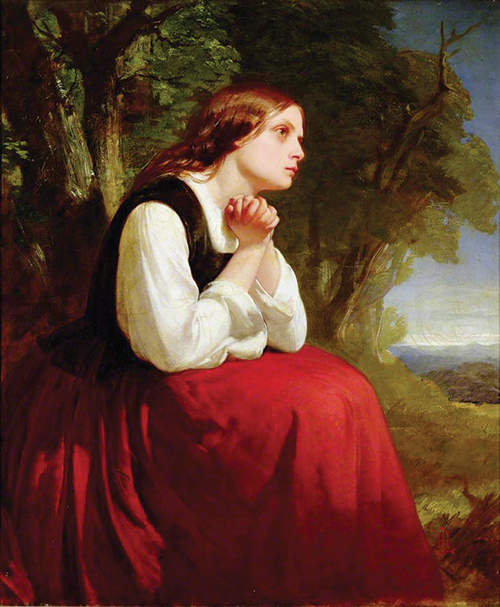
The stories we tell as families when we gather to celebrate preserve vital memories across generations. Nations, too, need to pass on the great stories that express their heritage and shape aspirations. In what may be America’s greatest epic poem, “Evangeline” by Henry Wadsworth Longfellow, we find another iteration of our theme on the strenuous harvest of love. Having been cast out of their homes by the British, the French Acadians scattered south from Canada and roamed across the continent, many finding refuge in the bayou of Louisiana. One young woman, Evangline, whose name comes from “gospel,” could find no new home without her lost beloved, Gabriel, always just before him in her endless search.
Long among them was seen a maiden who waited and wandered,
Lowly and meek in spirit, and patiently suffering all things.
Fair was she and young; but, alas! before her extended,
Dreary and vast and silent, the desert of life, with its pathway
Marked by the graves of those who had sorrowed and suffered before her,
Passions long extinguished, and hopes long dead and abandoned,
As the emigrant’s way o’er the Western desert is marked by
Camp-fires long consumed, and bones that bleach in the sunshine.
Something there was in her life incomplete, imperfect, unfinished;
As if a morning of June, with all its music and sunshine,
Suddenly paused in the sky, and, fading, slowly descended
Into the east again, from whence it late had arisen.
From Acadia, she follows him to the bayou, west to the prairies, up to the northern woods of the trappers, until she finally rests in the city of Philadelphia, becoming a Sister of Mercy. There, in her work tending the sick, she finally finds him, dying of the plague. Evangeline’s journey embodies the restless spirit of America, land of pilgrims, exiles, adventurers, and missionaries, that can reach completion only in a love that transcends death.
Art
Salvation history is a great love story that traces how all of us have been separated from our maker, the one who has espoused himself to us, and who comes to find us. He calls us to intimacy with him through a festive meal, our celebration of the Eucharistic sacrifice in which he offers himself for us. He also desires to come into our homes, to live in communion with us, like his friends, the siblings Lazareth, Mary, and Martha. Luke contrasts how the sisters received him when he came to visit—Martha was busy and anxious about many things, while Mary sat at the feet of Jesus, choosing the better part (Luke 10:38-42). Jesus says to the sisters that only one thing is necessary, and our festivity is meant to point us in this direction. Its purpose is not to direct our focus on the good things of this world; it uses them to point us toward that one thing.
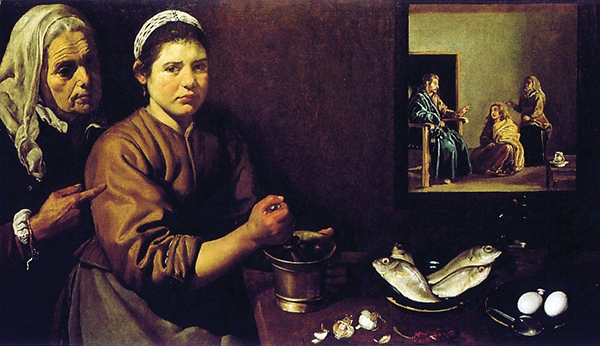
Diego Velázquez’s great painting of the Spanish Golden Age, “Christ in the House of Mary and Martha,” situates our work and relationships in relation to that one thing. He presents a genre painting of two women in the kitchen, one old and one young, that includes a painting within the painting, a kind of window or mirror into the biblical scene. The young woman is upset, and her hands are red from her work, which currently involves grinding garlic. Before her sits fish, an image of Christ, and eggs, symbols of the resurrection. The older woman leans in, pointing her toward the window, calling her to reflect on the biblical scene. Does the older woman represent the wisdom of looking beyond mundane cares and frivolities? Does the younger woman express anxiety at the demands of the work or frustration at being stuck in it? The encounter with Jesus that frames the image becomes a portal from the present into what is timeless, calling us to reexamine mundane things in light of the eternal, using them for the praise and honor of God.
Conclusion
As we feast and give thanks to God, we must remember that our eating, drinking, and celebrating should extend our prayer, becoming a means of praise. Our selections this month focus on how trials can be overcome through patient endurance, often helped by simple things like meals and personal encounters. As we celebrate the harvest in the autumn, it’s a time to remember and give thanks for the harvest of love we experience in our family and relationships. God is the one who provides us with every blessing in abundance, so that we can be generous with others, expressing the great harvest of life he desires to reap within us.
Bishop Conley’s Humanities Syllabus
November: “The Harvest of Live”
Book:
“The Betrothed” by Alessandro Manzoni
Movie:
“Babette’s Feast” (1987), Gabriel Axel
Music:
“The Marriage of Figaro” by Wolfgang Amadeus Mozart
Poem:
“Evangeline” by Henry Wadsworth Longfellow
Art:
“Christ in the House of Mary and Martha” by Diego Velázquez
ADDITIONAL SUGGESTIONS
Book:
“Jayber Crow” and “Hannah Coulter” by Wendell Berry
Movie:
“Return to Me” (2000), Bonnie Hunt
Music:
“Don Giovanni” by Mozart
“The Barber of Seville” by Gioachino Rossini
Poems:
“Song: to Celia” (“Drink to me only with thine eyes”) by Ben Jonson
“At Home” by Christina Rossetti
“The Lake Isle of Innisfree” by William Butler Yates
Art:
“The Wine of St. Martin’s Day” by Pieter Brueghel the Younger
A CHILDREN'S SYLLABUS
Book:
“Little House in the Big Woods” by Laura Ingalls Wilder
Movies:
“The Swiss Family Robinson” (1960), Ken Annakin
“Toby Tyler” (1960), Charles Barton
Music:
“Hansel and Gretel” by Engelbert Humperdinck (use English subtitles)
Poem:
“Thanksgiving Time” by Langston Hughes
Art:
“The Marriage at Cana” by Gerard David
“Procession in St. Mark’s Square” by Gentile Bellini
